



 Chat with AI
Exam 17: Water Flowing Underground

Exam 1: Why Study Earth84 Questions
Exam 2: Minerals: Building Blocks of the Planet88 Questions
Exam 3: Rocks and Rock-Forming Processes90 Questions
Exam 4: Formation of Magma and Igneous Rocks88 Questions
Exam 5: Formation of Sediment and Sedimentary Rocks83 Questions
Exam 6: Formation of Metamorphic Rocks84 Questions
Exam 7: Earth Materials As Time Keepers91 Questions
Exam 8: Earth Materials As Time Keepers85 Questions
Exam 9: Making Earth74 Questions
Exam 10: Motion Inside Earth62 Questions
Exam 11: Deformation of Rocks88 Questions
Exam 12: Global Tectonics: Plates and Plumes80 Questions
Exam 13: Tectonics and Surface Relief85 Questions
Exam 14: Soil Formation and Landscape Stability79 Questions
Exam 15: Mass Movements: Landscapes in Motion85 Questions
Exam 16: Streams: Flowing Water Shapes the Landscape85 Questions
Exam 17: Water Flowing Underground85 Questions
Exam 18: Glaciers: Cold-Climate Sculptors of Continents83 Questions
Exam 19: Shorelines: Changing Landscapes Where Land Meets Sea84 Questions
Exam 20: Wind: a Global Geologic Process85 Questions
Exam 21: Global Warming: Real Time Change in the Earth System79 Questions
Select questions type


Judge the following sentence according to the criteria given below. There is a downward limit to which water can descend because porosity and permeability decrease downward in Earth.
(Multiple Choice)
4.8/5  (70)
(70) Which of the following states has the most limestone and gypsum karst topography?
(Multiple Choice)
4.8/5 (62)
(62) Choose the option that puts the rock and sediment types in order from most porous to least porous.
(Multiple Choice)
4.9/5 (69)
(69) Which type of ground water would have the least amount of dissolved minerals?
(Multiple Choice)
4.7/5 (75)
(75) Figure 17.9 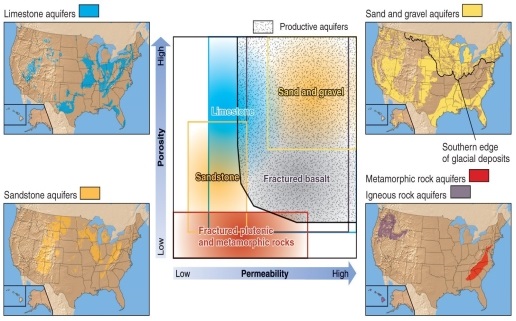 -According to Figure 17.9, which of the following materials would you expect to be the best confining bed?
 (Multiple Choice)
4.9/5 (82)
(82) "Carbon dioxide plays a vital role in dissolving and precipitation of rocks in the formation of karst topography." Evaluate this statement.
(Multiple Choice)
4.8/5 (96)
(96) Figure 17.29 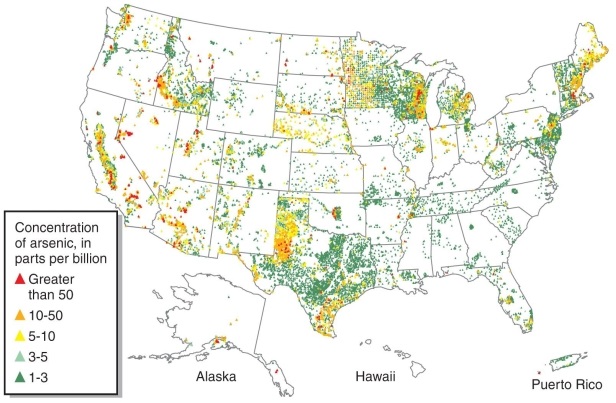 -Which of the following states has the most ground water that contains toxic concentrations of arsenic?
 (Multiple Choice)
4.8/5 (86)
(86) Which is the primary factor that causes ground water to flow more slowly than surface water?
(Multiple Choice)
5.0/5 (55)
(55) Judge the following sentence according to the criteria given below. Ground water acquires the temperature of the warmest rock that it passes through and then cools only slightly as it travels toward discharge at the surface because heat conducts from rock into water more readily than heat conducts from water into rock.
(Multiple Choice)
4.8/5 (69)
(69) Figure 17.9
-According to Figure 17.9, which of the following aquifers would you not expect to find in the state of Nevada?
-According to Figure 17.9, which of the following aquifers would you not expect to find in the state of Nevada? (Multiple Choice)
4.9/5 (74)
(74) The direction of ground-water flow between any two locations in an aquifer is determined by comparing the total ________ of the water at each location.
(Multiple Choice)
4.8/5 (79)
(79) Which option is not a piece of knowledge scientists have gained by inference from the Cape Cod experiment?
(Multiple Choice)
4.8/5 (79)
(79) Which assumption did the Cape Cod water flow velocity experiment rely upon?
(Multiple Choice)
4.8/5 (78)
(78) Figure 17.9
-According to Figure 17.9, which of the following materials would you expect to have the most sufficient porosity and permeability and be able to provide water in useful quantities?
-According to Figure 17.9, which of the following materials would you expect to have the most sufficient porosity and permeability and be able to provide water in useful quantities? (Multiple Choice)
4.9/5 (77)
(77) 
Filters
- Essay(0)
- Multiple Choice(0)
- Short Answer(0)
- True False(0)
- Matching(0)