



 Chat with AI
Exam 13: Gravitation

Exam 1: Measurement31 Questions
Exam 2: Motion Along a Straight Line79 Questions
Exam 3: Vector39 Questions
Exam 4: Motion in Two and Three Dimensions47 Questions
Exam 5: Force and Motion I68 Questions
Exam 6: Force and Motion II71 Questions
Exam 7: Kinetic Energy and Work67 Questions
Exam 8: Potential Energy and Conservation of Energy61 Questions
Exam 9: Center of Mass and Linear Momentum81 Questions
Exam 10: Rotation82 Questions
Exam 11: Rolling, Torque, and Angular Momentum54 Questions
Exam 12: Equilibrium and Elasticity53 Questions
Exam 13: Gravitation55 Questions
Exam 14: Fluids85 Questions
Exam 15: Oscillations62 Questions
Exam 16: Waves I71 Questions
Exam 17: Waves II61 Questions
Exam 18: Temperature, Heat, and the First Law of Thermodynamics82 Questions
Exam 19: The Kinetic Theory of Gases95 Questions
Exam 20: Entropy and the Second Law of Thermodynamics56 Questions
Exam 21: Electric Charge45 Questions
Exam 22: Electric Fields49 Questions
Exam 23: Gauss Law34 Questions
Exam 24: Electric Potential44 Questions
Exam 25: Capacitance55 Questions
Exam 26: Current and Resistance49 Questions
Exam 27: Circuits70 Questions
Exam 28: Magnetic Fields48 Questions
Exam 29: Magnetic Fields Due to Currents47 Questions
Exam 30: Induction and Inductance85 Questions
Exam 31: Electromagnetic Oscillations and Alternating Current84 Questions
Exam 32: Maxwells Equations; Magnetism of Matter81 Questions
Exam 33: Electromagnetic Waves79 Questions
Exam 34: Images72 Questions
Exam 35: Interference40 Questions
Exam 36: Diffraction74 Questions
Exam 37: Relativity65 Questions
Exam 38: Photons and Matter Waves53 Questions
Exam 39: More About Matter Waves41 Questions
Exam 40: All About Atoms76 Questions
Exam 41: Conduction of Electricity in Solids48 Questions
Exam 42: Nuclear Physics67 Questions
Exam 43: Energy From the Nucleus44 Questions
Exam 44: Quarks, Leptons, and the Big Bang52 Questions
Select questions type


Two planets are orbiting a star in a distant galaxy. The first has a semimajor axis of 150 *106 km, an eccentricity of 0.20, and a period of 1.0 Earth years. The second has a semimajor axis of 250 *106 km, an eccentricity of 0.30, and a period of:
(Multiple Choice)
4.9/5  (76)
(76) A spherical shell has inner radius R1, outer radius R2, and mass M, distributed uniformly throughout the shell. The magnitude of the gravitational force exerted on the shell by a point mass m a distance d from the center, inside the inner radius, is:
(Multiple Choice)
4.9/5 (70)
(70) An object is raised from the surface of Earth to a height of two Earth radii above Earth. Then:
(Multiple Choice)
4.9/5 (77)
(77) An object is dropped from an altitude of one Earth radius above Earth's surface. If M is the mass of Earth and R is its radius the speed of the object just before it hits Earth is given by:
(Multiple Choice)
4.9/5 (77)
(77) A spherical shell has inner radius R1, outer radius R2, and mass M, distributed uniformly throughout the shell. The magnitude of the gravitational force exerted on the shell by a point mass particle of m a distance d from the center, outside the inner radius, is:
(Multiple Choice)
4.8/5 (81)
(81) An astronaut on the Moon simultaneously drops a feather and a hammer. The fact that they land together shows that:
(Multiple Choice)
4.8/5 (82)
(82) The elliptical orbit of a planet around the Sun is shown on the diagram. Which of the following statements is true? 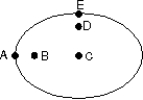
(Multiple Choice)
4.8/5 (73)
(73) Three particles, two with mass m and one mass M, might be arranged in any of the four configurations known below. Rank the configurations according to the magnitude of the gravitational force on M, least to greatest. 
(Multiple Choice)
4.8/5 (90)
(90) A rocket ship is coasting toward a planet. Its captain wishes to know the value of g at the surface of the planet. This may be inferred by:
(Multiple Choice)
4.8/5 (81)
(81) A planet in another solar system orbits a star with a mass of 4.0 *1030 kg. At one point in its orbit it is 250 * 106 km from the star and is moving at 35 km/s. Take the universal gravitational constant to be 6.67*10-11 m2/s2 . kg and calculate the semimajor axis of the planet's orbit. The result is:
(Multiple Choice)
4.8/5 (78)
(78) A particle might be placed  Rank these situations according to the magnitude of the gravitational force on the particle, least to greatest.
 (Multiple Choice)
4.8/5 (91)
(91) The approximate value of g at an altitude above Earth equal to one Earth diameter is:
(Multiple Choice)
4.9/5 (76)
(76) The escape velocity at the surface of Earth is approximately 8 km/s. What is the mass, in units of Earth's mass, of a planet with twice the radius of Earth for which the escape speed is twice that for Earth?
(Multiple Choice)
4.9/5 (78)
(78) A spaceship is returning to Earth with its engine turned off. Consider only the gravitational field of Earth and let M be the mass of Earth, m be the mass of the spaceship, and R be the distance from the center of Earth. In moving from position 1 to position 2 the kinetic energy of the spaceship increases by:
(Multiple Choice)
4.7/5 (74)
(74) 
Filters
- Essay(0)
- Multiple Choice(0)
- Short Answer(0)
- True False(0)
- Matching(0)