



 Chat with AI
Exam 13: Gravitation

Exam 1: Measurement31 Questions
Exam 2: Motion Along a Straight Line79 Questions
Exam 3: Vector39 Questions
Exam 4: Motion in Two and Three Dimensions47 Questions
Exam 5: Force and Motion I68 Questions
Exam 6: Force and Motion II71 Questions
Exam 7: Kinetic Energy and Work67 Questions
Exam 8: Potential Energy and Conservation of Energy61 Questions
Exam 9: Center of Mass and Linear Momentum81 Questions
Exam 10: Rotation82 Questions
Exam 11: Rolling, Torque, and Angular Momentum54 Questions
Exam 12: Equilibrium and Elasticity53 Questions
Exam 13: Gravitation55 Questions
Exam 14: Fluids85 Questions
Exam 15: Oscillations62 Questions
Exam 16: Waves I71 Questions
Exam 17: Waves II61 Questions
Exam 18: Temperature, Heat, and the First Law of Thermodynamics82 Questions
Exam 19: The Kinetic Theory of Gases95 Questions
Exam 20: Entropy and the Second Law of Thermodynamics56 Questions
Exam 21: Electric Charge45 Questions
Exam 22: Electric Fields49 Questions
Exam 23: Gauss Law34 Questions
Exam 24: Electric Potential44 Questions
Exam 25: Capacitance55 Questions
Exam 26: Current and Resistance49 Questions
Exam 27: Circuits70 Questions
Exam 28: Magnetic Fields48 Questions
Exam 29: Magnetic Fields Due to Currents47 Questions
Exam 30: Induction and Inductance85 Questions
Exam 31: Electromagnetic Oscillations and Alternating Current84 Questions
Exam 32: Maxwells Equations; Magnetism of Matter81 Questions
Exam 33: Electromagnetic Waves79 Questions
Exam 34: Images72 Questions
Exam 35: Interference40 Questions
Exam 36: Diffraction74 Questions
Exam 37: Relativity65 Questions
Exam 38: Photons and Matter Waves53 Questions
Exam 39: More About Matter Waves41 Questions
Exam 40: All About Atoms76 Questions
Exam 41: Conduction of Electricity in Solids48 Questions
Exam 42: Nuclear Physics67 Questions
Exam 43: Energy From the Nucleus44 Questions
Exam 44: Quarks, Leptons, and the Big Bang52 Questions
Select questions type


Planet 1 and planet 2 are both in circular orbits around the same central star. The orbit of planet 2 has a radius that is much larger than the radius of the orbit of planet 1. This means that:
(Multiple Choice)
4.9/5  (76)
(76) To measure the mass of a planet with the same radius as Earth, an astronaut drops an object from rest (relative to the planet) from an altitude of one radius above the surface. When the object hits its speed is 4 times what it would be if the same experiment were carried out for Earth. In units of Earth masses, the mass of the planet is:
(Multiple Choice)
4.8/5 (85)
(85) An artificial satellite of the Earth releases a bomb. Neglecting air resistance, the bomb will:
(Multiple Choice)
4.8/5 (85)
(85) A planet travels in an elliptical orbit about a star as shown. At what pair of points is the speed of the planet the same? 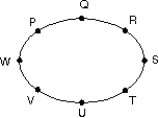
(Multiple Choice)
4.8/5 (79)
(79) The mass of a hypothetical planet is 1/100 that of Earth and its radius is 1/4 that of Earth. If a person weighs 600 N on Earth, what would he weigh on this planet?
(Multiple Choice)
4.8/5 (71)
(71) A small satellite is in elliptical orbit around Earth as shown. If L denotes the magnitude of its angular momentum and K denotes kinetic energy: 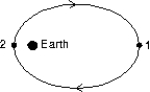
(Multiple Choice)
4.9/5 (78)
(78) An astronaut finishes some work on the outside of his satellite, which is in circular orbit around the Earth. He leaves his wrench outside the satellite. The wrench will:
(Multiple Choice)
4.8/5 (73)
(73) Given the perihelion distance, aphelion distance, and speed at perihelion of a planet, which of the following CANNOT be calculated?
(Multiple Choice)
4.7/5 (69)
(69) Assume that Earth is in circular orbit around the Sun with kinetic energy K and potential energy U, taken to be zero for infinite separation. Then, the relationship between K and U:
(Multiple Choice)
4.8/5 (77)
(77) A projectile is fired straight upward from Earth's surface with a speed that is half the escape speed. If R is the radius of Earth, the highest altitude reached, measured from the surface, is:
(Multiple Choice)
4.7/5 (86)
(86) A planet is in circular orbit around the Sun. Its distance from the Sun is four times the average distance of Earth from the Sun. The period of this planet, in Earth years, is:
(Multiple Choice)
4.9/5 (90)
(90) An artificial Earth satellite is moved from a circular orbit with radius R to a circular orbit with radius 2R. During this move:
(Multiple Choice)
4.8/5 (82)
(82) Earth exerts a gravitational force on the Moon, keeping it in its orbit. The reaction to this force, in the sense of Newton's third law, is:
(Multiple Choice)
5.0/5 (80)
(80) A spring scale, calibrated in newtons, is used to weigh sugar. If it were possible to weigh sugar at the following locations, where will the buyer get the most sugar to a newton?
(Multiple Choice)
4.8/5 (81)
(81) The magnitude of the acceleration of a planet in orbit around the Sun is proportional to:
(Multiple Choice)
4.7/5 (88)
(88) Venus has a mass of about 0.0558 times the mass of Earth and a diameter of about 0.381 times the diameter of Earth. The acceleration of a body falling near the surface of Venus is about:
(Multiple Choice)
4.9/5 (82)
(82) Suppose you have a pendulum clock which keeps correct time on Earth (acceleration due to gravity = 9.8 m/s2). Without changing the clock, you take it to the Moon (acceleration due to gravity = 1.6 m/s2). For every hour interval (on Earth) the Moon clock will record:
(Multiple Choice)
4.8/5 (94)
(94) The orbit of a certain a satellite has a semimajor axis of 1.5 * 107 m and an eccentricity of 0.20. Its perigee (minimum distance) and apogee (maximum distance) are respectively:
(Multiple Choice)
4.9/5 (72)
(72) In planetary motion the line from the star to the planet sweeps out equal areas in equal times. This is a direct consequence of:
(Multiple Choice)
4.8/5 (72)
(72) 
Filters
- Essay(0)
- Multiple Choice(0)
- Short Answer(0)
- True False(0)
- Matching(0)