



 Chat with AI
Exam 6: Force and Motion II

Exam 1: Measurement31 Questions
Exam 2: Motion Along a Straight Line79 Questions
Exam 3: Vector39 Questions
Exam 4: Motion in Two and Three Dimensions47 Questions
Exam 5: Force and Motion I68 Questions
Exam 6: Force and Motion II71 Questions
Exam 7: Kinetic Energy and Work67 Questions
Exam 8: Potential Energy and Conservation of Energy61 Questions
Exam 9: Center of Mass and Linear Momentum81 Questions
Exam 10: Rotation82 Questions
Exam 11: Rolling, Torque, and Angular Momentum54 Questions
Exam 12: Equilibrium and Elasticity53 Questions
Exam 13: Gravitation55 Questions
Exam 14: Fluids85 Questions
Exam 15: Oscillations62 Questions
Exam 16: Waves I71 Questions
Exam 17: Waves II61 Questions
Exam 18: Temperature, Heat, and the First Law of Thermodynamics82 Questions
Exam 19: The Kinetic Theory of Gases95 Questions
Exam 20: Entropy and the Second Law of Thermodynamics56 Questions
Exam 21: Electric Charge45 Questions
Exam 22: Electric Fields49 Questions
Exam 23: Gauss Law34 Questions
Exam 24: Electric Potential44 Questions
Exam 25: Capacitance55 Questions
Exam 26: Current and Resistance49 Questions
Exam 27: Circuits70 Questions
Exam 28: Magnetic Fields48 Questions
Exam 29: Magnetic Fields Due to Currents47 Questions
Exam 30: Induction and Inductance85 Questions
Exam 31: Electromagnetic Oscillations and Alternating Current84 Questions
Exam 32: Maxwells Equations; Magnetism of Matter81 Questions
Exam 33: Electromagnetic Waves79 Questions
Exam 34: Images72 Questions
Exam 35: Interference40 Questions
Exam 36: Diffraction74 Questions
Exam 37: Relativity65 Questions
Exam 38: Photons and Matter Waves53 Questions
Exam 39: More About Matter Waves41 Questions
Exam 40: All About Atoms76 Questions
Exam 41: Conduction of Electricity in Solids48 Questions
Exam 42: Nuclear Physics67 Questions
Exam 43: Energy From the Nucleus44 Questions
Exam 44: Quarks, Leptons, and the Big Bang52 Questions
Select questions type


Block A, with mass mA, is initially at rest on a horizontal floor. Block B, with mass mB, is initially at rest on the horizontal top surface of A. The coefficient of static friction between the two blocks is s. Block A is pulled with a horizonatal force. It begins to slide out from under B if the force is greater than:

Free
(Multiple Choice)
4.9/5  (83)
(83) Correct Answer: Verified
E
Block A, with a mass of 10 kg, rests on a 30 incline. The coefficient of kinetic friction is 0.20. The attached string is parallel to the incline and passes over a massless, frictionless pulley at the top. Block B, with a mass of 8.0 kg, is attached to the dangling end of the string. The acceleration of B is:
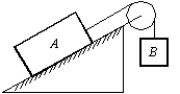
incline. The coefficient of kinetic friction is 0.20. The attached string is parallel to the incline and passes over a massless, frictionless pulley at the top. Block B, with a mass of 8.0 kg, is attached to the dangling end of the string. The acceleration of B is: Free
(Multiple Choice)
4.8/5 (81)
(81) Correct Answer:Verified
VerifiedB
Block A, with a mass of 10 kg, rests on a 30 incline. The coefficient of kinetic friction is 0.20. The attached string is parallel to the incline and passes over a massless, frictionless pulley at the top. Block B, with a mass of 3.0 kg, is attached to the dangling end of the string. The acceleration of B is: 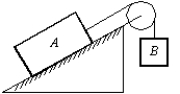
incline. The coefficient of kinetic friction is 0.20. The attached string is parallel to the incline and passes over a massless, frictionless pulley at the top. Block B, with a mass of 3.0 kg, is attached to the dangling end of the string. The acceleration of B is: Free
(Multiple Choice)
4.8/5 (82)
(82) Correct Answer:Verified
VerifiedA
If a certain car, going with speed v1, rounds a level curve with a radius R1, it is just on the verge of skidding. If its speed is now doubled, the radius of the tightest curve on the same road that it can round without skidding is:
(Multiple Choice)
4.8/5 (78)
(78) A boy pulls a wooden box along a rough horizontal floor at constant speed by means of a force  as shown. In the diagram f is the magnitude of the force of friction, N is the magnitude of the normal force, and Fg is the magnitude of the force of gravity. Which of the following must be true?
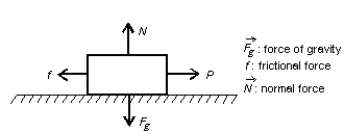
as shown. In the diagram f is the magnitude of the force of friction, N is the magnitude of the normal force, and Fg is the magnitude of the force of gravity. Which of the following must be true? (Multiple Choice)
5.0/5 (80)
(80) An object of mass m and another object of mass 2m are each forced to move along a circle of radius 1.0 m at a constant speed of 1.0 m/s. The magnitudes of their accelerations are:
(Multiple Choice)
4.9/5 (81)
(81) A forward horizontal force of 12 N is used to pull a 240-N crate at constant velocity across a horizontal floor. The coefficient of friction is:
(Multiple Choice)
4.8/5 (77)
(77) A horizontal shove of at least 200-N is required to start moving a 800-N crate initially at rest on a horizontal floor. The coefficient of static friction is:
(Multiple Choice)
4.9/5 (85)
(85) A ball is thrown downward from the edge of a cliff with an initial speed that is three times the terminal speed. Initially its acceleration is
(Multiple Choice)
4.9/5 (87)
(87) A bureau rests on a rough horizontal surface ( s = 0.50, k = 0.40). A constant horizontal force, just sufficient to start the bureau in motion, is then applied. The acceleration of the bureau is:
(Multiple Choice)
4.9/5 (83)
(83) A force  (larger than the largest possible force of static friction) is applied to the left to an object moving to the right on a horizontal surface. Then:
 (Multiple Choice)
4.8/5 (81)
(81) At what angle should the roadway on a curve with a 50m radius be banked to allow cars to negotiate the curve at 12 m/s even if the roadway is icy (and the frictional force is zero)?
(Multiple Choice)
4.8/5 (83)
(83) A 5.0-kg crate is on an incline that makes an angle 30 with the horizontal. If the coefficent of static friction is 0.5, the maximum force that can be applied parallel to the plane without moving the crate is:
 (Multiple Choice)
4.9/5 (75)
(75) A 12-kg crate rests on a horizontal surface and a boy pulls on it with a force that is 30 below the horizontal. If the coefficient of static friction is 0.40, the minimum magnitude force he needs to start the crate moving is:
 (Multiple Choice)
4.9/5 (88)
(88) A ball is thrown upward into the air with a speed that is greater than terminal speed. On the way up it slows down and, after its speed equals the terminal speed but before it gets to the top of its trajectory:
(Multiple Choice)
5.0/5 (80)
(80) A horizontal force of 12 N pushes a 0.50-kg book against a vertical wall. The book is initially at rest. If s = 0.6 and k = 0.80, the acceleration of the book in m/s2 is:
(Multiple Choice)
4.8/5 (88)
(88) A 5.0-kg crate is resting on a horizontal plank. The coefficient of static friction is 0.50 and the coefficient of kinetic friction is 0.40. After one end of the plank is raised so the plank makes an angle of 30 with the horizontal, the force of friction is:
with the horizontal, the force of friction is: (Multiple Choice)
4.8/5 (82)
(82) An object moves around a circle. If the radius is doubled keeping the speed the same then the magnitude of the contripetal force must be:
(Multiple Choice)
4.8/5 (80)
(80) A block is placed on a rough wooden plane. It is found that when the plane is tilted 30to the horizontal, the block will slide down at constant speed. The coefficient of kinetic friction of the block with the plane is:
to the horizontal, the block will slide down at constant speed. The coefficient of kinetic friction of the block with the plane is: (Multiple Choice)
5.0/5 (79)
(79) The driver of a 1000-kg car tries to turn through a circle of radius 100 m on an unbanked curve at a speed of 10 m/s. The actual frictional force between the tires and a slippery road has a magnitude of 900 N. The car:
(Multiple Choice)
4.7/5 (81)
(81) 
Filters
- Essay(0)
- Multiple Choice(0)
- Short Answer(0)
- True False(0)
- Matching(0)