



 Chat with AI
Exam 11: Rolling, Torque, and Angular Momentum

Exam 1: Measurement31 Questions
Exam 2: Motion Along a Straight Line79 Questions
Exam 3: Vector39 Questions
Exam 4: Motion in Two and Three Dimensions47 Questions
Exam 5: Force and Motion I68 Questions
Exam 6: Force and Motion II71 Questions
Exam 7: Kinetic Energy and Work67 Questions
Exam 8: Potential Energy and Conservation of Energy61 Questions
Exam 9: Center of Mass and Linear Momentum81 Questions
Exam 10: Rotation82 Questions
Exam 11: Rolling, Torque, and Angular Momentum54 Questions
Exam 12: Equilibrium and Elasticity53 Questions
Exam 13: Gravitation55 Questions
Exam 14: Fluids85 Questions
Exam 15: Oscillations62 Questions
Exam 16: Waves I71 Questions
Exam 17: Waves II61 Questions
Exam 18: Temperature, Heat, and the First Law of Thermodynamics82 Questions
Exam 19: The Kinetic Theory of Gases95 Questions
Exam 20: Entropy and the Second Law of Thermodynamics56 Questions
Exam 21: Electric Charge45 Questions
Exam 22: Electric Fields49 Questions
Exam 23: Gauss Law34 Questions
Exam 24: Electric Potential44 Questions
Exam 25: Capacitance55 Questions
Exam 26: Current and Resistance49 Questions
Exam 27: Circuits70 Questions
Exam 28: Magnetic Fields48 Questions
Exam 29: Magnetic Fields Due to Currents47 Questions
Exam 30: Induction and Inductance85 Questions
Exam 31: Electromagnetic Oscillations and Alternating Current84 Questions
Exam 32: Maxwells Equations; Magnetism of Matter81 Questions
Exam 33: Electromagnetic Waves79 Questions
Exam 34: Images72 Questions
Exam 35: Interference40 Questions
Exam 36: Diffraction74 Questions
Exam 37: Relativity65 Questions
Exam 38: Photons and Matter Waves53 Questions
Exam 39: More About Matter Waves41 Questions
Exam 40: All About Atoms76 Questions
Exam 41: Conduction of Electricity in Solids48 Questions
Exam 42: Nuclear Physics67 Questions
Exam 43: Energy From the Nucleus44 Questions
Exam 44: Quarks, Leptons, and the Big Bang52 Questions
Select questions type


Two identical disks, with rotational inertia I (= 1/2 MR2), roll without slipping across a horizontal floor and then up inclines. Disk A rolls up its incline without sliding. On the other hand, disk B rolls up a frictionless incline. Otherwise the inclines are identical. Disk A reaches a height 12 cm above the floor before rolling down again. Disk B reaches a height above the floor of:

Free
(Multiple Choice)
4.8/5  (78)
(78) Correct Answer: Verified
D
Two disks are mounted on low-friction bearings on a common shaft. The first disc has rotational inertia I and is spinning with angular velocity . The second disc has rotational inertia 2I and is spinning in the same direction as the first disc with angular velocity 2 as shown. The two disks are slowly forced toward each other along the shaft until they couple and have a final common angular velocity of: 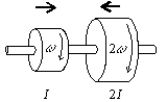
Free
(Multiple Choice)
4.9/5 (83)
(83) Correct Answer:Verified
VerifiedA
Two pendulum bobs of unequal mass are suspended from the same fixed point by strings of equal length. The lighter bob is drawn aside and then released so that it collides with the other bob on reaching the vertical position. The collision is elastic. What quantities are conserved in the collision?
Free
(Multiple Choice)
4.7/5 (91)
(91) Correct Answer:Verified
VerifiedA
When we apply the energy conversation principle to a cylinder rolling down an incline without sliding, we exclude the work done by friction because:
(Multiple Choice)
4.9/5 (80)
(80) A man, with his arms at his sides, is spinning on a light frictionless turntable. When he extends his arms:
(Multiple Choice)
4.7/5 (75)
(75) A 2.0-kg stone is tied to a 0.50-m long string and swung around a circle at a constant angular velocity of 12 rad/s. The net torque on the stone about the center of the circle is:
(Multiple Choice)
4.9/5 (89)
(89) Two objects are moving in the x,,y plane as shown. The magnitude of their total angular momentum (about the origin O) is: 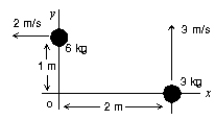
(Multiple Choice)
4.8/5 (78)
(78) A 2.0-kg block travels around a 0.50-m radius circle with an angular velocity of 12 rad/s. The magnitude of its angular momentum about the center of the circle is:
(Multiple Choice)
4.8/5 (86)
(86) When the speed of a rear-drive car is increasing on a horizontal road the direction of the frictional force on the tires is:
(Multiple Choice)
4.9/5 (82)
(82) An ice skater with rotational inertia I0 is spinning with angular speed 0. She pulls her arms in, thereby increasing her angular speed to 4 0. Her rotational inertia is then:
(Multiple Choice)
4.9/5 (86)
(86) A hoop rolls with constant velocity and without sliding along level ground. Its ratation kinetic energy is:
(Multiple Choice)
4.7/5 (75)
(75) A uniform sphere of radius R rotates about a diameter with angular momentum of magnitude L. Under the action of internal forces the sphere collapses to a uniform sphere of radius R/2. The magnitude of its new angular momentum is:
(Multiple Choice)
5.0/5 (91)
(91) A 2.0-kg block starts from rest on the positive x axis 3.0 m from the origin and thereafter has an acceleration given by 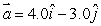 in m/s2. The torque, relative to the origin, acting on it at the end of 2.0 s is:
 (Multiple Choice)
4.9/5 (68)
(68) A 2.0-kg stone is tied to a 0.50 m long string and swung around a circle at a constant angular velocity of 12 rad/s. The circle is parallel to the xy plane and is centered on the z axis, 0.75 m from the origin. The magnitude of the torque about the origin is:
(Multiple Choice)
4.8/5 (77)
(77) A uniform disk, a thin hoop, and a uniform sphere, all with the same mass and same outer radius, are each free to rotate about a fixed axis through its center. Assume the hoop is connected to the rotation axis by light spokes. With the objects starting from rest, identical forces are simultaneously applied to the rims, as shown. Rank the objects according to their angular momenta after a given time t, least to greatest. 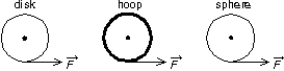
(Multiple Choice)
4.9/5 (82)
(82) A wheel rolls without slipping along a horizontal road as shown. The velocity of the center of the wheel is represented by . Point P is painted on the rim of the wheel. The instantaneous velocity of point P is: 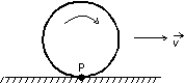
(Multiple Choice)
4.7/5 (91)
(91) A yo-yo, arranged as shown, rests on a frictionless surface. When a force  is applied to the string as shown, the yo-yo:
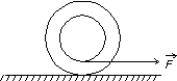
is applied to the string as shown, the yo-yo: (Multiple Choice)
4.7/5 (89)
(89) A wheel of radius 0.5 m rolls without sliding on a horizontal surface as shown. Starting from rest, the wheel moves with constant angular acceleration 6 rad/s2. The distance in traveled by the center of the wheel from t = 0 to t = 3 s is: 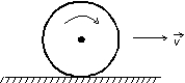
(Multiple Choice)
4.8/5 (78)
(78) 
Filters
- Essay(0)
- Multiple Choice(0)
- Short Answer(0)
- True False(0)
- Matching(0)