



 Chat with AI
Exam 11: Rolling, Torque, and Angular Momentum

Exam 1: Measurement31 Questions
Exam 2: Motion Along a Straight Line79 Questions
Exam 3: Vector39 Questions
Exam 4: Motion in Two and Three Dimensions47 Questions
Exam 5: Force and Motion I68 Questions
Exam 6: Force and Motion II71 Questions
Exam 7: Kinetic Energy and Work67 Questions
Exam 8: Potential Energy and Conservation of Energy61 Questions
Exam 9: Center of Mass and Linear Momentum81 Questions
Exam 10: Rotation82 Questions
Exam 11: Rolling, Torque, and Angular Momentum54 Questions
Exam 12: Equilibrium and Elasticity53 Questions
Exam 13: Gravitation55 Questions
Exam 14: Fluids85 Questions
Exam 15: Oscillations62 Questions
Exam 16: Waves I71 Questions
Exam 17: Waves II61 Questions
Exam 18: Temperature, Heat, and the First Law of Thermodynamics82 Questions
Exam 19: The Kinetic Theory of Gases95 Questions
Exam 20: Entropy and the Second Law of Thermodynamics56 Questions
Exam 21: Electric Charge45 Questions
Exam 22: Electric Fields49 Questions
Exam 23: Gauss Law34 Questions
Exam 24: Electric Potential44 Questions
Exam 25: Capacitance55 Questions
Exam 26: Current and Resistance49 Questions
Exam 27: Circuits70 Questions
Exam 28: Magnetic Fields48 Questions
Exam 29: Magnetic Fields Due to Currents47 Questions
Exam 30: Induction and Inductance85 Questions
Exam 31: Electromagnetic Oscillations and Alternating Current84 Questions
Exam 32: Maxwells Equations; Magnetism of Matter81 Questions
Exam 33: Electromagnetic Waves79 Questions
Exam 34: Images72 Questions
Exam 35: Interference40 Questions
Exam 36: Diffraction74 Questions
Exam 37: Relativity65 Questions
Exam 38: Photons and Matter Waves53 Questions
Exam 39: More About Matter Waves41 Questions
Exam 40: All About Atoms76 Questions
Exam 41: Conduction of Electricity in Solids48 Questions
Exam 42: Nuclear Physics67 Questions
Exam 43: Energy From the Nucleus44 Questions
Exam 44: Quarks, Leptons, and the Big Bang52 Questions
Select questions type


A single force acts on a particle situated on the positive x axis. The torque about the origin is in the negative z direction. The force might be:
(Multiple Choice)
4.9/5  (69)
(69) A cylinder of radius R = 6.0 cm is on a rough horizontal surface. The coefficient of kinetic friction between the cylinder and the surface is 0.30 and the rotational inertia for rotation about the axis is given by MR2/2, where M is its mass. Initially it is not rotating but its center of mass has a speed of 7.0 m/s. After 2.0 s the speed of its center of mass and its angular velocity about its center of mass, respectively, are:
(Multiple Choice)
5.0/5 (77)
(77) A block with mass M, on the end of a string, moves in a circle on a horizontal frictionless table as shown. As the string is slowly pulled through a small hole in the table: 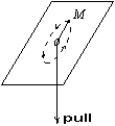
(Multiple Choice)
4.8/5 (79)
(79) A forward force acting on the axle accelerates a rolling wheel on a horizontal surface. If the wheel does not slide the frictional force of the surface on the wheel is:
(Multiple Choice)
4.9/5 (86)
(86) A 6.0-kg particle moves to the right at 4.0 m/s as shown. The magnitude of its angular momentum about the point O is: 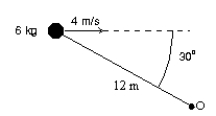
(Multiple Choice)
4.8/5 (84)
(84) A solid wheel with mass M, radius R, and rotational inertia MR2/2, rolls without sliding on a horizontial surface. A horizontal force F is applied to the axle and the center of mass has an acceleration a. The magnitudes of the applied force F and the frictional force f of the surface, respectively, are:
(Multiple Choice)
4.8/5 (89)
(89) A phonograph record is dropped onto a freely spinning turntable. Then:
(Multiple Choice)
4.8/5 (71)
(71) As a 2.0-kg block travels around a 0.50-m radius circle it has an angular speed of 12 rad/s. The circle is parallel to the xy plane and is centered on the z axis, 0.75 m from the origin. The magnitude of its angular momentum around the origin is:
(Multiple Choice)
4.8/5 (71)
(71) A rod rests on frictionless ice. Forces that are equal in magnitude and opposite in direction are simultaneously applied to its ends as shown. The quantity that vanishes is its: 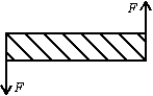
(Multiple Choice)
4.9/5 (74)
(74) A pulley with radius R and rotational inertia I is free to rotate on a horizontal fixed axis through its center. A string passes over the pulley. A block of mass m1 is attached to one end and a block of mass m2, is attached to the other. At one time the block with mass m1 is moving downward with speed v. If the string does not slip on the pulley, the magnitude of the total angular momentum, about the pulley center, of the blocks and pulley, considered as a system, is given by:
(Multiple Choice)
4.8/5 (85)
(85) A single force acts on a particle P. Rank each of the orientations of the force shown below according to the magnitude of the time rate of change of the particle's angular momentum about the point O, least to greatest. 
(Multiple Choice)
5.0/5 (91)
(91) As a 2.0-kg block travels around a 0.50-m radius circle with an angular speed of 12 rad/s. The circle is parallel to the xy plane and is centered on the z axis, 0.75 m from the origin. The component in the xy plane of the angular momentum around the origin has magnitude:
(Multiple Choice)
4.9/5 (82)
(82) The coefficient of static friction between a certain cylinder and a horizontal floor is 0.40. If the rotational inertia of the cylinder about its symmetry axis is given by I = (1/2)MR2, then the maximum acceleration the cylinder can have without sliding is:
(Multiple Choice)
4.8/5 (80)
(80) 
Filters
- Essay(0)
- Multiple Choice(0)
- Short Answer(0)
- True False(0)
- Matching(0)