



 Chat with AI
Exam 6: Force and Motion II

Exam 1: Measurement31 Questions
Exam 2: Motion Along a Straight Line79 Questions
Exam 3: Vector39 Questions
Exam 4: Motion in Two and Three Dimensions47 Questions
Exam 5: Force and Motion I68 Questions
Exam 6: Force and Motion II71 Questions
Exam 7: Kinetic Energy and Work67 Questions
Exam 8: Potential Energy and Conservation of Energy61 Questions
Exam 9: Center of Mass and Linear Momentum81 Questions
Exam 10: Rotation82 Questions
Exam 11: Rolling, Torque, and Angular Momentum54 Questions
Exam 12: Equilibrium and Elasticity53 Questions
Exam 13: Gravitation55 Questions
Exam 14: Fluids85 Questions
Exam 15: Oscillations62 Questions
Exam 16: Waves I71 Questions
Exam 17: Waves II61 Questions
Exam 18: Temperature, Heat, and the First Law of Thermodynamics82 Questions
Exam 19: The Kinetic Theory of Gases95 Questions
Exam 20: Entropy and the Second Law of Thermodynamics56 Questions
Exam 21: Electric Charge45 Questions
Exam 22: Electric Fields49 Questions
Exam 23: Gauss Law34 Questions
Exam 24: Electric Potential44 Questions
Exam 25: Capacitance55 Questions
Exam 26: Current and Resistance49 Questions
Exam 27: Circuits70 Questions
Exam 28: Magnetic Fields48 Questions
Exam 29: Magnetic Fields Due to Currents47 Questions
Exam 30: Induction and Inductance85 Questions
Exam 31: Electromagnetic Oscillations and Alternating Current84 Questions
Exam 32: Maxwells Equations; Magnetism of Matter81 Questions
Exam 33: Electromagnetic Waves79 Questions
Exam 34: Images72 Questions
Exam 35: Interference40 Questions
Exam 36: Diffraction74 Questions
Exam 37: Relativity65 Questions
Exam 38: Photons and Matter Waves53 Questions
Exam 39: More About Matter Waves41 Questions
Exam 40: All About Atoms76 Questions
Exam 41: Conduction of Electricity in Solids48 Questions
Exam 42: Nuclear Physics67 Questions
Exam 43: Energy From the Nucleus44 Questions
Exam 44: Quarks, Leptons, and the Big Bang52 Questions
Select questions type


A coin is placed on a horizontal phonograph turntable. Let N be the normal force exerted by the turntable on the coin, f be the frictional force exerted by the turntable on the coin, and fs, max be the maximum force of the static friction. The speed of the turntable is increased in small steps. If the coin does not slide, then
(Multiple Choice)
4.8/5  (79)
(79) A 0.2-kg stone is attached to a string and swung in a circle of radius 0.6 m on a horizontal and frictionless surface. If the stone makes 150 revolutions per minute, the tension force of the string on the stone is:
(Multiple Choice)
4.7/5 (86)
(86) Circular freeway entrance and exit ramps are commonly banked to handle a car moving at 13 m/s. To design a similar ramp for 26 m/s one should:
(Multiple Choice)
4.8/5 (79)
(79) A box with a weight of 50 N rests on a horizontal surface. A person pulls horizontally on it with a force of 10 N and it does not move. To start it moving, a second person pulls vertically upward on the box. If the coefficient of static friction is 0.4, what is the smallest vertical force for which the box moves? 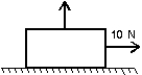
(Multiple Choice)
4.9/5 (76)
(76) An automobile moves on a level horizontal road in a circle of radius 30 m. The coefficient of friction between tires and road is 0.50. The maximum speed with which this car can round this curve is:
(Multiple Choice)
4.8/5 (67)
(67) Block A, with a mass of 10 kg, rests on a 35 incline. The coefficient of static friction is 0.40. An attached string is parallel to the incline and passes over a massless, frictionless pulley at the top. The largest mass mB, of block B, attached to the dangling end, for which A begins to slide down the incline is:
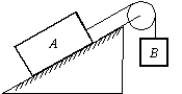
incline. The coefficient of static friction is 0.40. An attached string is parallel to the incline and passes over a massless, frictionless pulley at the top. The largest mass mB, of block B, attached to the dangling end, for which A begins to slide down the incline is: (Multiple Choice)
4.8/5 (78)
(78) A 24-N horizontal force is applied to a 40-N block initially at rest on a rough horizontal surface. Ifthe coefficients of friction are s = 0.5 and k = 0.4, the magnitude of the frictional force on the block is:
(Multiple Choice)
4.9/5 (80)
(80) A heavy wooden block is dragged by a force  along a rough steel plate, as shown below for two possible situations. The magnitude of
 is the same for the two situations. The magnitude of the frictional force in (ii), as compared with that in (i) is:
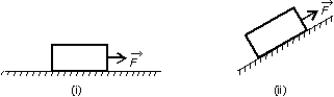
along a rough steel plate, as shown below for two possible situations. The magnitude of is the same for the two situations. The magnitude of the frictional force in (ii), as compared with that in (i) is: (Multiple Choice)
4.9/5 (84)
(84) An 800-N passenger in a car, presses against the car door with a 200 N force when the car makes a left turn at 13 m/s. The (faulty) door will pop open under a force of 800 N. Of the following, the least speed for which the man is thrown out of the car is:
(Multiple Choice)
4.7/5 (70)
(70) A brick slides on a horizontal surface. Which of the following will increase the frictional force on it?
(Multiple Choice)
4.9/5 (82)
(82) The iron ball shown is being swung in a vertical circle at the end of a 0.7-m string. How slowly, in ft/s, can the ball go through its top position without having the string go slack? 
(Multiple Choice)
4.9/5 (66)
(66) The speed of a 4.0-N hockey puck, sliding across a level ice surface, decreases at the rate of 0.61 m/s2. The coefficient of kinetic friction between the puck and ice is:
(Multiple Choice)
4.9/5 (83)
(83) An object moves in a circle. If the mass is tripled, the speed halved and the radius unchanged then the magnitude of the centripetal force must be multiplied by a factor of:
(Multiple Choice)
4.8/5 (75)
(75) One end of a 1.0-m long string is fixed, the other end is attached to a 2.0-kg stone. The stone swings in a vertical circle, passing the bottom point at 4.0 m/s. The tension force of the string (in newtons) at this point is about:
(Multiple Choice)
4.8/5 (85)
(85) A person riding a Ferris wheel is strapped into her seat by a seat belt. The wheel is spun so that the centripetal acceleration is g. Select the correct combination of forces that act on her when she is at the top. In the table, Fg = force of gravity, down; Fb = seat belt force, down; and Fs = seat force, up.
(Multiple Choice)
4.8/5 (88)
(88) A boy pulls a wooden box along a rough horizontal floor at constant speed by means of a force  as shown. In the diagram f is the magnitude of the force of friction, N is the magnitude of the normal force, and Fg is the magnitude of the force of gravity. Which of the following must be true?
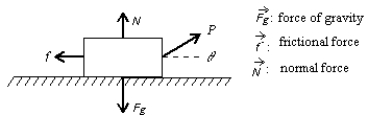
as shown. In the diagram f is the magnitude of the force of friction, N is the magnitude of the normal force, and Fg is the magnitude of the force of gravity. Which of the following must be true? (Multiple Choice)
5.0/5 (89)
(89) Which of the following five graphs is correct for a particle moving in a circle of radius r at a constant speed of 10 m/s? 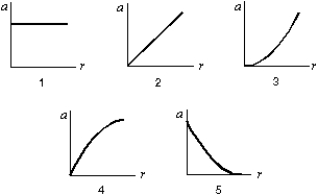
(Multiple Choice)
4.8/5 (84)
(84) One end of a 1.0-m string is fixed, the other end is attached to a 2.0-kg stone. The stone swings in a vertical circle, passing the top point at 4.0 m/s. The tension force of the string (in newtons) at this point is about:
(Multiple Choice)
4.8/5 (82)
(82) 
Filters
- Essay(0)
- Multiple Choice(0)
- Short Answer(0)
- True False(0)
- Matching(0)