



 Chat with AI
Exam 15: Oscillations

Exam 1: Measurement31 Questions
Exam 2: Motion Along a Straight Line79 Questions
Exam 3: Vector39 Questions
Exam 4: Motion in Two and Three Dimensions47 Questions
Exam 5: Force and Motion I68 Questions
Exam 6: Force and Motion II71 Questions
Exam 7: Kinetic Energy and Work67 Questions
Exam 8: Potential Energy and Conservation of Energy61 Questions
Exam 9: Center of Mass and Linear Momentum81 Questions
Exam 10: Rotation82 Questions
Exam 11: Rolling, Torque, and Angular Momentum54 Questions
Exam 12: Equilibrium and Elasticity53 Questions
Exam 13: Gravitation55 Questions
Exam 14: Fluids85 Questions
Exam 15: Oscillations62 Questions
Exam 16: Waves I71 Questions
Exam 17: Waves II61 Questions
Exam 18: Temperature, Heat, and the First Law of Thermodynamics82 Questions
Exam 19: The Kinetic Theory of Gases95 Questions
Exam 20: Entropy and the Second Law of Thermodynamics56 Questions
Exam 21: Electric Charge45 Questions
Exam 22: Electric Fields49 Questions
Exam 23: Gauss Law34 Questions
Exam 24: Electric Potential44 Questions
Exam 25: Capacitance55 Questions
Exam 26: Current and Resistance49 Questions
Exam 27: Circuits70 Questions
Exam 28: Magnetic Fields48 Questions
Exam 29: Magnetic Fields Due to Currents47 Questions
Exam 30: Induction and Inductance85 Questions
Exam 31: Electromagnetic Oscillations and Alternating Current84 Questions
Exam 32: Maxwells Equations; Magnetism of Matter81 Questions
Exam 33: Electromagnetic Waves79 Questions
Exam 34: Images72 Questions
Exam 35: Interference40 Questions
Exam 36: Diffraction74 Questions
Exam 37: Relativity65 Questions
Exam 38: Photons and Matter Waves53 Questions
Exam 39: More About Matter Waves41 Questions
Exam 40: All About Atoms76 Questions
Exam 41: Conduction of Electricity in Solids48 Questions
Exam 42: Nuclear Physics67 Questions
Exam 43: Energy From the Nucleus44 Questions
Exam 44: Quarks, Leptons, and the Big Bang52 Questions
Select questions type


Five hoops are each pivoted at a point on the rim and allowed to swing as physical pendulums. The masses and radii are 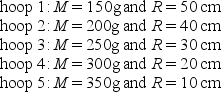 Order the hoops according to the periods of their motions, smallest to largest.
 (Multiple Choice)
4.8/5  (86)
(86) Three physical pendulums, with masses m1, m2 = 2m1, and m3 = 3m1, have the same shape and size and are suspended at the same point. Rank them according to their periods, from shortest to longest.
(Multiple Choice)
4.9/5 (69)
(69) An object attached to one end of a spring makes 20 vibrations in 10s. Its period is:
(Multiple Choice)
4.9/5 (80)
(80) A meter stick is pivoted at a point a distance a from its center and swings as a physical pendulum. Of the following values for a, which results in the shortest period of oscillation?
(Multiple Choice)
4.8/5 (73)
(73) A block attached to a spring undergoes simple harmonic motion on a horizontal frictionless surface. Its total energy is 50 J. When the displacement is half the amplitude, the kinetic energy is:
(Multiple Choice)
4.8/5 (74)
(74) The amplitude and phase constant of an oscillator are determined by:
(Multiple Choice)
4.9/5 (90)
(90) A certain spring elongates 9 mm when it is suspended vertically and a block of mass M is hung on it. The natural frequency of this mass-spring system is:
(Multiple Choice)
4.8/5 (80)
(80) Both the x and y coordinates of a point execute simple harmonic motion. The result might be a circular orbit if:
(Multiple Choice)
4.8/5 (70)
(70) An object of mass m, oscillating on the end of a spring with spring constant k has amplitude A. Its maximum speed is:
(Multiple Choice)
4.9/5 (88)
(88) If the length of a simple pendulum is doubled, its period will:
(Multiple Choice)
5.0/5 (73)
(73) For an oscillator subjected to a damping force proportional to its velocity:
(Multiple Choice)
4.7/5 (77)
(77) An object attached to one end of a spring makes 20 vibrations in 10 seconds. Its angular frequency is:
(Multiple Choice)
4.8/5 (82)
(82) A 0.25-kg block oscillates on the end of the spring with a spring constant of 200 N/m. If the oscillation is started by elongating the spring 0.15 m and giving the block a speed of 3.0 m/s, then the maximum speed of the block is:
(Multiple Choice)
4.8/5 (57)
(57) A 0.25-kg block oscillates on the end of the spring with a spring constant of 200 N/m. If the oscillation is started by elongating the spring 0.15 m and giving the block a speed of 3.0 m/s, then the amplitude of the oscillation is:
(Multiple Choice)
4.7/5 (77)
(77) When a body executes simple harmonic motion, its acceleration at the ends of its path must be:
(Multiple Choice)
4.8/5 (78)
(78) Five particles undergo damped harmonic motion. Values for the spring constant k, the damping constant b, and the mass m are given below. Which leads to the smallest rate of loss of mechanical energy?
(Multiple Choice)
4.8/5 (90)
(90) In simple harmonic motion, the magnitude of the acceleration is:
(Multiple Choice)
5.0/5 (78)
(78) 
Filters
- Essay(0)
- Multiple Choice(0)
- Short Answer(0)
- True False(0)
- Matching(0)