



 Chat with AI
Exam 25: Capacitance

Exam 1: Measurement31 Questions
Exam 2: Motion Along a Straight Line79 Questions
Exam 3: Vector39 Questions
Exam 4: Motion in Two and Three Dimensions47 Questions
Exam 5: Force and Motion I68 Questions
Exam 6: Force and Motion II71 Questions
Exam 7: Kinetic Energy and Work67 Questions
Exam 8: Potential Energy and Conservation of Energy61 Questions
Exam 9: Center of Mass and Linear Momentum81 Questions
Exam 10: Rotation82 Questions
Exam 11: Rolling, Torque, and Angular Momentum54 Questions
Exam 12: Equilibrium and Elasticity53 Questions
Exam 13: Gravitation55 Questions
Exam 14: Fluids85 Questions
Exam 15: Oscillations62 Questions
Exam 16: Waves I71 Questions
Exam 17: Waves II61 Questions
Exam 18: Temperature, Heat, and the First Law of Thermodynamics82 Questions
Exam 19: The Kinetic Theory of Gases95 Questions
Exam 20: Entropy and the Second Law of Thermodynamics56 Questions
Exam 21: Electric Charge45 Questions
Exam 22: Electric Fields49 Questions
Exam 23: Gauss Law34 Questions
Exam 24: Electric Potential44 Questions
Exam 25: Capacitance55 Questions
Exam 26: Current and Resistance49 Questions
Exam 27: Circuits70 Questions
Exam 28: Magnetic Fields48 Questions
Exam 29: Magnetic Fields Due to Currents47 Questions
Exam 30: Induction and Inductance85 Questions
Exam 31: Electromagnetic Oscillations and Alternating Current84 Questions
Exam 32: Maxwells Equations; Magnetism of Matter81 Questions
Exam 33: Electromagnetic Waves79 Questions
Exam 34: Images72 Questions
Exam 35: Interference40 Questions
Exam 36: Diffraction74 Questions
Exam 37: Relativity65 Questions
Exam 38: Photons and Matter Waves53 Questions
Exam 39: More About Matter Waves41 Questions
Exam 40: All About Atoms76 Questions
Exam 41: Conduction of Electricity in Solids48 Questions
Exam 42: Nuclear Physics67 Questions
Exam 43: Energy From the Nucleus44 Questions
Exam 44: Quarks, Leptons, and the Big Bang52 Questions
Select questions type


A certain capacitor has a capacitance of 5.0 F. After it is charged to 5 C and isolated, the plates are brought closer together so its capacitance becomes 10 F. The work done by the agent is about:
(Multiple Choice)
4.9/5  (77)
(77) Two parallel-plate capacitors with different capacitance but the same plate separation are connected in series to a battery. Both capacitors are filled with air. The quantity that is the same for both capacitors when they are fully charged is:
(Multiple Choice)
4.8/5 (88)
(88) A parallel-plate capacitor has a plate area of 0.2 m2 and a plate separation of 0.1 mm. If the charge on each plate has a magnitude of 4 *10-6 C the potential difference across the plates is approximately:
(Multiple Choice)
4.8/5 (93)
(93) The capacitance of a spherical capacitor with inner radius a and outer radius b is proportional to:
(Multiple Choice)
4.9/5 (89)
(89) The capacitance of a single isolated spherical conductor with radius R is proportional to:
(Multiple Choice)
4.8/5 (72)
(72) If both the plate area and the plate separation of a parallel-plate capacitor are doubled, the capacitance is:
(Multiple Choice)
4.9/5 (66)
(66) Capacitors A and B are identical. Capacitor A is charged so it stores 4 J of energy and capacitor B is uncharged. The capacitors are then connected in parallel. The total stored energy in the capacitors is now:
(Multiple Choice)
4.8/5 (86)
(86) Two parallel-plate capacitors with different plate separation but the same capacitance are connected in series to a battery. Both capacitors are filled with air. The quantity that is NOT the same for both capacitors when they are fully charged is:
(Multiple Choice)
4.9/5 (74)
(74) Capacitor C1 and C2 are connected in parallel. The equivalent capacitance is given by:
(Multiple Choice)
4.9/5 (83)
(83) If the plate separation of an isolated charged parallel-plate capacitor is doubled:
(Multiple Choice)
4.8/5 (74)
(74) Capacitor C1 is connected alone to a battery and charged until the magnitude of the charge on each plate is 4.0 * 10-8 C. Then it is removed from the vattery and connected to two other capacitors C2 and C3, as shown. The charge ont he positive placte of C1 is then 1.0 * 10 - 8 C. The charges on the positive plates of C2 and C3 are: 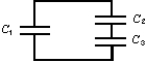
(Multiple Choice)
4.8/5 (78)
(78) The capacitance of a parallel-plate capacitor with plate area A and plate separation d is given by:
(Multiple Choice)
4.7/5 (72)
(72) To charge a 1-F capacitor with 2 C requires a potential difference of:
(Multiple Choice)
4.8/5 (86)
(86) 
Filters
- Essay(0)
- Multiple Choice(0)
- Short Answer(0)
- True False(0)
- Matching(0)