



 Chat with AI
Exam 25: Capacitance

Exam 1: Measurement31 Questions
Exam 2: Motion Along a Straight Line79 Questions
Exam 3: Vector39 Questions
Exam 4: Motion in Two and Three Dimensions47 Questions
Exam 5: Force and Motion I68 Questions
Exam 6: Force and Motion II71 Questions
Exam 7: Kinetic Energy and Work67 Questions
Exam 8: Potential Energy and Conservation of Energy61 Questions
Exam 9: Center of Mass and Linear Momentum81 Questions
Exam 10: Rotation82 Questions
Exam 11: Rolling, Torque, and Angular Momentum54 Questions
Exam 12: Equilibrium and Elasticity53 Questions
Exam 13: Gravitation55 Questions
Exam 14: Fluids85 Questions
Exam 15: Oscillations62 Questions
Exam 16: Waves I71 Questions
Exam 17: Waves II61 Questions
Exam 18: Temperature, Heat, and the First Law of Thermodynamics82 Questions
Exam 19: The Kinetic Theory of Gases95 Questions
Exam 20: Entropy and the Second Law of Thermodynamics56 Questions
Exam 21: Electric Charge45 Questions
Exam 22: Electric Fields49 Questions
Exam 23: Gauss Law34 Questions
Exam 24: Electric Potential44 Questions
Exam 25: Capacitance55 Questions
Exam 26: Current and Resistance49 Questions
Exam 27: Circuits70 Questions
Exam 28: Magnetic Fields48 Questions
Exam 29: Magnetic Fields Due to Currents47 Questions
Exam 30: Induction and Inductance85 Questions
Exam 31: Electromagnetic Oscillations and Alternating Current84 Questions
Exam 32: Maxwells Equations; Magnetism of Matter81 Questions
Exam 33: Electromagnetic Waves79 Questions
Exam 34: Images72 Questions
Exam 35: Interference40 Questions
Exam 36: Diffraction74 Questions
Exam 37: Relativity65 Questions
Exam 38: Photons and Matter Waves53 Questions
Exam 39: More About Matter Waves41 Questions
Exam 40: All About Atoms76 Questions
Exam 41: Conduction of Electricity in Solids48 Questions
Exam 42: Nuclear Physics67 Questions
Exam 43: Energy From the Nucleus44 Questions
Exam 44: Quarks, Leptons, and the Big Bang52 Questions
Select questions type


Each plate of a capacitor stores a charge of magnitude 1 mC when a 100-V potential difference is applied. The capacitance is:
(Multiple Choice)
4.9/5  (75)
(75) Two capacitors are identical except that one is filled with air and the other with oil. Both capacitors carry the same charge. The ratio of the electric fields Eair/Eoil is:
(Multiple Choice)
4.9/5 (84)
(84) To store a total of 0.040 J of energy in the two identical capacitors shown, each should have a capacitance of: 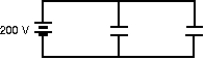
(Multiple Choice)
4.8/5 (80)
(80) A battery is used to charge a parallel combination of two identical capacitors. If the potential difference across the battery terminals is V and the total charge Q flows through the battery during the charging process then the charge on the positive plate of each capacitor and the potential difference across each capacitor are:
(Multiple Choice)
4.8/5 (78)
(78) A parallel-plate capacitor has a plate area of 0.3 m2 and a plate separation of 0.1 mm. If the charge on each plate has a magnitude of 5 *10-6 C then the force exerted by one plate on the other has a magnitude of about:
(Multiple Choice)
4.9/5 (85)
(85) The capacitance of a cylindrical capacitor can be increased by:
(Multiple Choice)
4.9/5 (78)
(78) One of the materials listed below is to be placed between two indenticle metal sheets, with no air gap, to form a parallel-plate capacititance. Which produces the greates capacitance?
(Multiple Choice)
4.8/5 (93)
(93) A parallel-plate capacitor has a plate area of 0.2 m2 and a plate separation of 0.1 mm. To obtain an electric field of 2.0 * 106 V/m between the plates, the magnitude of the charge on each plate should be:
(Multiple Choice)
4.9/5 (80)
(80) Capacitors C1 and C2 are connected in series. The equivalent capacitance is given by:
(Multiple Choice)
4.8/5 (87)
(87) Two parallel-plate capacitors with the same plate area but different capacitance are connected in parallel to a battery. Both capacitors are filled with air. The quantity that is the same for both capacitors when they are fully charged is:
(Multiple Choice)
4.7/5 (86)
(86) A 2- F and a 1- F capacitor are connected in parallel and a potential difference is applied across the combination. The 2- F capacitor has:
(Multiple Choice)
4.8/5 (80)
(80) Capacitors C1 and C2 are connected in parallel and a potential difference is applied to the combination. If the capacitor that is equivalent to the combination has the same potential difference, then the charge on the equivalent capacitor is the same as:
(Multiple Choice)
4.9/5 (76)
(76) Capacitors C1 and C2 are connected in series and a potential difference is applied to the combination. If the capacitor that is equivalent to the combination has the same potential difference, then the charge on the equivalent capacitor is the same as:
(Multiple Choice)
4.9/5 (77)
(77) Each of the three 25- F capacitors shown is initially uncharged. How many coulombs of charge pass through the ammeter A after the switch S is closed? 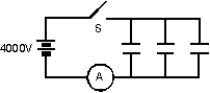
(Multiple Choice)
4.9/5 (71)
(71) A 2- F and a 1- F capacitor are connected in parrael and a potential difference is applied across the combination. The 2- F capacitor has:
(Multiple Choice)
4.9/5 (64)
(64) Two identical capacitors are connected in series and two, each identical to the first, are connected in parallel. The equivalent capacitance of the series connection is ________ the equivalent capacitance of parallel connection.
(Multiple Choice)
4.8/5 (68)
(68) 
Filters
- Essay(0)
- Multiple Choice(0)
- Short Answer(0)
- True False(0)
- Matching(0)