



 Chat with AI
Exam 40: All About Atoms

Exam 1: Measurement31 Questions
Exam 2: Motion Along a Straight Line79 Questions
Exam 3: Vector39 Questions
Exam 4: Motion in Two and Three Dimensions47 Questions
Exam 5: Force and Motion I68 Questions
Exam 6: Force and Motion II71 Questions
Exam 7: Kinetic Energy and Work67 Questions
Exam 8: Potential Energy and Conservation of Energy61 Questions
Exam 9: Center of Mass and Linear Momentum81 Questions
Exam 10: Rotation82 Questions
Exam 11: Rolling, Torque, and Angular Momentum54 Questions
Exam 12: Equilibrium and Elasticity53 Questions
Exam 13: Gravitation55 Questions
Exam 14: Fluids85 Questions
Exam 15: Oscillations62 Questions
Exam 16: Waves I71 Questions
Exam 17: Waves II61 Questions
Exam 18: Temperature, Heat, and the First Law of Thermodynamics82 Questions
Exam 19: The Kinetic Theory of Gases95 Questions
Exam 20: Entropy and the Second Law of Thermodynamics56 Questions
Exam 21: Electric Charge45 Questions
Exam 22: Electric Fields49 Questions
Exam 23: Gauss Law34 Questions
Exam 24: Electric Potential44 Questions
Exam 25: Capacitance55 Questions
Exam 26: Current and Resistance49 Questions
Exam 27: Circuits70 Questions
Exam 28: Magnetic Fields48 Questions
Exam 29: Magnetic Fields Due to Currents47 Questions
Exam 30: Induction and Inductance85 Questions
Exam 31: Electromagnetic Oscillations and Alternating Current84 Questions
Exam 32: Maxwells Equations; Magnetism of Matter81 Questions
Exam 33: Electromagnetic Waves79 Questions
Exam 34: Images72 Questions
Exam 35: Interference40 Questions
Exam 36: Diffraction74 Questions
Exam 37: Relativity65 Questions
Exam 38: Photons and Matter Waves53 Questions
Exam 39: More About Matter Waves41 Questions
Exam 40: All About Atoms76 Questions
Exam 41: Conduction of Electricity in Solids48 Questions
Exam 42: Nuclear Physics67 Questions
Exam 43: Energy From the Nucleus44 Questions
Exam 44: Quarks, Leptons, and the Big Bang52 Questions
Select questions type


Six electrons are in a two-dimensional square potential energy well with sides of length L. The potential energy is infinite at the sides and zero inside. The single-particle energies are given by  where nx and ny are integers. If a seventh electron is added to the system when it is in its ground state the least energy the additional electron can have is:
 (Multiple Choice)
4.8/5  (69)
(69) In a helium-neon laser, the laser light arises from a transition from a _________ state to a _________ state:
(Multiple Choice)
4.9/5 (76)
(76) The most energetic electron in any atom at the end of a period of the periodic table is in:
(Multiple Choice)
4.9/5 (80)
(80) Electrons are in a two-dimensional square potential energy well with sides of length L. The potential energy is infinite at the sides and zero inside. The single-particle energies are given by  where nx and ny are integers. At most the number of electrons that can have energy 8(h2/8mL2) is:
 (Multiple Choice)
4.8/5 (88)
(88) Radiation with the minimum wavelength as well as the K x-ray lines are detected for a certain target. The energy of the incident electrons is then doubled, with the result that:
(Multiple Choice)
4.8/5 (77)
(77) Photons in a laser beam have the same energy, wavelength, polarization direction, and phase because:
(Multiple Choice)
4.9/5 (67)
(67) The transition shown gives rise to an x-ray. The correct label for this is: 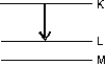
(Multiple Choice)
4.9/5 (69)
(69) Five electrons are in a two-dimensional square potential energy well with sides of length L. The potential energy is infinite at the sides and zero inside. The single-particle energies are given by  where nx and ny are integers. In units of (h2/8mL2) the energy of the first excited state of the system is:
 (Multiple Choice)
4.9/5 (80)
(80) A magnetic dipole is placed between the poles of a magnet as shown. The direction of the associated force exerted on the dipole is: 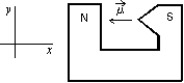
(Multiple Choice)
4.9/5 (84)
(84) Suppose the energy required to ionize an argon atom is i, the energy to excite it is e, and its thermal energy at room temperature is t. In increasing order, these three energies are:
(Multiple Choice)
4.9/5 (83)
(83) A group of electromagnetic waves might  Which of these describe the waves from a laser?
 (Multiple Choice)
4.9/5 (74)
(74) An electron in an atom is in a state with principal quantum number n = 4. The possible values of the orbital quantum number  are:
are: (Multiple Choice)
4.9/5 (77)
(77) The group of atoms at the beginning of periods of the periodic table are called:
(Multiple Choice)
5.0/5 (73)
(73) Which of the following is essential for laser action to occur between two energy levels of an atom?
(Multiple Choice)
4.9/5 (65)
(65) The number of states in a shell with principal quantum number n = 3 is:
(Multiple Choice)
4.8/5 (89)
(89) An electron is in a quantum state for which there are seven allowed values of the z component of the angular momentum. The magnitude of the angular momentum is:
(Multiple Choice)
4.7/5 (78)
(78) The number of states in a subshell with orbital quantum number  is:
is: (Multiple Choice)
4.7/5 (75)
(75) The possible values for the magnetic quantum number ms of an electron in an atom:
(Multiple Choice)
4.9/5 (70)
(70) For any atom other that hydrogen and helium all electrons in the same shell have:
(Multiple Choice)
4.8/5 (84)
(84) 
Filters
- Essay(0)
- Multiple Choice(0)
- Short Answer(0)
- True False(0)
- Matching(0)