



 Chat with AI
Exam 40: All About Atoms

Exam 1: Measurement31 Questions
Exam 2: Motion Along a Straight Line79 Questions
Exam 3: Vector39 Questions
Exam 4: Motion in Two and Three Dimensions47 Questions
Exam 5: Force and Motion I68 Questions
Exam 6: Force and Motion II71 Questions
Exam 7: Kinetic Energy and Work67 Questions
Exam 8: Potential Energy and Conservation of Energy61 Questions
Exam 9: Center of Mass and Linear Momentum81 Questions
Exam 10: Rotation82 Questions
Exam 11: Rolling, Torque, and Angular Momentum54 Questions
Exam 12: Equilibrium and Elasticity53 Questions
Exam 13: Gravitation55 Questions
Exam 14: Fluids85 Questions
Exam 15: Oscillations62 Questions
Exam 16: Waves I71 Questions
Exam 17: Waves II61 Questions
Exam 18: Temperature, Heat, and the First Law of Thermodynamics82 Questions
Exam 19: The Kinetic Theory of Gases95 Questions
Exam 20: Entropy and the Second Law of Thermodynamics56 Questions
Exam 21: Electric Charge45 Questions
Exam 22: Electric Fields49 Questions
Exam 23: Gauss Law34 Questions
Exam 24: Electric Potential44 Questions
Exam 25: Capacitance55 Questions
Exam 26: Current and Resistance49 Questions
Exam 27: Circuits70 Questions
Exam 28: Magnetic Fields48 Questions
Exam 29: Magnetic Fields Due to Currents47 Questions
Exam 30: Induction and Inductance85 Questions
Exam 31: Electromagnetic Oscillations and Alternating Current84 Questions
Exam 32: Maxwells Equations; Magnetism of Matter81 Questions
Exam 33: Electromagnetic Waves79 Questions
Exam 34: Images72 Questions
Exam 35: Interference40 Questions
Exam 36: Diffraction74 Questions
Exam 37: Relativity65 Questions
Exam 38: Photons and Matter Waves53 Questions
Exam 39: More About Matter Waves41 Questions
Exam 40: All About Atoms76 Questions
Exam 41: Conduction of Electricity in Solids48 Questions
Exam 42: Nuclear Physics67 Questions
Exam 43: Energy From the Nucleus44 Questions
Exam 44: Quarks, Leptons, and the Big Bang52 Questions
Select questions type


The number of values of the orbital quantum number  associated with the principal quantum number n = 3 is:
 (Multiple Choice)
4.7/5  (67)
(67) Five electrons are in a two-dimensional square potential energy well with sides of length L. The potential energy is infinite at the sides and zero inside. The single-particle energies are given by  where nx and ny are integers. In units of (h2/8mL2) the energy of the ground state of the system is
 (Multiple Choice)
4.8/5 (76)
(76) Which of the following is essential for the laser action to occur between two energy levels of an atom?
(Multiple Choice)
4.8/5 (72)
(72) An electron in an atom is in a state with  and
 The angle between
 and the z axis is:
and The angle between and the z axis is: (Multiple Choice)
4.8/5 (60)
(60) Which of the following 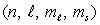 combinations is impossible for an electron in an atom?
 (Multiple Choice)
5.0/5 (79)
(79) An atom is in a state with orbital quantum number  Possible values of the magnetic quantum number
 are:
Possible values of the magnetic quantum number are: (Multiple Choice)
4.8/5 (81)
(81) The states being filled from the beginning to end of the lanthanide series of atoms are:
(Multiple Choice)
4.8/5 (79)
(79) No state in an atom can be occupied by more than one electron. This is most closely related to the:
(Multiple Choice)
4.8/5 (78)
(78) The electron states in an atom which constitute a single subshell all have:
(Multiple Choice)
4.9/5 (81)
(81) The most energetic photon in a continuous x-ray spectrum has an energy approximately equal to:
(Multiple Choice)
4.9/5 (64)
(64) Possible values of the principal quantum number n for an electron in an atom are:
(Multiple Choice)
4.8/5 (90)
(90) Electrons in a certain laser make transitions from a metastable state to the ground state. Initially there are 6 * 1020 atoms in the metastable state and 2 * 1020 atoms in the ground state. The number of photons that can be produced in a single burst is about:
(Multiple Choice)
4.8/5 (76)
(76)  the quantity
The most energetic electron in any atom at the beginning of a period of the periodic table is in:
(Multiple Choice)
4.8/5 (71)
(71) If electrons did not have intrinsic angular momentum (spin) but still obeyed the Pauli exclusion principle the states occupied by electrons in the ground state of helium would be:
(Multiple Choice)
4.9/5 (80)
(80) An electron in an atom is in a state with  The minimum angle between
 and the z axis is:
The minimum angle between and the z axis is: (Multiple Choice)
4.8/5 (79)
(79) The purpose of the mirrors at the ends of a helium-neon laser is:
(Multiple Choice)
5.0/5 (77)
(77) 
Filters
- Essay(0)
- Multiple Choice(0)
- Short Answer(0)
- True False(0)
- Matching(0)