



 Chat with AI
Exam 24: Translation of Foreign Currency Financial Statements

Exam 1: Accounting Regulation and the Conceptual Framework21 Questions
Exam 2: Application of Accounting Theory30 Questions
Exam 3: Fair Value Measurement29 Questions
Exam 4: Inventories30 Questions
Exam 5: Property, Plant and Equipment27 Questions
Exam 6: Intangible Assets24 Questions
Exam 7: Impairment of Assets23 Questions
Exam 8: Provisions, Contingent Liabilities and Contingent Assets27 Questions
Exam 9: Employee Benefits28 Questions
Exam 10: Leases24 Questions
Exam 11: Financial Instruments21 Questions
Exam 12: Income Taxes22 Questions
Exam 13: Share Capital and Reserves29 Questions
Exam 14: Share-Based Payment24 Questions
Exam 15: Revenue23 Questions
Exam 16: Presentation of Financial Statements25 Questions
Exam 17: Statement of Cash Flows29 Questions
Exam 18: Accounting Policies and Other Disclosures14 Questions
Exam 19: Earnings Per Share19 Questions
Exam 20: Operating Segments20 Questions
Exam 21: Related Party Disclosures27 Questions
Exam 22: Sustainability and Corporate Social Responsibility Reporting17 Questions
Exam 23: Foreign Currency Transactions and Forward Exchange Contracts20 Questions
Exam 24: Translation of Foreign Currency Financial Statements18 Questions
Exam 25: Business Combinations23 Questions
Exam 26: Consolidation: Controlled Entities40 Questions
Exam 27: Consolidation: Wholly Owned Entities48 Questions
Exam 28: Consolidation: Intragroup Transactions40 Questions
Exam 29: Consolidation: Non-Controlling Interest51 Questions
Exam 30: Consolidation: Other Issues28 Questions
Exam 31: Associates and Joint Ventures26 Questions
Exam 32: Joint Arrangements26 Questions
Exam 33: Insolvency and Liquidation40 Questions
Exam 34: Accounting for Mineral Resources24 Questions
Exam 35: Agriculture27 Questions
Select questions type


By applying the definition provided in AASB 121 The Effects of Changes in Foreign Exchange Rates, the following items will be regarded as a monetary item:

Free
(Multiple Choice)
4.7/5  (90)
(90) Correct Answer: Verified
D
Aussie Ltd acquired 100% of Sing Sing Ltd (Sing Sing) on 1 July 20X0. The balance sheet of Sing Sing on that date was as follows:
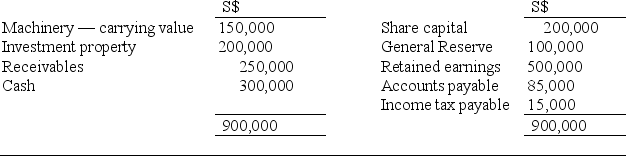
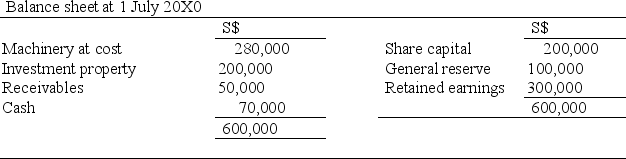 The balance sheet of Sing Sing as at is as follows:
Balance sheet as at 30 June 20X1
 Relevant exchange rates are as follows:
 If the local currency of Sing Sing is Singapore dollars and the functional currency is Australian dollars the total assets of S$900,000 would translate into Australian dollars as:
The balance sheet of Sing Sing as at is as follows:
Balance sheet as at 30 June 20X1
Relevant exchange rates are as follows:
If the local currency of Sing Sing is Singapore dollars and the functional currency is Australian dollars the total assets of S$900,000 would translate into Australian dollars as:Free
(Multiple Choice)
4.9/5 (66)
(66) Correct Answer:Verified
VerifiedB
Monetary items are best described as:
Free
(Multiple Choice)
4.9/5 (84)
(84) Correct Answer:Verified
VerifiedB
Differences arise in relation to the treatment of which of the following when translating from the local to functional currency as opposed to the functional to presentation currency?
(Multiple Choice)
4.9/5 (71)
(71) According to AASB 121 The Effects of Changes in Foreign Exchange Rates, the following statement, 'the currency that affects the economic wealth of the entity', provides a definition of:
(Multiple Choice)
4.7/5 (75)
(75) When translating into the functional currency foreign currency denominated non-monetary items measured using historical cost must be translated using the:
(Multiple Choice)
4.8/5 (86)
(86) When translating into the presentation currency the translation difference is recognised:
(Multiple Choice)
4.9/5 (76)
(76) When translating into the functional currency monetary liabilities are translated using the:
(Multiple Choice)
4.8/5 (81)
(81) Aussie Ltd has an investment in Yankee Inc. The shares in Yankee were acquired on 15 August 20X4. Yankee uses the revaluation model to account for land & buildings. A building which was acquired by Yankee on 1 April 20X2 was revalued on 15 March 20X9. The exchange rate used to translate the building into the presentation currency at 30 June 20X9 is the rate that applied on:
(Multiple Choice)
4.8/5 (77)
(77) The general rule for translating liabilities denominated in a foreign currency into the functional currency is to:
(Multiple Choice)
4.9/5 (77)
(77) Post acquisition date retained earnings that are denominated in a foreign currency are:
(Multiple Choice)
5.0/5 (88)
(88) If foreign currency denominated non-monetary items are measured using the fair value method, they must be translated into the functional currency using the:
(Multiple Choice)
4.8/5 (85)
(85) Indicators pointing towards the local overseas currency as the functional currency include, that the:
I - Parent's cash flows are directly affected on a current basis.
II - Cash flows are primarily in the local currency and do not affect the parent's cash flows.
III - Sales prices are primarily responsive to exchange rate changes in the short-term.
IV - Production costs are determined primarily by local conditions.
(Multiple Choice)
4.8/5 (74)
(74) When translating the revenue and expenses in the statement of profit or loss and other comprehensive income, theoretically each item of revenue and expense should be translated using the spot exchange rate between the:
(Multiple Choice)
4.9/5 (80)
(80) Aussie Ltd acquired 100% of Sing Sing Ltd (Sing Sing) on 1 July 20X0. The balance sheet of Sing Sing on that date was as follows:
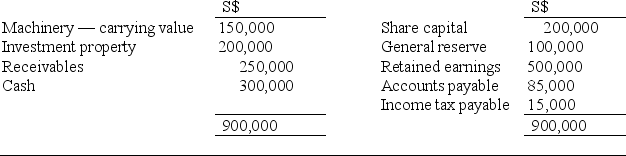
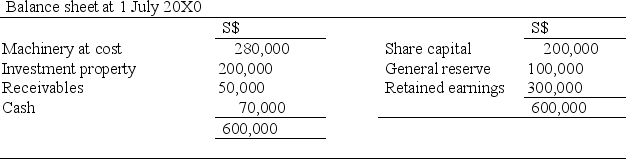 The balance sheet of Sing Sing as at is as follows:
Balance sheet as at 30 June 20X1
 Relevant exchange rates are as follows:
 If the functional currency of Sing Sing is Singapore dollars and the presentation currency is Australian dollars the total assets of S$900 000 would translate into Australian dollars as:
The balance sheet of Sing Sing as at is as follows:
Balance sheet as at 30 June 20X1
Relevant exchange rates are as follows:
If the functional currency of Sing Sing is Singapore dollars and the presentation currency is Australian dollars the total assets of S$900 000 would translate into Australian dollars as: (Multiple Choice)
4.9/5 (85)
(85) According to AASB 121 The Effects of Changes in Foreign Exchange Rates, the currency in which an entity primarily generates and expends cash is considered to be the:
(Multiple Choice)
4.9/5 (75)
(75) When translating foreign currency denominated financial statements into the functional currency, the exchange differences are recognised:
(Multiple Choice)
4.9/5 (88)
(88) Under AASB 121 The Effects of Changes in Foreign Exchange Rates, an entity must disclose which of the following items in particular?
I - The amount of exchange differences included in profit or loss of the period.
II - The amount of the exchange difference included directly in share capital during the period.
III - Whether a change in the functional currency has occurred.
IV - The reason for using a presentation currency that is different from the functional currency.
(Multiple Choice)
4.8/5 (69)
(69) 
Filters
- Essay(0)
- Multiple Choice(0)
- Short Answer(0)
- True False(0)
- Matching(0)