



 Chat with AI
Exam 17: Lipids

Exam 1: Chemistry in Our Lives51 Questions
Exam 2: Chemistry and Measurements90 Questions
Exam 3: Energy and Matter87 Questions
Exam 4: Atoms100 Questions
Exam 5: Nuclear Chemistry79 Questions
Exam 6: Ionic and Molecular Compounds98 Questions
Exam 7: Chemical Reactions and Quantities114 Questions
Exam 8: Gases96 Questions
Exam 9: Solutions87 Questions
Exam 10: Reaction Rates and Chemical Equilibrium67 Questions
Exam 11: Acids and Bases92 Questions
Exam 12: Introduction to Organic Chemistry: Hydrocarbons140 Questions
Exam 13: Alcohols, Phenols, Thiols, and Ethers66 Questions
Exam 14: Aldehydes, Ketones, and Chiral Molecules85 Questions
Exam 15: Carbohydrates75 Questions
Exam 16: Carboxylic Acids and Esters83 Questions
Exam 17: Lipids85 Questions
Exam 18: Amines and Amides91 Questions
Exam 19: Amino Acids and Proteins84 Questions
Exam 20: Enzymes and Vitamins87 Questions
Exam 21: Nucleic Acids and Protein Synthesis80 Questions
Exam 22: Metabolic Pathways for Carbohydrates80 Questions
Exam 23: Metabolism and Energy Production81 Questions
Exam 24: Metabolic Pathways for Lipids and Amino Acids73 Questions
Select questions type


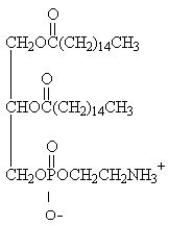
For the question(s) that follow, identify the class of lipid to which each of the following molecules belongs.
-
(Multiple Choice)
4.9/5  (66)
(66) In the fluid-mosaic model of cell membranes, the lipid molecules are oriented with their heads to the outside of the membrane.
(True/False)
4.8/5 (79)
(79) Which of the following is NOT a lipoprotein that carries nonpolar lipids through the bloodstream?
(Multiple Choice)
4.8/5 (75)
(75) In this diagram of a cell membrane, the object labeled (B) is a
(Multiple Choice)
4.9/5 (79)
(79) One function of phospholipids is to provide structure to biomembranes.
(True/False)
4.8/5 (81)
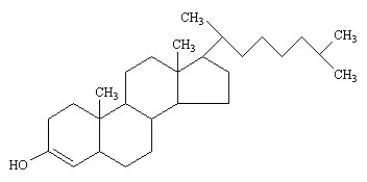
(81) For the question(s) that follow, identify the class of lipid to which each of the following molecules belongs.
-
(Multiple Choice)
4.9/5 (74)
(74) The saponification of a fat gives fatty acid salts and glycerol.
(True/False)
4.9/5 (85)
(85) In this diagram of a cell membrane, the small branched object labeled (A) is part of a
(Multiple Choice)
4.7/5 (72)
(72) A triacylglycerol that is solid at room temperature is called a(n)
(Multiple Choice)
4.8/5 (79)
(79) Compared to saturated fatty acids, unsaturated fatty acids have
(Multiple Choice)
4.7/5 (66)
(66) 
Filters
- Essay(0)
- Multiple Choice(0)
- Short Answer(0)
- True False(0)
- Matching(0)