



 Chat with AI
Exam 19: Amino Acids and Proteins

Exam 1: Chemistry in Our Lives51 Questions
Exam 2: Chemistry and Measurements90 Questions
Exam 3: Energy and Matter87 Questions
Exam 4: Atoms100 Questions
Exam 5: Nuclear Chemistry79 Questions
Exam 6: Ionic and Molecular Compounds98 Questions
Exam 7: Chemical Reactions and Quantities114 Questions
Exam 8: Gases96 Questions
Exam 9: Solutions87 Questions
Exam 10: Reaction Rates and Chemical Equilibrium67 Questions
Exam 11: Acids and Bases92 Questions
Exam 12: Introduction to Organic Chemistry: Hydrocarbons140 Questions
Exam 13: Alcohols, Phenols, Thiols, and Ethers66 Questions
Exam 14: Aldehydes, Ketones, and Chiral Molecules85 Questions
Exam 15: Carbohydrates75 Questions
Exam 16: Carboxylic Acids and Esters83 Questions
Exam 17: Lipids85 Questions
Exam 18: Amines and Amides91 Questions
Exam 19: Amino Acids and Proteins84 Questions
Exam 20: Enzymes and Vitamins87 Questions
Exam 21: Nucleic Acids and Protein Synthesis80 Questions
Exam 22: Metabolic Pathways for Carbohydrates80 Questions
Exam 23: Metabolism and Energy Production81 Questions
Exam 24: Metabolic Pathways for Lipids and Amino Acids73 Questions
Select questions type


Which of the following would be most likely to be deficient in at least one essential amino acid?
(Multiple Choice)
4.9/5  (81)
(81) Which R group would most likely be found in a hydrophobic area of the tertiary structure of a globular protein?
(Multiple Choice)
4.7/5 (71)
(71) The peptide bonds that combine amino acids in a protein are
(Multiple Choice)
4.8/5 (77)
(77) Immunoglobulin, a protein that stimulates immune responses, would be classified as a ________ protein.
(Multiple Choice)
4.8/5 (71)
(71) In insulin, two peptide chains are held together in a single unit by
(Multiple Choice)
4.9/5 (81)
(81) Sickle-cell anemia is caused by a change in the primary structure of a subunit of the hemoglobin protein.
(True/False)
4.8/5 (79)
(79) Upon hydrolysis the dipeptide abbreviated as Gly-Lys will yield the same products as the dipeptide abbreviated as Lys-Gly.
(True/False)
4.8/5 (85)
(85) Consider the R groups of the following amino acids: cysteine: -CH2SH; alanine: -CH₃ ; serine: -CH2OH The name for the dipeptide shown below is ________.
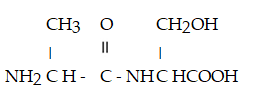
(Multiple Choice)
5.0/5 (70)
(70) What amino acids have polar R groups that are attracted to water?
(Multiple Choice)
4.8/5 (79)
(79) 
Filters
- Essay(0)
- Multiple Choice(0)
- Short Answer(0)
- True False(0)
- Matching(0)