



 Chat with AI
Exam 10: Monopoly and Antitrust Policy

Exam 1: Economics: Foundations and Models145 Questions
Exam 2: Trade-Offs, comparative Advantage, and the Market System151 Questions
Exam 3: Where Prices Come From: the Interaction of Demand and Supply149 Questions
Exam 4: Market Efficiency and Market Failure171 Questions
Exam 5: The Economics of Health Care117 Questions
Exam 6: Firms, the Stock Market, and Corporate Governance126 Questions
Exam 7: Consumer Choice and Elasticity193 Questions
Exam 8: Technology,production,and Costs147 Questions
Exam 9: Firms in Perfectly Competitive Markets153 Questions
Exam 10: Monopoly and Antitrust Policy148 Questions
Exam 11: Monopolistic Competition and Oligopoly200 Questions
Exam 12: GDP: Measuring Total Production and Income135 Questions
Exam 13: Unemployment and Inflation148 Questions
Exam 14: Economic Growth, the Financial System, and Business Cycles130 Questions
Exam 15: Aggregate Demand and Aggregate Supply Analysis145 Questions
Exam 16: Money, banks, and the Federal Reserve System144 Questions
Exam 17: Monetary Policy145 Questions
Exam 18: Fiscal Policy143 Questions
Exam 19: Comparative Advantage,international Trade,and Exchange Rates158 Questions
Select questions type


Figure 10-7 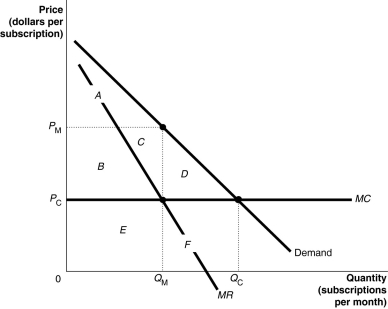 In 2011,Verizon was granted permission to enter the market for cable TV in Upstate New York,ending the virtual monopoly that Time Warner Cable had in most local communities in the region.Figure 10-7 shows the cable television market in Upstate New York.
-Refer to Figure 10-7.Suppose the local government imposes a $2.50 per month tax on cable companies.What happens to the price charged by the cable company following the imposition of this tax?
In 2011,Verizon was granted permission to enter the market for cable TV in Upstate New York,ending the virtual monopoly that Time Warner Cable had in most local communities in the region.Figure 10-7 shows the cable television market in Upstate New York.
-Refer to Figure 10-7.Suppose the local government imposes a $2.50 per month tax on cable companies.What happens to the price charged by the cable company following the imposition of this tax? (Multiple Choice)
4.8/5  (78)
(78) A merger between the Ford Motor Company and General Motors would be an example of a
(Multiple Choice)
4.8/5 (95)
(95) If we use a narrow definition of monopoly,then a monopoly is defined as a firm
(Multiple Choice)
4.8/5 (84)
(84) Figure 10-6  -Refer to Figure 10-6.The deadweight loss due to a monopoly is represented by the area
 (Multiple Choice)
4.9/5 (74)
(74) Figure 10-8 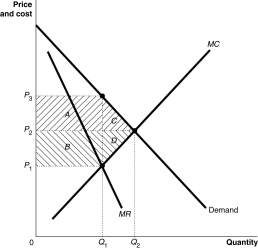 -Refer to Figure 10-8.From the monopoly graph above,identify the following:
a.The profit maximizing price
b.The profit maximizing quantity
c.The area representing deadweight loss
d.The area representing the transfer of consumer surplus to the monopoly
-Refer to Figure 10-8.From the monopoly graph above,identify the following:
a.The profit maximizing price
b.The profit maximizing quantity
c.The area representing deadweight loss
d.The area representing the transfer of consumer surplus to the monopoly (Essay)
4.9/5 (79)
(79) Because a monopoly's demand curve is the same as the market demand curve for its product,
(Multiple Choice)
4.8/5 (87)
(87) Figure 10-2  Figure 10-2 above shows the demand and cost curves facing a monopolist.
-Refer to Figure 10-2.Suppose the monopolist represented in the diagram above produces positive output.What is the profit/loss per unit?
Figure 10-2 above shows the demand and cost curves facing a monopolist.
-Refer to Figure 10-2.Suppose the monopolist represented in the diagram above produces positive output.What is the profit/loss per unit? (Multiple Choice)
5.0/5 (72)
(72) If a theatre company expects $250,000 in ticket revenue from five performances and $288,000 in ticket revenue if it adds a sixth performance,the
(Multiple Choice)
4.8/5 (72)
(72) What is a monopoly? Can a firm be a monopoly if close substitutes for its product exists?
(Essay)
4.7/5 (89)
(89) The De Beers Company,one of the longest-lived monopolies,is facing increasing competition.One source of competition comes from people who might resell their previously owned diamonds.Why is De Beers worried that people might resell their previously owned diamonds?
(Multiple Choice)
4.9/5 (73)
(73) If a firm's average total cost is less than price where MR=MC,
(Multiple Choice)
4.7/5 (80)
(80) If a natural monopoly regulatory commission sets a price where marginal cost is equal to demand
(Multiple Choice)
4.8/5 (83)
(83) A monopoly is defined as a firm that has the largest market share in an industry.
(True/False)
4.9/5 (84)
(84) The standards used by the Department of Justice and the FTC to evaluate a potential merger are based on market concentration as determined by the
(Multiple Choice)
4.9/5 (81)
(81) Figure 10-4 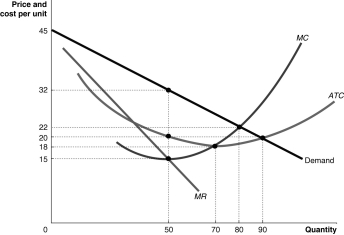 -Refer to Figure 10-4.Use the figure above to answer the following questions.
a.What is the profit-maximizing quantity and what price will the monopolist charge?
b.What is the total revenue at the profit-maximizing output level?
c.What is the total cost at the profit-maximizing output level?
d.What is the profit?
e.What is the profit per unit (average profit)at the profit-maximizing output level?
f.If this industry was organized as a perfectly competitive industry,what would be the profit-maximizing price and quantity?
-Refer to Figure 10-4.Use the figure above to answer the following questions.
a.What is the profit-maximizing quantity and what price will the monopolist charge?
b.What is the total revenue at the profit-maximizing output level?
c.What is the total cost at the profit-maximizing output level?
d.What is the profit?
e.What is the profit per unit (average profit)at the profit-maximizing output level?
f.If this industry was organized as a perfectly competitive industry,what would be the profit-maximizing price and quantity? (Essay)
4.8/5 (85)
(85) Figure 10-5  Figure 10-5 shows the demand and cost curves for a monopolist.
-Refer to Figure 10-5.At the profit-maximizing quantity,what is the difference between the monopoly's price and the marginal cost of production?
Figure 10-5 shows the demand and cost curves for a monopolist.
-Refer to Figure 10-5.At the profit-maximizing quantity,what is the difference between the monopoly's price and the marginal cost of production? (Multiple Choice)
4.8/5 (82)
(82) 
Filters
- Essay(0)
- Multiple Choice(0)
- Short Answer(0)
- True False(0)
- Matching(0)