



 Chat with AI
Exam 8: Technology,production,and Costs

Exam 1: Economics: Foundations and Models145 Questions
Exam 2: Trade-Offs, comparative Advantage, and the Market System151 Questions
Exam 3: Where Prices Come From: the Interaction of Demand and Supply149 Questions
Exam 4: Market Efficiency and Market Failure171 Questions
Exam 5: The Economics of Health Care117 Questions
Exam 6: Firms, the Stock Market, and Corporate Governance126 Questions
Exam 7: Consumer Choice and Elasticity193 Questions
Exam 8: Technology,production,and Costs147 Questions
Exam 9: Firms in Perfectly Competitive Markets153 Questions
Exam 10: Monopoly and Antitrust Policy148 Questions
Exam 11: Monopolistic Competition and Oligopoly200 Questions
Exam 12: GDP: Measuring Total Production and Income135 Questions
Exam 13: Unemployment and Inflation148 Questions
Exam 14: Economic Growth, the Financial System, and Business Cycles130 Questions
Exam 15: Aggregate Demand and Aggregate Supply Analysis145 Questions
Exam 16: Money, banks, and the Federal Reserve System144 Questions
Exam 17: Monetary Policy145 Questions
Exam 18: Fiscal Policy143 Questions
Exam 19: Comparative Advantage,international Trade,and Exchange Rates158 Questions
Select questions type


Over the past twenty years,the number of small family farms has fallen significantly and in their place there are fewer,but larger,farms owned by corporations.Which of the following best explains this trend?

Free
(Multiple Choice)
4.8/5  (82)
(82) Correct Answer: Verified
B
If 11 workers can produce a total of 54 units of a product and a 12th worker has a marginal product of 6 units,then the average product of 12 workers is
Free
(Multiple Choice)
4.7/5 (70)
(70) Correct Answer:Verified
VerifiedD
Figure 8-1 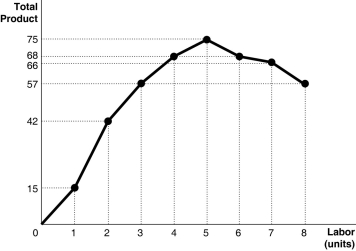 -Refer to Figure 8-1.The marginal product of the 7th worker is
Free
(Multiple Choice)
4.9/5 (75)
(75) Correct Answer:Verified
VerifiedD
Which of the following is not a source of technological advancement for a producer?
(Multiple Choice)
4.9/5 (77)
(77) Consider a manufacturing operation that uses specialized machinery and labor to produce its output.In this case,the input that is not fixed in the short run is labor.
(True/False)
4.9/5 (83)
(83) Economies of scale exist as a firm increases its size in the long run because of all of the following except
(Multiple Choice)
4.8/5 (82)
(82) 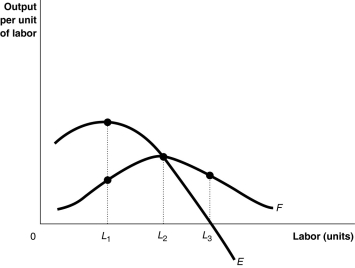 -Refer to Figure 8-2.The curve labeled "F" is
What is the difference between total cost and variable cost in the long run?
(Essay)
4.9/5 (80)
(80) Which of the following are implicit costs for a typical firm?
(Multiple Choice)
4.8/5 (63)
(63) Suppose the total cost of producing 40,000 flash drives is $120,000,and the fixed cost is $30,000.
a.What is the variable cost?
b.When output is 40,000,what are the average variable cost and the average fixed cost?
c.Assuming the cost curves have the usual shape,is the dollar difference between the average total cost and the average variable cost greater when the output is 40,000 flash drives or when the output is 60,000 flash drives? Explain.
(Essay)
4.8/5 (72)
(72) Table 8-3
 Table 8-3 shows cost data for Lotus Lanterns,a producer of whimsical night lights.
-Refer to Table 8-3.What is the average total cost of production when the firm produces 120 lanterns?
Table 8-3 shows cost data for Lotus Lanterns,a producer of whimsical night lights.
-Refer to Table 8-3.What is the average total cost of production when the firm produces 120 lanterns? (Multiple Choice)
4.9/5 (70)
(70) If a firm experiences positive technological change,it is able to produce more output using the same inputs.
(True/False)
5.0/5 (67)
(67) If the firm is producing no output in the short run,then its total costs are zero.
(True/False)
4.9/5 (84)
(84) Adam spent $10,000 on new equipment for his small business,"Adam's Fitness Studio." Membership at his fitness center is very low and at this rate,Adam needs an additional $12,000 per year to keep his studio open.Which of the following is true?
(Multiple Choice)
4.9/5 (88)
(88) 
Filters
- Essay(0)
- Multiple Choice(0)
- Short Answer(0)
- True False(0)
- Matching(0)