



 Chat with AI
Exam 17: Monetary Policy

Exam 1: Economics: Foundations and Models145 Questions
Exam 2: Trade-Offs, comparative Advantage, and the Market System151 Questions
Exam 3: Where Prices Come From: the Interaction of Demand and Supply149 Questions
Exam 4: Market Efficiency and Market Failure171 Questions
Exam 5: The Economics of Health Care117 Questions
Exam 6: Firms, the Stock Market, and Corporate Governance126 Questions
Exam 7: Consumer Choice and Elasticity193 Questions
Exam 8: Technology,production,and Costs147 Questions
Exam 9: Firms in Perfectly Competitive Markets153 Questions
Exam 10: Monopoly and Antitrust Policy148 Questions
Exam 11: Monopolistic Competition and Oligopoly200 Questions
Exam 12: GDP: Measuring Total Production and Income135 Questions
Exam 13: Unemployment and Inflation148 Questions
Exam 14: Economic Growth, the Financial System, and Business Cycles130 Questions
Exam 15: Aggregate Demand and Aggregate Supply Analysis145 Questions
Exam 16: Money, banks, and the Federal Reserve System144 Questions
Exam 17: Monetary Policy145 Questions
Exam 18: Fiscal Policy143 Questions
Exam 19: Comparative Advantage,international Trade,and Exchange Rates158 Questions
Select questions type


Your roommate is having trouble grasping how monetary policy works.Which of the following explanations could you use to correctly describe the mechanism by which the Fed can affect the economy through monetary policy? Increasing the money supply

Free
(Multiple Choice)
4.8/5  (85)
(85) Correct Answer: Verified
A
The top policy goal for Paul Volcker when he became chairman of the Federal Reserve's Board of Governors in 1979 was
Free
(Multiple Choice)
4.8/5 (76)
(76) Correct Answer:Verified
VerifiedA
Figure 17-5 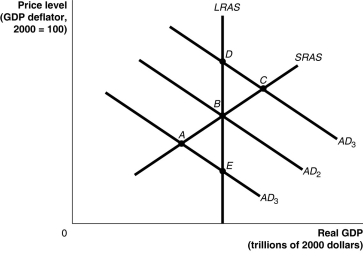 -Refer to Figure 17-5.Suppose the Fed sells Treasury Bills in pursuit of contractionary monetary policy.Using the static AD-AS model in the figure above,this situation would be depicted as a movement from
Free
(Multiple Choice)
4.9/5 (87)
(87) Correct Answer:Verified
VerifiedC
Using the Taylor rule,if the current inflation rate exceeds the target inflation rate and real GDP exceeds potential GDP,then the federal funds target rate ________ the sum of the current inflation rate plus the real equilibrium federal funds rate.
(Multiple Choice)
4.9/5 (84)
(84) Which of the following will lead to a decrease in the equilibrium interest rate in the economy?
(Multiple Choice)
5.0/5 (83)
(83) If the Federal Reserve targets the interest rate and the money demand curve shifts to the left,then the Fed
(Multiple Choice)
4.8/5 (77)
(77) One of the monetary policy goals of the Federal Reserve is price stability.
(True/False)
4.9/5 (81)
(81) Figure 17-6 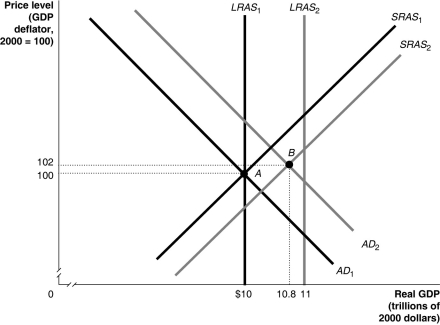 -Refer to Figure 17-6.In the dynamic model of AD-AS in the figure above,if the economy is at point A in year 1 and is expected to go to point B in year 2,and the Federal Reserve pursues no policy,then at point B
 (Multiple Choice)
4.7/5 (80)
(80) Suppose that households became mistrustful of the banking system and decide to decrease their checking accounts and increase their holdings of currency.Using the money demand and money supply model and assuming everything else is held constant,the equilibrium interest rate should
(Multiple Choice)
4.7/5 (77)
(77) From an initial long-run macroeconomic equilibrium,if the Federal Reserve anticipated that next year aggregate demand would grow significantly faster than long-run aggregate supply,then the Federal Reserve would most likely
(Multiple Choice)
4.9/5 (71)
(71) The Fed has adopted an interest rate target for most of the time since World War II.
(True/False)
5.0/5 (79)
(79) When calculating GDP,the Bureau of Economic Analysis revises its quarterly data
(Multiple Choice)
4.8/5 (79)
(79) For purposes of monetary policy,the Federal Reserve has targeted the interest rate known as the
(Multiple Choice)
4.8/5 (78)
(78) Which of the following explains why mortgages weren't considered securities prior to 1970?
(Multiple Choice)
4.8/5 (74)
(74) In the Taylor rule,does the target for the federal funds rate respond differently for a recession caused by a decrease in aggregate demand and for a recession caused by a decrease in short-run aggregate supply? Explain whether there is or is not a difference in how the target for the federal funds rate changes.
(Essay)
4.7/5 (73)
(73) Contractionary monetary policy on the part of the Fed results in
(Multiple Choice)
4.7/5 (95)
(95) Figure 17-7  -Refer to Figure 17-7.In the dynamic AD-AS model,if the economy is at point A in year 1 and is expected to go to point B in year 2,and the Federal Reserve pursues no policy,then at point B
 (Multiple Choice)
4.8/5 (82)
(82) The goals of monetary policy tend to be interrelated.For example,when the Fed pursues the goal of ________,it also can achieve the goal of ________ simultaneously.
(Multiple Choice)
4.9/5 (72)
(72) The Federal Reserve's performance in the mid-to-late 1980s,1990s,and early 2000s has received high marks from economists,even without inflation targeting.
(True/False)
5.0/5 (87)
(87) The Fed uses a "core" price index,one that excludes food and energy prices to measure inflation.It does so because
(Multiple Choice)
4.8/5 (71)
(71) 
Filters
- Essay(0)
- Multiple Choice(0)
- Short Answer(0)
- True False(0)
- Matching(0)