



 Chat with AI
Exam 17: Monetary Policy

Exam 1: Economics: Foundations and Models145 Questions
Exam 2: Trade-Offs, comparative Advantage, and the Market System151 Questions
Exam 3: Where Prices Come From: the Interaction of Demand and Supply149 Questions
Exam 4: Market Efficiency and Market Failure171 Questions
Exam 5: The Economics of Health Care117 Questions
Exam 6: Firms, the Stock Market, and Corporate Governance126 Questions
Exam 7: Consumer Choice and Elasticity193 Questions
Exam 8: Technology,production,and Costs147 Questions
Exam 9: Firms in Perfectly Competitive Markets153 Questions
Exam 10: Monopoly and Antitrust Policy148 Questions
Exam 11: Monopolistic Competition and Oligopoly200 Questions
Exam 12: GDP: Measuring Total Production and Income135 Questions
Exam 13: Unemployment and Inflation148 Questions
Exam 14: Economic Growth, the Financial System, and Business Cycles130 Questions
Exam 15: Aggregate Demand and Aggregate Supply Analysis145 Questions
Exam 16: Money, banks, and the Federal Reserve System144 Questions
Exam 17: Monetary Policy145 Questions
Exam 18: Fiscal Policy143 Questions
Exam 19: Comparative Advantage,international Trade,and Exchange Rates158 Questions
Select questions type


The situation in which short-term interest rates are pushed to zero,leaving the central bank unable to lower them further is known as
(Multiple Choice)
4.8/5  (64)
(64) Use the money demand and money supply model to show the money market in equilibrium with an interest rate of 5 percent and the quantity of money of $800 billion.Suppose the Federal Reserve increases the money supply to $850 billion.At the previous equilibrium interest rate of 5 percent,will households and firms now be holding more money or less money than they want to hold,and will they be buying or selling short-term financial assets? At the new equilibrium interest rate,households and firms will desire to hold the entire $850 billion of the money supply.What causes households and firms to want to hold the additional $50 billion of the money supply?
(Essay)
4.8/5 (90)
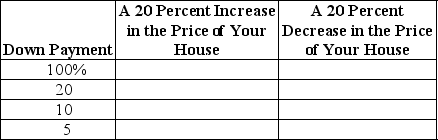
(90) In the following table,fill in the columns for your return on investment if the price of your house increased or decreased by 20 percent,based on the down payments specified in the first column.
Return on Your Investment From…
(Essay)
4.7/5 (89)
(89) While many analysts defended the actions taken by the Fed and the Treasury to respond to the financial crisis in 2008,others were critical of these actions.The critics were concerned that by not allowing large firms to fail,
(Multiple Choice)
4.8/5 (83)
(83) When the Federal Reserve increases the money supply,people spend more because interest rates fall.
(True/False)
4.9/5 (69)
(69) Mortgage lenders often resell mortgages in secondary markets.How might this make lenders act differently than if they intended to hold the mortgages themselves?
(Essay)
4.8/5 (83)
(83) In October 2008,Congress passed the ________,under which the Treasury provided funds to banks in exchange for stock.
(Multiple Choice)
4.8/5 (62)
(62) Which of the following is true about the Federal Reserve and its ability to prevent recessions? The Federal Reserve
(Multiple Choice)
4.9/5 (87)
(87) Figure 17-5  -Refer to Figure 17-5.Suppose the economy is in short-run equilibrium above potential GDP,the unemployment rate is very low,and wages and prices are rising.Using the static AD-AS model in the figure above,the correct Fed policy for this situation would be depicted as a movement from
 (Multiple Choice)
4.8/5 (74)
(74) A monetary policy target is a variable that the Fed can affect directly,which then affects one or more of the Fed's policy goals.
(True/False)
4.8/5 (72)
(72) By the height of the housing bubble in 2005 and early 2006,lenders had greatly loosened the standards for obtaining a mortgage loan,with many mortgages being granted to ________ borrowers with flawed credit histories and ________ borrowers who did not document their incomes.
(Multiple Choice)
4.8/5 (75)
(75) Expansionary monetary policy to prevent real GDP from falling below potential real GDP would cause the inflation rate to be relatively ________ and real GDP to be relatively ________.
(Multiple Choice)
4.8/5 (84)
(84) In September 2011,the Fed announced a new policy in which it would invest in additional mortgage-backed securities in an attempt to further reduce mortgage rates and boost the housing market.Lower mortgage rates should lead to an increase in refinancing,which should ________ disposable income and therefore ________ aggregate demand.
(Multiple Choice)
4.8/5 (81)
(81) Use the money demand and money supply model to show graphically and briefly explain the effect on the interest rate if real GDP increases.
(Essay)
4.9/5 (96)
(96) The economy suffered a mild recession in 2001.Despite the recession,home sales and durable goods sales remained high.Which of the following is a plausible explanation?
(Multiple Choice)
5.0/5 (100)
(100) Use the dynamic aggregate demand and aggregate supply model and start with Year 1 in long-run macroeconomic equilibrium.For Year 2,graph aggregate demand,long-run aggregate supply,and short-run aggregate supply such that the condition of the economy will induce the Federal Reserve to conduct a contractionary monetary policy.Briefly explain the condition of the economy and what the Federal Reserve is attempting to do.
(Essay)
4.9/5 (85)
(85) The interest rate that banks charge other banks for overnight loans is the
(Multiple Choice)
4.7/5 (83)
(83) Which of the following describes what the Fed would do to pursue an expansionary monetary policy?
(Multiple Choice)
4.8/5 (87)
(87) 
Filters
- Essay(0)
- Multiple Choice(0)
- Short Answer(0)
- True False(0)
- Matching(0)