



 Chat with AI
Exam 17: Monetary Policy

Exam 1: Economics: Foundations and Models145 Questions
Exam 2: Trade-Offs, comparative Advantage, and the Market System151 Questions
Exam 3: Where Prices Come From: the Interaction of Demand and Supply149 Questions
Exam 4: Market Efficiency and Market Failure171 Questions
Exam 5: The Economics of Health Care117 Questions
Exam 6: Firms, the Stock Market, and Corporate Governance126 Questions
Exam 7: Consumer Choice and Elasticity193 Questions
Exam 8: Technology,production,and Costs147 Questions
Exam 9: Firms in Perfectly Competitive Markets153 Questions
Exam 10: Monopoly and Antitrust Policy148 Questions
Exam 11: Monopolistic Competition and Oligopoly200 Questions
Exam 12: GDP: Measuring Total Production and Income135 Questions
Exam 13: Unemployment and Inflation148 Questions
Exam 14: Economic Growth, the Financial System, and Business Cycles130 Questions
Exam 15: Aggregate Demand and Aggregate Supply Analysis145 Questions
Exam 16: Money, banks, and the Federal Reserve System144 Questions
Exam 17: Monetary Policy145 Questions
Exam 18: Fiscal Policy143 Questions
Exam 19: Comparative Advantage,international Trade,and Exchange Rates158 Questions
Select questions type


The dynamic aggregate demand and aggregate supply model accounts for the price level rising every year.
(True/False)
4.8/5  (75)
(75) Expansionary monetary policy refers to the Fed's increasing the money supply and increasing interest rates to increase real GDP.
(True/False)
4.8/5 (68)
(68) Since World War II,the Federal Reserve has not been involved in carrying out monetary policy.
(True/False)
5.0/5 (73)
(73) Monetary policy could be procyclical if the Federal Reserve
(Multiple Choice)
4.8/5 (76)
(76) To reassure investors who were unwilling to buy mortgages in the secondary market,the U.S.Congress used two government sponsored enterprises,Fannie Mae and Freddie Mac,to stand between investors and banks that grant mortgages.Fannie Mae and Freddie Mac
(Multiple Choice)
4.8/5 (82)
(82) Using the money demand and money supply model,show and explain why the Federal Reserve cannot achieve a target for both the money supply and an interest rate.
(Essay)
4.9/5 (89)
(89) The Federal Reserve cut the federal funds rate seven times between September 2007 and March 2008.What event led the Fed to make these reductions in the federal funds rate?
(Multiple Choice)
4.7/5 (74)
(74) Under the monetary growth rule proposed by the monetarists,the money supply would grow each year at a constant rate equal to the long-run rate of growth of
(Multiple Choice)
4.9/5 (89)
(89) Suppose the equilibrium real federal funds rate is 2 percent,the target rate of inflation is 2 percent,the current inflation rate is 4 percent,and real GDP is 2 percent above potential real GDP.If the weights for the inflation gap and the output gap are both 1/2,then according to the Taylor rule the federal funds target rate equals
(Multiple Choice)
5.0/5 (97)
(97) In reality,the Fed is unable to use monetary policy to keep real GDP exactly at its potential level.
(True/False)
4.8/5 (80)
(80) Suppose that the Federal Reserve Open Market Committee adheres to the ideas expressed by ________.If the economy moves into a recession,the Fed would recommend that the federal funds target rate decrease as long as the inflation rate did not rise above the publicly announced goal for inflation.
(Multiple Choice)
4.8/5 (72)
(72) Figure 17-5 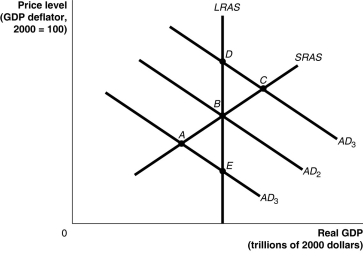 -Refer to Figure 17-5.Suppose the economy is in a recession and the Fed pursues an expansionary monetary policy.Using the static AD-AS model in the figure above,this would be depicted as a movement from
 (Multiple Choice)
4.8/5 (81)
(81) With the Troubled Asset Relief Program (TARP),the Treasury provided funds to banks in exchange for stock.
(True/False)
4.8/5 (81)
(81) When housing prices fell as they did beginning in 2006 following the housing market bubble,most banks and other lenders ________ the requirement for borrowers,making it ________ for potential home buyers to obtain mortgages.
(Multiple Choice)
4.7/5 (77)
(77) The Taylor rule links the Federal Reserve's target for the
(Multiple Choice)
4.8/5 (74)
(74) Monetarists think that the Fed should use ________ as a target when conducting monetary policy.
(Multiple Choice)
4.9/5 (64)
(64) Table 17-2
 -Refer to Table 17-2.The hypothetical information in the table shows what the values for real GDP and the price level will be in 2011 if the Federal Reserve does not use monetary policy:
a.If the Fed wants to keep real GDP at its potential level in 2011,should it use an expansionary policy or a contractionary policy? Should the trading desk buy T-bills or sell them?
b.Suppose the Fed's policy is successful in keeping real GDP at its potential level in 2011.State whether each of the following will be higher or lower than if the Fed had taken no action:
(i)Real GDP
(ii)Full-employment real GDP
(iii)The inflation rate
(iv)The unemployment rate
c.Draw an aggregate demand and aggregate supply graph to illustrate your answer.Be sure that your graph contains LRAS curves for 2010 and 2011;SRAS curves 2010 and 2011;AD curve for 2010 and 2011,with and without monetary policy actions;and equilibrium real GDP and the price level in 2011 with and without policy.
-Refer to Table 17-2.The hypothetical information in the table shows what the values for real GDP and the price level will be in 2011 if the Federal Reserve does not use monetary policy:
a.If the Fed wants to keep real GDP at its potential level in 2011,should it use an expansionary policy or a contractionary policy? Should the trading desk buy T-bills or sell them?
b.Suppose the Fed's policy is successful in keeping real GDP at its potential level in 2011.State whether each of the following will be higher or lower than if the Fed had taken no action:
(i)Real GDP
(ii)Full-employment real GDP
(iii)The inflation rate
(iv)The unemployment rate
c.Draw an aggregate demand and aggregate supply graph to illustrate your answer.Be sure that your graph contains LRAS curves for 2010 and 2011;SRAS curves 2010 and 2011;AD curve for 2010 and 2011,with and without monetary policy actions;and equilibrium real GDP and the price level in 2011 with and without policy. (Essay)
4.7/5 (76)
(76) Figure 17-7  -Refer to Figure 17-7.In the dynamic AD-AS model,the economy is at point A in year 1 and is expected to go to point B in year 2,and the Federal Reserve pursues policy.This will result in
 (Multiple Choice)
4.8/5 (80)
(80) 
Filters
- Essay(0)
- Multiple Choice(0)
- Short Answer(0)
- True False(0)
- Matching(0)