



 Chat with AI
Exam 10: Monopoly and Antitrust Policy

Exam 1: Economics: Foundations and Models145 Questions
Exam 2: Trade-Offs, comparative Advantage, and the Market System151 Questions
Exam 3: Where Prices Come From: the Interaction of Demand and Supply149 Questions
Exam 4: Market Efficiency and Market Failure171 Questions
Exam 5: The Economics of Health Care117 Questions
Exam 6: Firms, the Stock Market, and Corporate Governance126 Questions
Exam 7: Consumer Choice and Elasticity193 Questions
Exam 8: Technology,production,and Costs147 Questions
Exam 9: Firms in Perfectly Competitive Markets153 Questions
Exam 10: Monopoly and Antitrust Policy148 Questions
Exam 11: Monopolistic Competition and Oligopoly200 Questions
Exam 12: GDP: Measuring Total Production and Income135 Questions
Exam 13: Unemployment and Inflation148 Questions
Exam 14: Economic Growth, the Financial System, and Business Cycles130 Questions
Exam 15: Aggregate Demand and Aggregate Supply Analysis145 Questions
Exam 16: Money, banks, and the Federal Reserve System144 Questions
Exam 17: Monetary Policy145 Questions
Exam 18: Fiscal Policy143 Questions
Exam 19: Comparative Advantage,international Trade,and Exchange Rates158 Questions
Select questions type


Which of following is the best example of a monopoly if we use a broader definition of monopoly?
(Multiple Choice)
5.0/5  (81)
(81) Microsoft hires marketing and sales specialists to decide what prices it should set for its products,whereas a wealthy corn farmer in Iowa,who sells his output in the world commodity market,does not.Why is this so?
(Multiple Choice)
4.8/5 (90)
(90) A possible advantage of a horizontal merger for the economy is that
(Multiple Choice)
4.8/5 (82)
(82) The U.S.government would never approve a proposed merger between two firms that could significantly increase the newly merged firm's market power even if the efficiency gains from the newly merged firm could make consumers better off.
(True/False)
4.8/5 (75)
(75) Figure 10-1  Figure 10-1 above shows the demand and cost curves facing a monopolist.
-Refer to Figure 10-1.To maximize profit,the firm will produce
Figure 10-1 above shows the demand and cost curves facing a monopolist.
-Refer to Figure 10-1.To maximize profit,the firm will produce (Multiple Choice)
4.8/5 (73)
(73) Holding everything else constant,government approval of horizontal mergers is more likely to be granted if the "market" that firms are in are broadly defined rather than narrowly defined.
(True/False)
4.8/5 (91)
(91) Figure 10-3  Figure 10-3 shows the demand and cost curves for a monopolist.
-Refer to Figure 10-3.What is the price charged for the profit-maximizing output level?
Figure 10-3 shows the demand and cost curves for a monopolist.
-Refer to Figure 10-3.What is the price charged for the profit-maximizing output level? (Multiple Choice)
4.7/5 (75)
(75) Figure 10-7 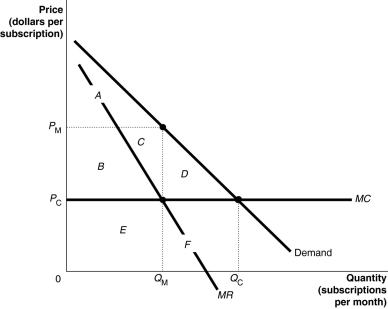 In 2011,Verizon was granted permission to enter the market for cable TV in Upstate New York,ending the virtual monopoly that Time Warner Cable had in most local communities in the region.Figure 10-7 shows the cable television market in Upstate New York.
-Refer to Figure 10-7.Following the entry of Verizon,the subscription price falls from PM to PC.What is the increase in consumer surplus as a result of this change?
In 2011,Verizon was granted permission to enter the market for cable TV in Upstate New York,ending the virtual monopoly that Time Warner Cable had in most local communities in the region.Figure 10-7 shows the cable television market in Upstate New York.
-Refer to Figure 10-7.Following the entry of Verizon,the subscription price falls from PM to PC.What is the increase in consumer surplus as a result of this change? (Multiple Choice)
5.0/5 (88)
(88) A local electricity-generating company has a monopoly that is protected by an entry barrier that takes the form of
(Multiple Choice)
4.8/5 (72)
(72) Figure 10-9  Figure 10-9 shows the cost and demand curves for the Erickson Power Company.
-Refer to Figure 10-9.Why won't regulators require that Erickson Power produce the economically efficient output level?
Figure 10-9 shows the cost and demand curves for the Erickson Power Company.
-Refer to Figure 10-9.Why won't regulators require that Erickson Power produce the economically efficient output level? (Multiple Choice)
4.8/5 (75)
(75) Figure 10-2  Figure 10-2 above shows the demand and cost curves facing a monopolist.
-Refer to Figure 10-2.What happens to the monopolist represented in the diagram in the long run?
Figure 10-2 above shows the demand and cost curves facing a monopolist.
-Refer to Figure 10-2.What happens to the monopolist represented in the diagram in the long run? (Multiple Choice)
4.8/5 (69)
(69) Table 10-2
 Shakti Inc.has been granted a patent for its Arnica toothache balm.Table 10-2 shows the demand and the total cost schedule for the firm.
-Refer to Table 10-2.What is the amount of Shakti's profit?
Shakti Inc.has been granted a patent for its Arnica toothache balm.Table 10-2 shows the demand and the total cost schedule for the firm.
-Refer to Table 10-2.What is the amount of Shakti's profit? (Multiple Choice)
4.7/5 (73)
(73) Figure 10-2 Figure 10-2 above shows the demand and cost curves facing a monopolist.
-Refer to Figure 10-2.Suppose the monopolist represented in the diagram above produces positive output.What is the price charged at the profit-maximizing/loss-minimizing output level?
Figure 10-2 above shows the demand and cost curves facing a monopolist.
-Refer to Figure 10-2.Suppose the monopolist represented in the diagram above produces positive output.What is the price charged at the profit-maximizing/loss-minimizing output level? (Multiple Choice)
4.9/5 (69)
(69) For which of the following firms is patent protection of vital importance?
(Multiple Choice)
4.9/5 (87)
(87) Suppose an industry is made up of 25 firms,all with equal market share.The four-firm concentration ratio of this industry is
(Multiple Choice)
4.9/5 (83)
(83) How do the price and quantity of a monopoly compare to that of a perfectly competitive industry?
(Essay)
5.0/5 (83)
(83) What is the relationship between marginal revenue and average revenue for a monopolist and is it the same for a perfect competitor?
(Essay)
4.9/5 (84)
(84) Firms do not have market power in which of the following market structures?
(Multiple Choice)
4.9/5 (91)
(91) 
Filters
- Essay(0)
- Multiple Choice(0)
- Short Answer(0)
- True False(0)
- Matching(0)