



 Chat with AI
Exam 4: Phylogeny and Evolutionary History

Exam 1: An Overview of Evolutionary Biology49 Questions
Exam 2: Early Evolutionary Ideas and Darwin S Insight49 Questions
Exam 3: Natural Selection47 Questions
Exam 4: Phylogeny and Evolutionary History47 Questions
Exam 5: Inferring Phylogeny46 Questions
Exam 6: Transmission Genetics and the Sources of Genetic Variation50 Questions
Exam 7: The Genetics of Populations46 Questions
Exam 8: Evolution in Finite Populations50 Questions
Exam 9: Evolution at Multiple Loci47 Questions
Exam 10: Genome Evolution49 Questions
Exam 11: The Origin and Evolution of Early Life50 Questions
Exam 12: Major Transitions47 Questions
Exam 13: Evolution and Development45 Questions
Exam 14: Species and Speciation48 Questions
Exam 15: Extinction and Evolutionary Trends49 Questions
Exam 16: The Evolution of Sex49 Questions
Exam 17: The Evolution of Sociality50 Questions
Exam 18: Coevolution50 Questions
Exam 19: Human Evolution49 Questions
Exam 20: Evolution and Medicine50 Questions
Select questions type


By mapping a given trait on a phylogenetic tree that we have already constructed using other data, we can
(Multiple Choice)
4.9/5  (78)
(78) Give an example of two groups of organisms that share a trait due to shared ancestry, and contrast this with an example of organisms that share a trait but not because of shared ancestry. What are each of these types of shared traits called? Explain the evolutionary processes that resulted in the similarities in each example.
(Essay)
4.9/5 (78)
(78) The unrooted phylogeny in the figure shows the relationships among proteobacteria. Which of the following would be true if the root were placed on the branch between nodes A and B? 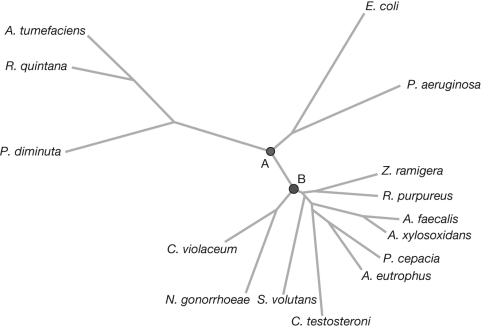
(Multiple Choice)
5.0/5 (79)
(79) Imagine that you are studying a coat color in mice, with two forms of a trait divergent evolution of coat color. Explain your answer.
(Essay)
4.9/5 (75)
(75) In the figure, what does the lower interior node in each figure represent? 
(Multiple Choice)
4.8/5 (70)
(70) 
Filters
- Essay(0)
- Multiple Choice(0)
- Short Answer(0)
- True False(0)
- Matching(0)