



 Chat with AI
Exam 10: Genome Evolution

Exam 1: An Overview of Evolutionary Biology49 Questions
Exam 2: Early Evolutionary Ideas and Darwin S Insight49 Questions
Exam 3: Natural Selection47 Questions
Exam 4: Phylogeny and Evolutionary History47 Questions
Exam 5: Inferring Phylogeny46 Questions
Exam 6: Transmission Genetics and the Sources of Genetic Variation50 Questions
Exam 7: The Genetics of Populations46 Questions
Exam 8: Evolution in Finite Populations50 Questions
Exam 9: Evolution at Multiple Loci47 Questions
Exam 10: Genome Evolution49 Questions
Exam 11: The Origin and Evolution of Early Life50 Questions
Exam 12: Major Transitions47 Questions
Exam 13: Evolution and Development45 Questions
Exam 14: Species and Speciation48 Questions
Exam 15: Extinction and Evolutionary Trends49 Questions
Exam 16: The Evolution of Sex49 Questions
Exam 17: The Evolution of Sociality50 Questions
Exam 18: Coevolution50 Questions
Exam 19: Human Evolution49 Questions
Exam 20: Evolution and Medicine50 Questions
Select questions type


Transposons can be deleterious to a host genome because they can

Free
(Multiple Choice)
4.9/5  (76)
(76) Correct Answer: Verified
D
When comparing recombination rates between a dog, with a genome size of 2,410 Mb, and a mustard weed, with a genome size of 100 Mb, which would you expect to have a larger recombination rate per kilobase? Explain your answer.
Free
(Essay)
4.9/5 (88)
(88) Correct Answer:Verified
VerifiedRecombination rate per kb is negatively correlated with genome size. Thus, one would expect the mustard weed to have a larger per-kilobase recombination rate than the dog, because its genome is smaller.
Which of the following statements is FALSE regarding viral genomes?
Free
(Multiple Choice)
4.8/5 (75)
(75) Correct Answer:Verified
VerifiedB
What are transcription factors and how do they address the G-value paradox?
(Essay)
4.8/5 (72)
(72) Certain single-celled amoeba have a genome that is 1,000 times the size of the genome of a complex multicellular puffer fish. This is an example of what phenomenon?
(Multiple Choice)
4.9/5 (73)
(73) What general patterns of recombination have been observed in eukaryotic genomes?
(Essay)
4.7/5 (68)
(68) What was the first eukaryotic organism to have its entire genome sequenced?
(Multiple Choice)
4.7/5 (67)
(67) Most prokaryotic genomes are structured as ________ chromosome(s).
(Multiple Choice)
5.0/5 (91)
(91) Which of the following makes up the smallest fraction of the human genome?
(Multiple Choice)
4.7/5 (68)
(68) Viral genomes exhibit extreme compression in size, and this is possible because multiple genes may be packed in the same region of the genome. Which of the following is NOT a way in which this can occur?
(Multiple Choice)
4.7/5 (79)
(79) What is the source of DNA acquired by a bacterial cell during conjugation?
(Multiple Choice)
4.8/5 (79)
(79) Which of the following tends to contribute to an overall increase in genome size over evolutionary time?
(Multiple Choice)
4.9/5 (62)
(62) A researcher collects a soil sample and sequences the entire genomes of two prokaryotes found in the sample. In these genomes, he finds identical prophage DNA located in different areas of the two genomes. Based on the similarity of the sequences of the prophages and their placement in the prokaryotes' genomes, what could he conclude about the relatedness of the two prokaryotes?
(Essay)
4.8/5 (74)
(74) A researcher discovers a new prokaryote whose genome is ~8 Mb in size. Based on the figure shown, what type of organism is this likely to be? 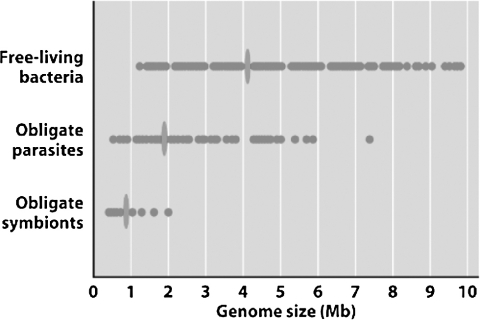
(Multiple Choice)
4.9/5 (68)
(68) For which of the following would a syntenic dot plot NOT be useful?
(Multiple Choice)
4.8/5 (70)
(70) When examining recombination rates across a chromosome, a researcher detects an area of high recombination rates. What could he or she infer based on this observation?
(Multiple Choice)
4.9/5 (71)
(71) 
Filters
- Essay(0)
- Multiple Choice(0)
- Short Answer(0)
- True False(0)
- Matching(0)