



 Chat with AI
Exam 11: The Origin and Evolution of Early Life

Exam 1: An Overview of Evolutionary Biology49 Questions
Exam 2: Early Evolutionary Ideas and Darwin S Insight49 Questions
Exam 3: Natural Selection47 Questions
Exam 4: Phylogeny and Evolutionary History47 Questions
Exam 5: Inferring Phylogeny46 Questions
Exam 6: Transmission Genetics and the Sources of Genetic Variation50 Questions
Exam 7: The Genetics of Populations46 Questions
Exam 8: Evolution in Finite Populations50 Questions
Exam 9: Evolution at Multiple Loci47 Questions
Exam 10: Genome Evolution49 Questions
Exam 11: The Origin and Evolution of Early Life50 Questions
Exam 12: Major Transitions47 Questions
Exam 13: Evolution and Development45 Questions
Exam 14: Species and Speciation48 Questions
Exam 15: Extinction and Evolutionary Trends49 Questions
Exam 16: The Evolution of Sex49 Questions
Exam 17: The Evolution of Sociality50 Questions
Exam 18: Coevolution50 Questions
Exam 19: Human Evolution49 Questions
Exam 20: Evolution and Medicine50 Questions
Select questions type


Why does understanding the origin of life require the collaboration of biologists, chemists, geologists, and atmospheric scientists?

Free
(Essay)
4.7/5  (83)
(83) Correct Answer: Verified
Biologists provide a definition of life and an understanding of the process of evolution. Chemists provide an understanding of the reactions necessary to produce the organic molecules used by living organisms. Geologists provide an understanding of the conditions on Earth billions of years ago when life began. Atmospheric scientists provide understanding of the atmospheric conditions on Earth billions of years ago when life began. All of this information is needed to evaluate how life started.
Why would natural selection favor reduced parasitic bacterial genomes?
Free
(Multiple Choice)
4.8/5 (92)
(92) Correct Answer:Verified
VerifiedC
Current scientific estimates indicate that Earth is approximately 4.5-4.6 ________ years old and that life began on Earth approximately 3.2-3.5 ________ years ago. 
Free
(Multiple Choice)
4.8/5 (82)
(82) Correct Answer:Verified
VerifiedC
Deletion experiments of E. coli have determined the minimal set of metabolic pathways. When these pathways were compared to a closely related species, W. glossinidia, an endosymbiotic organism that obtains resources from its host, researchers found that
(Multiple Choice)
4.9/5 (87)
(87) Sol Spiegelman and colleagues demonstrated natural selection with RNA molecules. How did they satisfy the three conditions required for natural selection?
(Essay)
4.9/5 (83)
(83) How do comparative data on genes of extant species help us to make estimates of what happened before the phylogenetic event horizon?
(Multiple Choice)
4.9/5 (84)
(84) Why might the analysis of endosymbiotic bacterial genomes be misleading for understanding the minimal gene set?
(Multiple Choice)
4.9/5 (76)
(76) How did the discovery of ribozymes affect our understanding of the evolution of proteins and nucleic acids?
(Multiple Choice)
4.9/5 (81)
(81) Replicators A, B, C, and D become encapsulated by a membrane of fatty acids they produced. Building the membrane resulted in a great metabolic cost. The new membrane provides limited control over the new microenvironment, is fairly permeable, and frequently allows unneeded substances in while allowing newly made molecules to dissipate into the environment. Given this information, is it likely this new encapsulation will be favored by natural selection?
(Multiple Choice)
4.9/5 (62)
(62) How does this figure illustrate a line of evidence supporting RNA world? 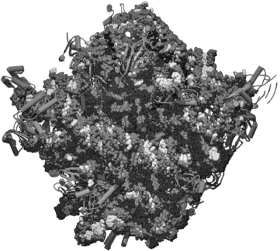
(Multiple Choice)
4.7/5 (83)
(83) How did phospholipids confer an advantage in terms of natural selection for vesicles that had higher phospholipid content?
(Multiple Choice)
4.8/5 (93)
(93) Which of the following was NOT identified as a basic function of genes included in a minimal gene set of Bacillus subtilis in Koonin's 2003 study?
(Multiple Choice)
4.9/5 (74)
(74) The figure shows horizontal gene transfer and the early evolution of life. Based on this figure, order the following events from earliest to latest. 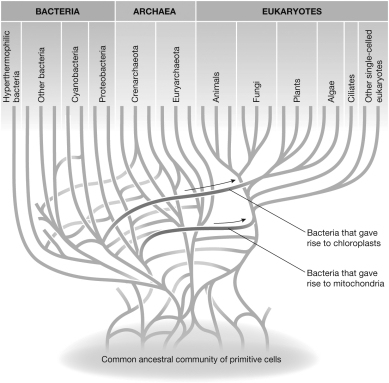 A. Mitochondrial horizontal gene transfer
B. Chloroplast horizontal gene transfer
C. Plants and algae separate from animals and fungi
D. Fungi separate from animals
A. Mitochondrial horizontal gene transfer
B. Chloroplast horizontal gene transfer
C. Plants and algae separate from animals and fungi
D. Fungi separate from animals (Short Answer)
4.9/5 (82)
(82) How can both clay and ice crystals enhance chemical reactions necessary to form complex organic molecules?
(Multiple Choice)
4.7/5 (84)
(84) Explain molecular mutualism and how it is applied to the hypercycle model.
(Essay)
4.7/5 (83)
(83) Consider this figure showing horizontal gene transfer and the early evolution of life. Which of the following statements is FALSE? 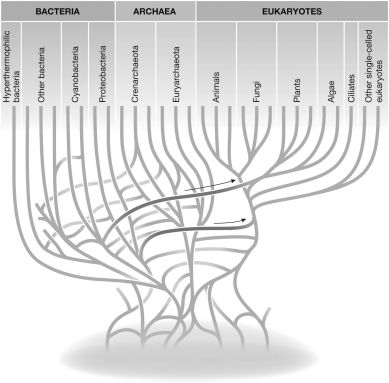
(Multiple Choice)
4.8/5 (82)
(82) In the hypercycle illustrated in the figure, the four components increase their own replication and also positively affect the replication of other members. How does the presence of a membrane, uniting the four components, favor the connections between the members of the hypercycle in this case compared to a set that does not have a membrane? 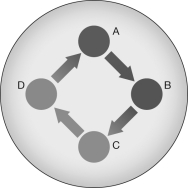
(Essay)
4.8/5 (78)
(78) 
Filters
- Essay(0)
- Multiple Choice(0)
- Short Answer(0)
- True False(0)
- Matching(0)