



 Chat with AI
Exam 12: Major Transitions

Exam 1: An Overview of Evolutionary Biology49 Questions
Exam 2: Early Evolutionary Ideas and Darwin S Insight49 Questions
Exam 3: Natural Selection47 Questions
Exam 4: Phylogeny and Evolutionary History47 Questions
Exam 5: Inferring Phylogeny46 Questions
Exam 6: Transmission Genetics and the Sources of Genetic Variation50 Questions
Exam 7: The Genetics of Populations46 Questions
Exam 8: Evolution in Finite Populations50 Questions
Exam 9: Evolution at Multiple Loci47 Questions
Exam 10: Genome Evolution49 Questions
Exam 11: The Origin and Evolution of Early Life50 Questions
Exam 12: Major Transitions47 Questions
Exam 13: Evolution and Development45 Questions
Exam 14: Species and Speciation48 Questions
Exam 15: Extinction and Evolutionary Trends49 Questions
Exam 16: The Evolution of Sex49 Questions
Exam 17: The Evolution of Sociality50 Questions
Exam 18: Coevolution50 Questions
Exam 19: Human Evolution49 Questions
Exam 20: Evolution and Medicine50 Questions
Select questions type


Which of the following is a benefit of multicellularity for slime mold amoebas?
(Multiple Choice)
4.8/5  (84)
(84) Why do the benefits of group living focus on foraging and predation?
(Multiple Choice)
4.8/5 (86)
(86) List the sequence of endosymbiotic events, beginning with ancestral Cyanobacteria, Proteobacteria, and Archaebacteria, that led to the evolution of plants.
(Essay)
4.8/5 (81)
(81) Which of the following major transitions proposed by John Maynard Smith and Eörs Szathmary (1997) most likely occurred first?
(Multiple Choice)
5.0/5 (76)
(76) In what way are single-celled slime mold amoebas and individual honeybees (social insects that live in colonies) alike?
(Multiple Choice)
4.9/5 (71)
(71) Consider Dyctiostelium discoideum, a slime mold that form slugs, and Volvox carteri, a species of volvocine algae. Both slime mold slugs and V. carteri contain soma and germ cells. Is the slug an individual? Is the Volvox colony an individual? Explain.
(Essay)
4.8/5 (83)
(83) Based on the figure, what date of origin would you predict for organisms with around 100 different cell types? 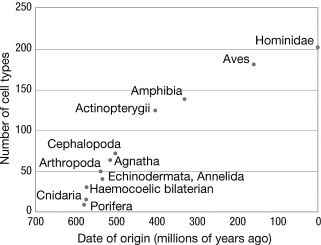
(Multiple Choice)
4.8/5 (76)
(76) 
Filters
- Essay(0)
- Multiple Choice(0)
- Short Answer(0)
- True False(0)
- Matching(0)