



 Chat with AI
Exam 17: The Evolution of Sociality

Exam 1: An Overview of Evolutionary Biology49 Questions
Exam 2: Early Evolutionary Ideas and Darwin S Insight49 Questions
Exam 3: Natural Selection47 Questions
Exam 4: Phylogeny and Evolutionary History47 Questions
Exam 5: Inferring Phylogeny46 Questions
Exam 6: Transmission Genetics and the Sources of Genetic Variation50 Questions
Exam 7: The Genetics of Populations46 Questions
Exam 8: Evolution in Finite Populations50 Questions
Exam 9: Evolution at Multiple Loci47 Questions
Exam 10: Genome Evolution49 Questions
Exam 11: The Origin and Evolution of Early Life50 Questions
Exam 12: Major Transitions47 Questions
Exam 13: Evolution and Development45 Questions
Exam 14: Species and Speciation48 Questions
Exam 15: Extinction and Evolutionary Trends49 Questions
Exam 16: The Evolution of Sex49 Questions
Exam 17: The Evolution of Sociality50 Questions
Exam 18: Coevolution50 Questions
Exam 19: Human Evolution49 Questions
Exam 20: Evolution and Medicine50 Questions
Select questions type


Under what circumstance is there a mixed Nash equilibrium for the hawk-dove game?
(Multiple Choice)
4.7/5  (82)
(82) Consider Robert Trivers' parent-offspring conflict model. How do you expect the zone of conflict between parent and offspring to differ when the future offspring is a half instead of a full sibling? 
(Multiple Choice)
4.7/5 (76)
(76) Calculate the coefficient of relatedness for the following relationships in a haplodiploid hymenopteran species:
A) Sister to full sisters
B) Sister to brother
C) Brother to sister
(Essay)
4.8/5 (76)
(76) Charles Darwin was initially puzzled by the observation that worker honeybees die when they sting an intruder to their hive (the bee's stinger is ripped from the bee's abdomen, causing a fatal injury). Based on what you know about natural selection, why did this observation complicate Darwin's theory?
(Multiple Choice)
4.7/5 (85)
(85) What is the term used to describe an individual's total fitness, as a product of both producing offspring itself and helping its kin in their reproductive efforts?
(Multiple Choice)
4.8/5 (89)
(89) Allele Z codes for a cooperative behavior among half siblings (r 0.25). Recipients of this behavior receive a benefit of four fitness units and the behavior costs the donor two fitness units. Using Hamilton's rule (rb c > 0), would you expect allele Z to spread in the population?
(Multiple Choice)
4.8/5 (81)
(81) What three evolutionary paths can lead to the evolution of cooperation?
(Essay)
4.8/5 (88)
(88) Which of the following concepts could be applied to test the kinship and cooperation model?
(Multiple Choice)
4.9/5 (80)
(80) Consider the modified payoff structure for the hawk-dove game below. Which of the following strategies should the players adopt? (v benefit of the resource that is being fought over.) 
(Multiple Choice)
5.0/5 (82)
(82) Describe the control in Tibbetts and Izzo's experiment, illustrated below, in which they manipulated the facial pattern and fighting behavior of wasps. 
(Essay)
4.9/5 (96)
(96) Based on the model for conventional signals below, which signal level should an individual of medium ability adopt? 
(Multiple Choice)
4.7/5 (74)
(74) The results of Tibbetts and Izzo's 2010 experiment on facial patterns and the fighting behavior of paper wasps are shown below. Why did Tibbetts and Izzo manipulate the wasps' aggressiveness, in addition to facial pattern? 
(Multiple Choice)
4.8/5 (73)
(73) Between which amounts of parental investment can you find the "zone of conflict" between parent and focal offspring? Delineate the zone of conflict in the figure below, and briefly explain how you chose the lower and upper bound. 
(Essay)
4.7/5 (70)
(70) When graphing the amount of resources a parent invests in a focal offspring against fitness costs to the parent and benefits to the offspring, what is the so-called zone of conflict?
(Multiple Choice)
5.0/5 (69)
(69) Allele X codes for a cooperative behavior among full siblings. Recipients of this behavior receive a benefit of seven fitness units, and the behavior costs the donor three fitness units. Use Hamilton's rule to determine whether allele X will spread in the population.
(Essay)
4.9/5 (95)
(95) Based on the figure, what is the coefficient of relatedness (r) between individuals A and B? 
(Multiple Choice)
4.9/5 (74)
(74) In the context of cooperation, ________ selection acts against cooperators who pay some cost that others (such as free riders) do not pay. Selfish individuals who do not cooperate are favored by this type of selection because they receive any benefits that accrue through the actions of cooperators, but they pay none of the costs.
(Multiple Choice)
4.8/5 (76)
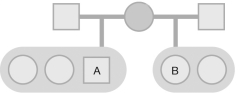
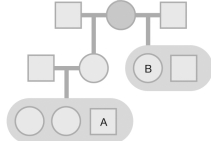
(76) Based on the figures shown here, calculate the coefficient of relatedness for individuals A and B in each case. Show your calculations. A
 B
 C
B
C
(Essay)
4.8/5 (87)
(87) What is the most likely explanation for why female Belding's ground squirrels make alarm calls to alert nearby individuals of a predator much more frequently than males do?
(Essay)
4.9/5 (76)
(76) ________ is the probability that the homologous alleles in two individuals are identical by descent due to inheritance of the alleles from a common ancestor.
(Multiple Choice)
4.9/5 (83)
(83) 
Filters
- Essay(0)
- Multiple Choice(0)
- Short Answer(0)
- True False(0)
- Matching(0)