



 Chat with AI
Exam 20: Evolution and Medicine

Exam 1: An Overview of Evolutionary Biology49 Questions
Exam 2: Early Evolutionary Ideas and Darwin S Insight49 Questions
Exam 3: Natural Selection47 Questions
Exam 4: Phylogeny and Evolutionary History47 Questions
Exam 5: Inferring Phylogeny46 Questions
Exam 6: Transmission Genetics and the Sources of Genetic Variation50 Questions
Exam 7: The Genetics of Populations46 Questions
Exam 8: Evolution in Finite Populations50 Questions
Exam 9: Evolution at Multiple Loci47 Questions
Exam 10: Genome Evolution49 Questions
Exam 11: The Origin and Evolution of Early Life50 Questions
Exam 12: Major Transitions47 Questions
Exam 13: Evolution and Development45 Questions
Exam 14: Species and Speciation48 Questions
Exam 15: Extinction and Evolutionary Trends49 Questions
Exam 16: The Evolution of Sex49 Questions
Exam 17: The Evolution of Sociality50 Questions
Exam 18: Coevolution50 Questions
Exam 19: Human Evolution49 Questions
Exam 20: Evolution and Medicine50 Questions
Select questions type


The mutation accumulation and antagonistic pleiotropy hypotheses for senescence both make which of the following predictions about extrinsic mortality?
(Multiple Choice)
4.7/5  (77)
(77) All of the following are true of V(D)J recombination EXCEPT it
(Multiple Choice)
4.7/5 (60)
(60) The size difference between most multicellular hosts and their pathogens results in which of the following evolutionary advantages for the pathogen?
(Multiple Choice)
4.8/5 (73)
(73) These graphs show how world-record performance in (A) track and (B) field events vary with age. What phenomenon do these data demonstrate? 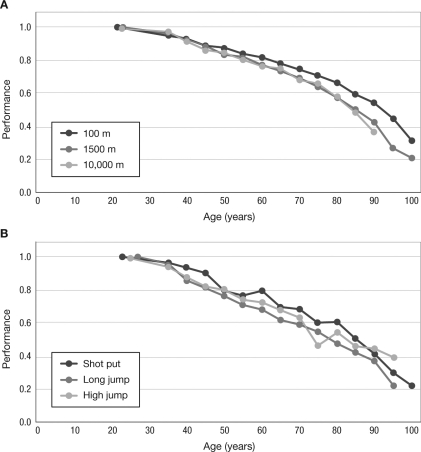
(Multiple Choice)
4.8/5 (82)
(82) Patients with severe bacterial sepsis who develop a fever have higher survival rates than those who do not develop a fever. Does this observation provide causative evidence for the beneficial role of fever in fighting infections?
(Multiple Choice)
4.8/5 (91)
(91) Does this graph provide evidence in support of the rate-of-living hypothesis for senescence? 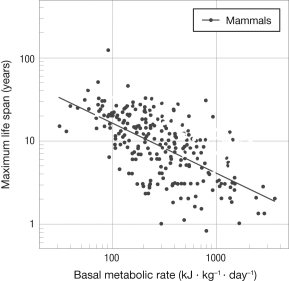
(Multiple Choice)
4.9/5 (78)
(78) Explain why it was beneficial for primitive fish to have a pouch of esophagus or gut tissue that trapped gas bubbles, but why it was problematic for humans.
(Essay)
5.0/5 (68)
(68) Which of the following is a mechanism that many pathogens have evolved to subvert the host immune system?
(Multiple Choice)
4.9/5 (84)
(84) Name Niko Tinbergen's four levels of explanation. Write one question about fever that addresses each level of explanation. Limit your answer to one sentence for each level.
(Essay)
4.8/5 (73)
(73) Which of the following describes a proximate explanation for fever in mammals?
(Multiple Choice)
5.0/5 (81)
(81) 
Filters
- Essay(0)
- Multiple Choice(0)
- Short Answer(0)
- True False(0)
- Matching(0)