



 Chat with AI
Exam 20: Evolution and Medicine

Exam 1: An Overview of Evolutionary Biology49 Questions
Exam 2: Early Evolutionary Ideas and Darwin S Insight49 Questions
Exam 3: Natural Selection47 Questions
Exam 4: Phylogeny and Evolutionary History47 Questions
Exam 5: Inferring Phylogeny46 Questions
Exam 6: Transmission Genetics and the Sources of Genetic Variation50 Questions
Exam 7: The Genetics of Populations46 Questions
Exam 8: Evolution in Finite Populations50 Questions
Exam 9: Evolution at Multiple Loci47 Questions
Exam 10: Genome Evolution49 Questions
Exam 11: The Origin and Evolution of Early Life50 Questions
Exam 12: Major Transitions47 Questions
Exam 13: Evolution and Development45 Questions
Exam 14: Species and Speciation48 Questions
Exam 15: Extinction and Evolutionary Trends49 Questions
Exam 16: The Evolution of Sex49 Questions
Exam 17: The Evolution of Sociality50 Questions
Exam 18: Coevolution50 Questions
Exam 19: Human Evolution49 Questions
Exam 20: Evolution and Medicine50 Questions
Select questions type


Name three methods that pathogens use to subvert their host's immune system.
(Short Answer)
4.8/5  (64)
(64) All of the following are evolved immune defenses that attempt to isolate pathogens, minimize the harm they cause, and remove them from the body, EXCEPT ________ systems.
(Multiple Choice)
4.8/5 (79)
(79) What is the likely phylogenetic explanation for the crossing of food and air pathways in humans?
(Multiple Choice)
4.8/5 (74)
(74) Figures A and B show the effect of a late- and an early acting mutation on the lifetime fitness of individuals. Reproduction begins at day 30. Using the graphs, how would you determine which of the two mutations had a greater effect on lifetime fitness? 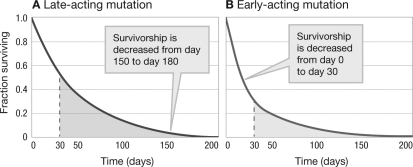
(Essay)
4.9/5 (76)
(76) Which of the following strategies allows vertebrate hosts to counteract the asymmetries in evolutionary rates between most pathogens and their hosts?
(Multiple Choice)
4.9/5 (71)
(71) Which of the two viral phylogenies below shows the signature of a recent, epidemic population expansion? Explain your answer. 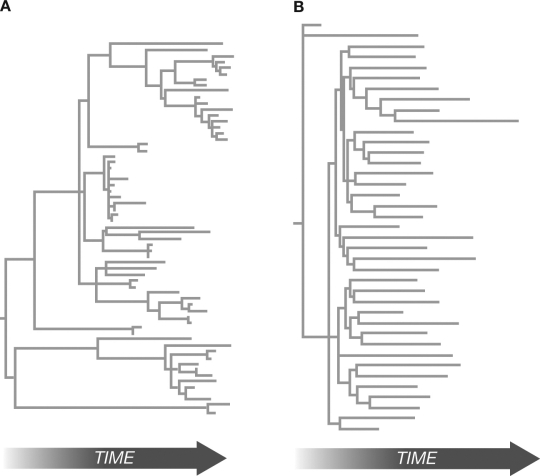
(Essay)
4.9/5 (75)
(75) This figure shows the basal and fever temperatures for various vertebrates. If fever conferred only benefits, and had no costs, how might you expect this graph to differ? 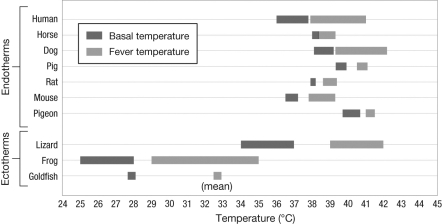
(Multiple Choice)
4.9/5 (84)
(84) Consider Niko Tinbergen's four levels of explanation and complete the following sentence: ________ explanations tell us about the immediate mechanisms that precipitate a particular disease, and ________ explanations tell us how processes such as natural selection leave the body vulnerable to disease.
(Multiple Choice)
4.7/5 (87)
(87) How can age-specific antagonistic pleiotropy account for senescence?
(Multiple Choice)
4.8/5 (94)
(94) An increased susceptibility to developing myopia, shortsightedness, is thought to be a consequence of spending time doing "near work," in which the eye is focused on an object, such as a book or computer, less than two feet away. What is the most likely evolutionary explanation for this phenomenon?
(Multiple Choice)
4.7/5 (78)
(78) Under which of Randy Nesse and George Williams' evolutionary explanations for disease does the antagonistic pleiotropy hypothesis for senescence fall?
(Multiple Choice)
4.7/5 (76)
(76) Plants do not have a germ line and gametes are derived from cell lines that are also responsible for the growth of the organism. Can the disposable soma hypothesis be applied to plants?
(Multiple Choice)
4.9/5 (92)
(92) This table shows the values for heritability of life span in four different species. Why do these data refute the rate-of-living hypothesis for senescence? 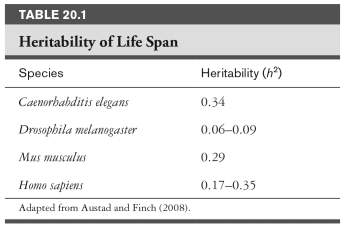
(Essay)
4.9/5 (82)
(82) This figure shows the process of clonal selection and clonal expansion in the vertebrate adaptive immune system. Describe two steps in this process that resemble evolution by natural selection. 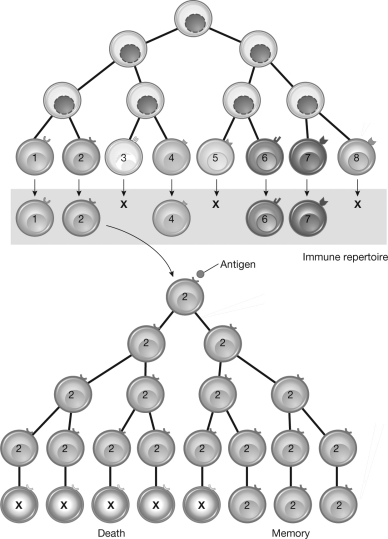
(Not Answered)
This question doesn't have any answer yet
How does the disposable soma hypothesis account for the abundance of alleles that show antagonistic pleiotropy with respect to age?
(Multiple Choice)
5.0/5 (88)
(88) Experimental infection of lizards with heat-killed bacteria by Linda Vaughn et al. (1974) resulted in behavioral changes that led to ________ in the lizards.
(Multiple Choice)
4.8/5 (94)
(94) This graph shows a correlation between body mass and longevity for flightless mammals, but bats lie well above the trend line for flightless mammals. Which of the following is likely true based on these data? 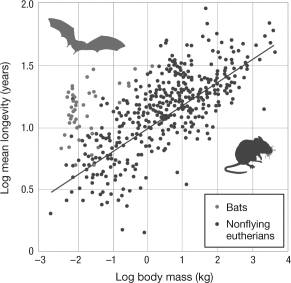
(Multiple Choice)
4.9/5 (91)
(91) Which of the following supports the rate-of-living hypothesis?
(Multiple Choice)
4.8/5 (90)
(90) Asymmetric division in Caulobacter crescentus allowed Ackermann et al. (2003) to measure the reproductive rate of these bacteria relative to their age. This figure shows the age-specific reproductive output for three replicate experiments. What do these data demonstrate? 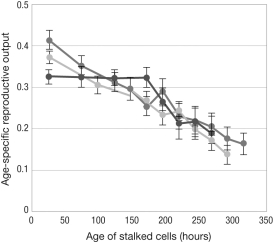
(Multiple Choice)
4.9/5 (86)
(86) 
Filters
- Essay(0)
- Multiple Choice(0)
- Short Answer(0)
- True False(0)
- Matching(0)