



 Chat with AI
Exam 5: Accounting for Merchandising Operations

Exam 1: Accounting in Business245 Questions
Exam 2: Analyzing and Recording Transactions201 Questions
Exam 3: Adjusting Accounts and Preparing Financial Statements227 Questions
Exam 4: Completing the Accounting Cycle177 Questions
Exam 5: Accounting for Merchandising Operations189 Questions
Exam 6: Inventories and Cost of Sales194 Questions
Exam 7: Accounting Information Systems166 Questions
Exam 8: Cash and Internal Controls195 Questions
Exam 9: Accounting for Receivables162 Questions
Exam 10: Long-Term Assets208 Questions
Exam 11: Current Liabilities and Payroll Accounting178 Questions
Exam 12: Accounting for Partnerships141 Questions
Exam 13: Accounting for Corporations210 Questions
Exam 14: Long-Term Liabilities158 Questions
Exam 15: Investments and International Operations156 Questions
Exam 16: Statement of Cash Flows173 Questions
Exam 17: Analysis of Financial Statements182 Questions
Exam 18: Managerial Accounting Concepts and Principles199 Questions
Exam 19: Job Order Cost Accounting165 Questions
Exam 20: Process Cost Accounting172 Questions
Exam 21: Cost Allocation and Performance Measurement173 Questions
Exam 22: Cost-Volume-Profit Analysis190 Questions
Exam 23: Master Budgets and Planning166 Questions
Exam 24: Flexible Budgets and Standard Costs178 Questions
Exam 25: Capital Budgeting and Managerial Decisions153 Questions
Select questions type


A wholesaler is an intermediary that buys products from manufacturers or other wholesalers and sells them to consumers.
(True/False)
4.9/5  (71)
(71) On October 1, Courtland Company sold merchandise in the amount of $5,800 to Carter Company, with credit terms of 2/10, n/30. The cost of the items sold is $4,000. Courtland uses the periodic inventory system. On October 4, Carter returns some of the merchandise. The selling price of the merchandise is $500 and the cost of the merchandise returned is $350. Carter pays the invoice on October 8, and takes the appropriate discount. The journal entry that Courtland makes on October 8 is:
(Multiple Choice)
4.8/5 (92)
(92) Under the ___________ system, each purchase, purchase return and allowance, purchase discount, and transportation-in transaction is recorded in a separate temporary account.
(Essay)
4.8/5 (64)
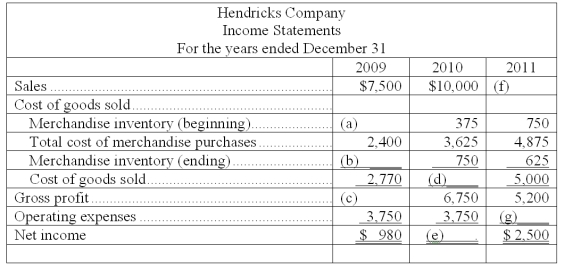
(64) Fill in the blanks (a) through (g) for the Hendricks Company for each of the income statements for 2009, 2010, and 2011.
(Essay)
4.7/5 (88)
(88) A company had net sales of $340,500, its cost of goods sold was $257,000, and its net income was $13,750. The company's gross margin ratio equals 24.5%.
(True/False)
5.0/5 (73)
(73) A seller usually prepares a ____________________ to confirm a buyer's return or allowance, and informs the buyer of the seller's credit to the buyer's Account Receivable on the seller's books.
(Essay)
4.9/5 (90)
(90) All of the following statements regarding inventory shrinkage are except:
(Multiple Choice)
4.9/5 (94)
(94) Under both the periodic and perpetual inventory systems, the temporary account Purchases Returns and Allowances is used to accumulate the cost of all returns and allowances for a period.
(True/False)
4.9/5 (83)
(83) A company's current ratio is 1.2 and its quick ratio is 0.25. This company is probably an excellent credit risk because the ratios reveal no indication of liquidity problems.
(True/False)
4.9/5 (82)
(82) A company purchased $4,000 worth of merchandise. Transportation costs were an additional $350. The company later returned $275 worth of merchandise and paid the invoice within the 2% cash discount period. The total amount paid for this merchandise is:
(Multiple Choice)
4.8/5 (69)
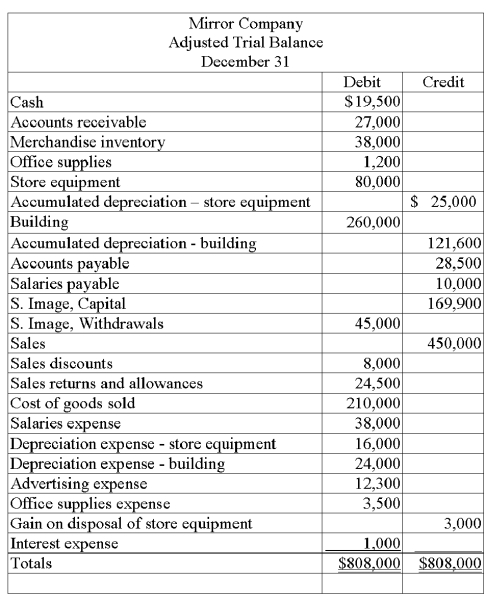
(69) From the adjusted trial balance given below for the Mirror Company, prepare an income statement. Salaries expense and depreciation expense on the building are equally divided between selling activities and the general and administrative activities.
(Essay)
4.7/5 (84)
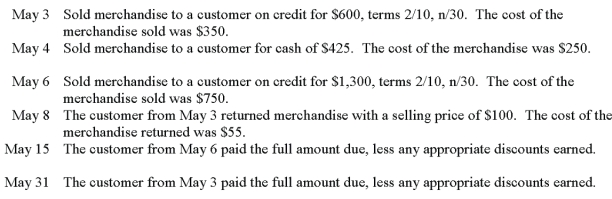
(84) Maia's Bike Shop uses the periodic inventory system and had the following transactions during the month of May:
Prepare the required journal entries that Maia's Bike Shop must make to record these transactions.
(Essay)
4.8/5 (81)
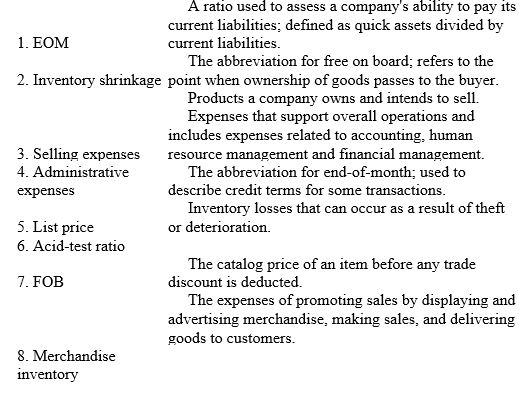
(81) Match the following definitions and terms by placing the letter for the terms a through j in the blank space next to the best definition.
(Essay)
4.8/5 (77)
(77) A company's net sales are $775,420, its costs of goods sold are $413,890, and its net income is $117,220. Its gross margin ratio equals:
(Multiple Choice)
4.9/5 (73)
(73) A company's quick assets are $147,000 and its current liabilities are $143,000. This company's acid-test ratio is 1.03.
(True/False)
4.9/5 (76)
(76) On October 1, Courtland Company sold merchandise in the amount of $5,800 to Carter Company, with credit terms of 2/10, n/30. The cost of the items sold is $4,000. Courtland uses the periodic inventory system. Carter pays the invoice on October 8, and takes the appropriate discount. The journal entry that Courtland makes on October 8 is:
(Multiple Choice)
4.8/5 (90)
(90) 
Filters
- Essay(0)
- Multiple Choice(0)
- Short Answer(0)
- True False(0)
- Matching(0)