



 Chat with AI
Exam 5: Accounting for Merchandising Operations

Exam 1: Accounting in Business245 Questions
Exam 2: Analyzing and Recording Transactions201 Questions
Exam 3: Adjusting Accounts and Preparing Financial Statements227 Questions
Exam 4: Completing the Accounting Cycle177 Questions
Exam 5: Accounting for Merchandising Operations189 Questions
Exam 6: Inventories and Cost of Sales194 Questions
Exam 7: Accounting Information Systems166 Questions
Exam 8: Cash and Internal Controls195 Questions
Exam 9: Accounting for Receivables162 Questions
Exam 10: Long-Term Assets208 Questions
Exam 11: Current Liabilities and Payroll Accounting178 Questions
Exam 12: Accounting for Partnerships141 Questions
Exam 13: Accounting for Corporations210 Questions
Exam 14: Long-Term Liabilities158 Questions
Exam 15: Investments and International Operations156 Questions
Exam 16: Statement of Cash Flows173 Questions
Exam 17: Analysis of Financial Statements182 Questions
Exam 18: Managerial Accounting Concepts and Principles199 Questions
Exam 19: Job Order Cost Accounting165 Questions
Exam 20: Process Cost Accounting172 Questions
Exam 21: Cost Allocation and Performance Measurement173 Questions
Exam 22: Cost-Volume-Profit Analysis190 Questions
Exam 23: Master Budgets and Planning166 Questions
Exam 24: Flexible Budgets and Standard Costs178 Questions
Exam 25: Capital Budgeting and Managerial Decisions153 Questions
Select questions type


All of the following statements regarding sales returns and allowances are except:
(Multiple Choice)
4.9/5  (85)
(85) Sales less sales discounts less sales returns and allowances equals:
(Multiple Choice)
4.8/5 (94)
(94) The __________________ inventory system continually updates accounting records for merchandise transactions for the amounts of inventory available for sale and inventory sold.
(Essay)
4.7/5 (79)
(79) Describe the key attributes of inventory for a merchandising company.
(Essay)
4.9/5 (82)
(82) The periodic inventory system requires updating the inventory account only at the end of the period to reflect the quantity and cost of both the goods available and the goods sold.
(True/False)
4.7/5 (79)
(79) When a credit customer returns merchandise to the seller, under a perpetual inventory system, the seller would debit Sales Returns and Allowances and credit Accounts Receivable and also debit Merchandise Inventory and credit Cost of Goods Sold.
(True/False)
4.9/5 (83)
(83) The gross margin ratio is defined as gross margin divided by net sales.
(True/False)
4.9/5 (84)
(84) Calculate the gross margin ratio for each of the following separate cases A through D:

(Essay)
4.9/5 (99)
(99) ABC Corporation's total quick assets were $5,888,000, its current assets were $11,700,000 and its current liabilities were $8,000,000. Its acid-test ratio equals:
(Multiple Choice)
5.0/5 (79)
(79) Each sales transaction for a seller that uses a perpetual inventory system involves recognizing both revenue and cost of merchandise sold.
(True/False)
5.0/5 (78)
(78) What is the acid-test ratio? How does it measure a company's liquidity?
(Essay)
4.7/5 (74)
(74) Because sellers assume that their customers will pay within the discount period, the seller usually records the discount at the time of the sale.
(True/False)
4.7/5 (72)
(72) A buyer failed to take advantage of the vendor's credit terms of 2/15, n/45, but instead paid the invoice in full at the end of 60 days. By not taking advantage of the cash discount, the buyer lost the equivalent of ____________ annual interest on the amount of the purchase.
(Multiple Choice)
5.0/5 (90)
(90) Credit terms for a purchase include the amounts and timing of payments from a buyer to a seller.
(True/False)
4.8/5 (78)
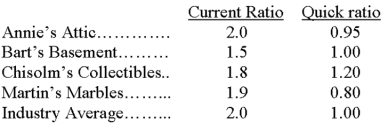
(78) The following information refers to Annie's Attic and its competitors in the antiques business.
Required:
Comment on the relative liquidity positions of these companies.
(Essay)
4.9/5 (83)
(83) A company's gross profit was $83,750 and its net sales were $347,800. Its gross margin ratio equals:
(Multiple Choice)
4.8/5 (88)
(88) On October 1, Courtland Company sold merchandise in the amount of $5,800 to Carter Company, with credit terms of 2/10, n/30. The cost of the items sold is $4,000. Courtland uses the periodic inventory system. On October 4, Carter returns some of the merchandise. The selling price of the merchandise is $500 and the cost of the merchandise returned is $350. The entry or entries that Courtland must make on October 4 is:
(Multiple Choice)
4.7/5 (90)
(90) Benson Company had cash sales of $94,275, credit sales of $83,450, sales returns and allowances of $1,700, and sales discounts of $3,475. Benson's net sales for this period equal:
(Multiple Choice)
4.7/5 (73)
(73) 
Filters
- Essay(0)
- Multiple Choice(0)
- Short Answer(0)
- True False(0)
- Matching(0)