



 Chat with AI
Exam 5: Accounting for Merchandising Operations

Exam 1: Accounting in Business245 Questions
Exam 2: Analyzing and Recording Transactions201 Questions
Exam 3: Adjusting Accounts and Preparing Financial Statements227 Questions
Exam 4: Completing the Accounting Cycle177 Questions
Exam 5: Accounting for Merchandising Operations189 Questions
Exam 6: Inventories and Cost of Sales194 Questions
Exam 7: Accounting Information Systems166 Questions
Exam 8: Cash and Internal Controls195 Questions
Exam 9: Accounting for Receivables162 Questions
Exam 10: Long-Term Assets208 Questions
Exam 11: Current Liabilities and Payroll Accounting178 Questions
Exam 12: Accounting for Partnerships141 Questions
Exam 13: Accounting for Corporations210 Questions
Exam 14: Long-Term Liabilities158 Questions
Exam 15: Investments and International Operations156 Questions
Exam 16: Statement of Cash Flows173 Questions
Exam 17: Analysis of Financial Statements182 Questions
Exam 18: Managerial Accounting Concepts and Principles199 Questions
Exam 19: Job Order Cost Accounting165 Questions
Exam 20: Process Cost Accounting172 Questions
Exam 21: Cost Allocation and Performance Measurement173 Questions
Exam 22: Cost-Volume-Profit Analysis190 Questions
Exam 23: Master Budgets and Planning166 Questions
Exam 24: Flexible Budgets and Standard Costs178 Questions
Exam 25: Capital Budgeting and Managerial Decisions153 Questions
Select questions type


Brig Company had $800,000 in net sales, $350,000 in gross profit, and $200,000 in operating expenses. Cost of goods sold equals:
(Multiple Choice)
5.0/5  (79)
(79) What are the difference(s) between the periodic and the perpetual inventory systems?
(Essay)
4.9/5 (87)
(87) A perpetual inventory system continually updates accounting records for inventory transactions.
(True/False)
4.8/5 (85)
(85) A merchandiser's classified balance sheet reports merchandise inventory as a current asset.
(True/False)
4.8/5 (93)
(93) A merchandising company's operating cycle begins with the sale of merchandise and ends with the collection of cash from the sale.
(True/False)
4.9/5 (81)
(81) ___________ expenses are those expenses that support a company's overall operations and include expenses related to accounting, human resource management, and financial management.
(Essay)
4.9/5 (85)
(85) ___________________ refer to reductions in the selling price of merchandise sold to customers, often involving damaged or defective merchandise that a customer is willing to purchase with a decrease in the selling price.
(Essay)
4.8/5 (65)
(65) Sales discounts can benefit a seller by decreasing the delay in receiving cash, and __________.
(Essay)
4.8/5 (75)
(75) Roller Blade Company uses the perpetual inventory system and had the following transactions during October:
Prepare journal entries to record each of the preceding transactions.

(Essay)
4.7/5 (76)
(76) Inventory shrinkage can be computed by comparing the ___________ of inventory with recorded quantities and amounts.
(Essay)
4.7/5 (81)
(81) A buyer records the costs of shipping goods in a Delivery Expense, or transportation-out account when the buyer is responsible for these costs.
(True/False)
4.7/5 (83)
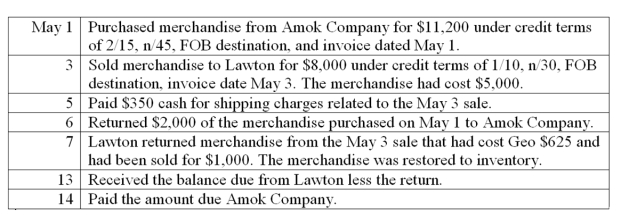
(83) Prepare journal entries to record the following merchandise transactions of Geo Company, which applies the perpetual inventory system.
(Essay)
4.9/5 (84)
(84) Sales discounts on credit sales can benefit a seller by decreasing the delay in receiving cash and reducing future collections efforts.
(True/False)
4.9/5 (70)
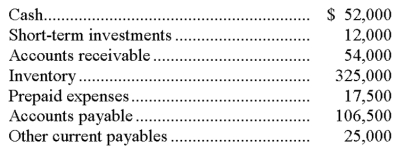
(70) A company reported the following year-end information:
Required:
1. Explain the purpose of the acid-test ratio.
2. Calculate the acid-test ratio for this company.
3. What does the acid-test ratio reveal about this company?
(Essay)
4.8/5 (75)
(75) A debit to Sales Returns and Allowances and a credit to Accounts Receivable:
(Multiple Choice)
4.8/5 (83)
(83) The gross margin ratio equals net sales less ___________ divided by net sales.
(Essay)
4.8/5 (75)
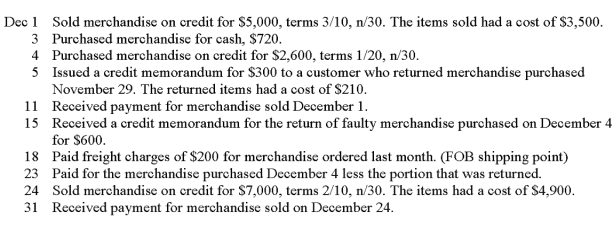
(75) Ceres Computer Sales uses the perpetual inventory system and had the following transactions during December.
Required:
Prepare the general journal entries to record these transactions.
(Essay)
4.7/5 (73)
(73) A perpetual inventory system requires updating of the inventory account only at the beginning of an accounting period.
(True/False)
4.9/5 (71)
(71) 
Filters
- Essay(0)
- Multiple Choice(0)
- Short Answer(0)
- True False(0)
- Matching(0)