



 Chat with AI
Exam 9: Accounting for Receivables

Exam 1: Accounting in Business245 Questions
Exam 2: Analyzing and Recording Transactions201 Questions
Exam 3: Adjusting Accounts and Preparing Financial Statements227 Questions
Exam 4: Completing the Accounting Cycle177 Questions
Exam 5: Accounting for Merchandising Operations189 Questions
Exam 6: Inventories and Cost of Sales194 Questions
Exam 7: Accounting Information Systems166 Questions
Exam 8: Cash and Internal Controls195 Questions
Exam 9: Accounting for Receivables162 Questions
Exam 10: Long-Term Assets208 Questions
Exam 11: Current Liabilities and Payroll Accounting178 Questions
Exam 12: Accounting for Partnerships141 Questions
Exam 13: Accounting for Corporations210 Questions
Exam 14: Long-Term Liabilities158 Questions
Exam 15: Investments and International Operations156 Questions
Exam 16: Statement of Cash Flows173 Questions
Exam 17: Analysis of Financial Statements182 Questions
Exam 18: Managerial Accounting Concepts and Principles199 Questions
Exam 19: Job Order Cost Accounting165 Questions
Exam 20: Process Cost Accounting172 Questions
Exam 21: Cost Allocation and Performance Measurement173 Questions
Exam 22: Cost-Volume-Profit Analysis190 Questions
Exam 23: Master Budgets and Planning166 Questions
Exam 24: Flexible Budgets and Standard Costs178 Questions
Exam 25: Capital Budgeting and Managerial Decisions153 Questions
Select questions type


Describe how accounts receivable arise and how they accounted for, including the use of a subsidiary ledger and an allowance account.
(Essay)
4.8/5  (64)
(64) Bardo Company allows customers to make purchases on credit. The terms of all credit sales are 2/10, n/30, and all sales are recorded at the gross price. Other customers can use a bank credit card where the bank deducts a 4% service charge for credit card sales and credits the bank account of Bardo immediately when credit card receipts are deposited. Bardo uses the perpetual inventory method. Prepare journal entries to record the following selected transactions and events.
(Essay)
4.9/5 (79)
(79) Outdoors Unlimited accepts the Explorer credit card from its customers. Explorer charges a 3.5% service fee and pays Outdoors Unlimited the amount net of Explorer charges once a month. During February, Outdoors Unlimited sold $27,000 worth of merchandise to customers using the Explorer charge card. On February 28, Outdoor Unlimited sent the $27,000 worth of credit card receipts to Explorer. On March 4, Outdoors Unlimited received cash proceeds from Explorer for the February credit sales less the service charge. Prepare the journal entries to record February sales and the March 4 cash receipt.
(Essay)
4.8/5 (91)
(91) On November 19, Hayes Company receives a $15,000, 60-day, 10% note from a customer as payment on his account. What adjusting entry should be made on the December 31 year-end?
(Multiple Choice)
4.7/5 (75)
(75) A company had net sales of $500,000 and an average accounts receivable of $80,000. Its accounts receivable turnover equals 6.25.
(True/False)
4.8/5 (68)
(68) What is the accounts receivable turnover ratio? How is it calculated? How is it used to assess financial condition?
(Essay)
4.7/5 (63)
(63) A company had the following items and amounts in its unadjusted trial balance as of December 31 of the current year:
Prepare the adjusting entry to estimate bad debts assuming an aging analysis estimates that 8% of the outstanding accounts receivable will be uncollectible.

(Essay)
4.8/5 (76)
(76) Receivables can be used to obtain cash by either selling them or using them as security for a loan.
(True/False)
4.8/5 (74)
(74) The direct write-off method of accounting for bad debts records the loss from an uncollectible account receivable when it is determined to be uncollectible.
(True/False)
4.8/5 (82)
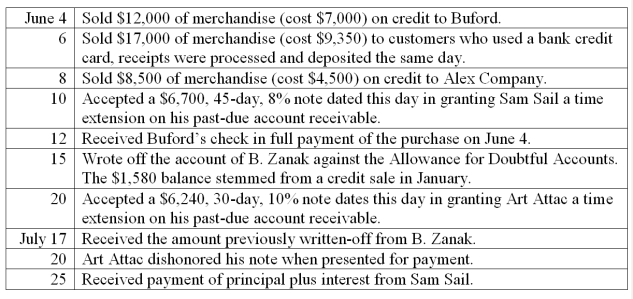
(82) On May 31, a company had a balance in its accounts receivable of $103,895. Prepare journal entries to record the following transactions for June.

(Essay)
4.8/5 (88)
(88) Darby uses the allowance method to account for uncollectible accounts. Its year-end unadjusted trial balance shows Accounts Receivable of $104,500, allowance for doubtful accounts of $665 (credit) and sales of $925,000. If uncollectible accounts are estimated to be 4% of accounts receivable, what is the amount of the bad debts expense adjusting entry?
(Multiple Choice)
4.7/5 (79)
(79) A supplementary record created to maintain a separate account for each customer is called the ______________________.
(Essay)
4.8/5 (81)
(81) Newton Company uses the allowance method of accounting for uncollectible accounts. On May 3, the Newton Company wrote off the $3,000 uncollectible account of its customer, P. Best. On July 10, Newton received a check for the full amount of $3,000 from Best. On July 10, the entry or entries Newton makes to record the recovery of the bad debt is:
(Multiple Choice)
4.9/5 (77)
(77) A Company had net sales of $23,000 million, and its average account receivables were $5,860 million. Its accounts receivable turnover is 0.92.
(True/False)
4.8/5 (92)
(92) When the maker of a note honors a note this indicates that the note is:
(Multiple Choice)
4.9/5 (68)
(68) A ____________________ is a signed promise to pay a specified amount of money either on demand or at a definite future date.
(Essay)
4.8/5 (89)
(89) Electron borrowed $75,000 cash from TechCom by signing a promissory note. TechCom's entry to record the transaction should include a:
(Multiple Choice)
4.7/5 (78)
(78) The person who signs a note receivable and promises to pay the principal and interest is the:
(Multiple Choice)
4.8/5 (84)
(84) 
Filters
- Essay(0)
- Multiple Choice(0)
- Short Answer(0)
- True False(0)
- Matching(0)