



 Chat with AI
Exam 9: Accounting for Receivables

Exam 1: Accounting in Business245 Questions
Exam 2: Analyzing and Recording Transactions201 Questions
Exam 3: Adjusting Accounts and Preparing Financial Statements227 Questions
Exam 4: Completing the Accounting Cycle177 Questions
Exam 5: Accounting for Merchandising Operations189 Questions
Exam 6: Inventories and Cost of Sales194 Questions
Exam 7: Accounting Information Systems166 Questions
Exam 8: Cash and Internal Controls195 Questions
Exam 9: Accounting for Receivables162 Questions
Exam 10: Long-Term Assets208 Questions
Exam 11: Current Liabilities and Payroll Accounting178 Questions
Exam 12: Accounting for Partnerships141 Questions
Exam 13: Accounting for Corporations210 Questions
Exam 14: Long-Term Liabilities158 Questions
Exam 15: Investments and International Operations156 Questions
Exam 16: Statement of Cash Flows173 Questions
Exam 17: Analysis of Financial Statements182 Questions
Exam 18: Managerial Accounting Concepts and Principles199 Questions
Exam 19: Job Order Cost Accounting165 Questions
Exam 20: Process Cost Accounting172 Questions
Exam 21: Cost Allocation and Performance Measurement173 Questions
Exam 22: Cost-Volume-Profit Analysis190 Questions
Exam 23: Master Budgets and Planning166 Questions
Exam 24: Flexible Budgets and Standard Costs178 Questions
Exam 25: Capital Budgeting and Managerial Decisions153 Questions
Select questions type


Teller purchased merchandise from TechCom on October 17 of the current year and TechCom accepted Teller's $4,800, 90-day, 10% note. What entry should TechCom make on December 31, to record the accrued interest on the note?
(Multiple Choice)
4.7/5  (82)
(82) The accounts receivable turnover is calculated by dividing _________________ by ___________________.
(Essay)
4.9/5 (79)
(79) What is the amount of interest that is due on a $36,000, 90-day, 4% note receivable at maturity?
(Essay)
4.8/5 (83)
(83) Tepsi's accounts receivable turnover was 9.9 for this year and 11.0 for last year. Craig's turnover was 9.3 for this year and 9.3 for last year. These results imply that:
(Multiple Choice)
4.7/5 (81)
(81) The advantage of the allowance method of accounting for bad debts is that it identifies the specific customers who will not pay their bills.
(True/False)
4.9/5 (96)
(96) Companies follow both the matching principle and the materiality constraint when applying the direct write-off method.
(True/False)
4.9/5 (72)
(72) On August 9, Pierce Company receives a $8,500, 90-day, 8% note from customer Eric Simms as payment on his account. What entry should be made on the maturity date assuming the maker pays in full?
(Multiple Choice)
4.8/5 (71)
(71) A company received a $1,000, 90-day, 10% note receivable. The journal entry to record receipt of the note includes a debit to Notes Receivable.
(True/False)
4.8/5 (77)
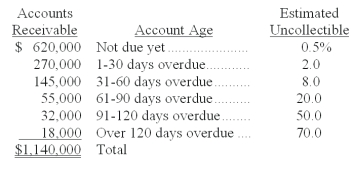
(77) A company uses the aging of accounts receivable method to estimate its bad debts expense. On December 31 of the current year an aging analysis of accounts receivable revealed the following:
Required:
a. Calculate the amount of the Allowance for Doubtful Accounts that should be reported on the current year-end balance sheet.
b. Calculate the amount of the Bad Debts Expense that should be reported on the current year's income statement, assuming that the balance of the Allowance for Doubtful Accounts on January 1 of the current year was $44,000 and that accounts receivable written off during the current year totaled $49,200.
c. Prepare the adjusting entry to record bad debts expense on December 31 of the current year.
d. Show how Accounts Receivable will appear on the current year-end balance sheet as of December 31.
(Essay)
4.9/5 (87)
(87) Companies can report credit card expense as a discount deducted from sales or as a selling expense.
(True/False)
5.0/5 (70)
(70) The process of using accounts receivable as security for a loan is known as factoring accounts receivable.
(True/False)
4.9/5 (73)
(73) A company factored $45,000 of its accounts receivable and was charged a 3% factoring fee. The journal entry to record this transaction would include a:
(Multiple Choice)
4.9/5 (81)
(81) Tecom had net sales of $315,000 and average accounts receivable of $75,600. Its competitor, ZCom, had net sales of $299,000 and average accounts receivables of $81,350. Calculate the accounts receivable turnover for both companies. Which company is doing a better job of managing its accounts receivables?
(Essay)
5.0/5 (79)
(79) The use of an allowance for bad debts is required under the materiality constraint.
(True/False)
4.7/5 (82)
(82) If a credit card sale is made, the seller can either debit Cash or debit Accounts receivable at the time of the sale depending on the type of credit card.
(True/False)
4.8/5 (73)
(73) Teller purchased merchandise from TechCom on October 17 of the current year and TechCom accepted Teller's $4,800, 90-day, 10% note. If the note is dishonored, what entry should TechCom make on January 15 of the next year?
(Multiple Choice)
4.9/5 (77)
(77) A method of estimating bad debts expense that involves a detailed examination of outstanding accounts and their length of time past due is the:
(Multiple Choice)
5.0/5 (74)
(74) 
Filters
- Essay(0)
- Multiple Choice(0)
- Short Answer(0)
- True False(0)
- Matching(0)