



 Chat with AI
Exam 9: Accounting for Receivables

Exam 1: Accounting in Business245 Questions
Exam 2: Analyzing and Recording Transactions201 Questions
Exam 3: Adjusting Accounts and Preparing Financial Statements227 Questions
Exam 4: Completing the Accounting Cycle177 Questions
Exam 5: Accounting for Merchandising Operations189 Questions
Exam 6: Inventories and Cost of Sales194 Questions
Exam 7: Accounting Information Systems166 Questions
Exam 8: Cash and Internal Controls195 Questions
Exam 9: Accounting for Receivables162 Questions
Exam 10: Long-Term Assets208 Questions
Exam 11: Current Liabilities and Payroll Accounting178 Questions
Exam 12: Accounting for Partnerships141 Questions
Exam 13: Accounting for Corporations210 Questions
Exam 14: Long-Term Liabilities158 Questions
Exam 15: Investments and International Operations156 Questions
Exam 16: Statement of Cash Flows173 Questions
Exam 17: Analysis of Financial Statements182 Questions
Exam 18: Managerial Accounting Concepts and Principles199 Questions
Exam 19: Job Order Cost Accounting165 Questions
Exam 20: Process Cost Accounting172 Questions
Exam 21: Cost Allocation and Performance Measurement173 Questions
Exam 22: Cost-Volume-Profit Analysis190 Questions
Exam 23: Master Budgets and Planning166 Questions
Exam 24: Flexible Budgets and Standard Costs178 Questions
Exam 25: Capital Budgeting and Managerial Decisions153 Questions
Select questions type


The _______________________ method uses both past and current receivables to estimate the allowance amount, and assumes that the longer an amount is past due, the more likely it is to be uncollectible.
(Essay)
4.8/5  (88)
(88) The buyer who purchases and takes ownership of another company's accounts receivable is called a:
(Multiple Choice)
4.8/5 (76)
(76) Installment accounts receivable is another name for aging of accounts receivable.
(True/False)
4.8/5 (84)
(84) On May 31, Rayco has $375,800 of accounts receivable. Rayco uses the allowance method of accounting for bad debts and has an existing credit balance in the allowance for doubtful accounts of $14,250.
1. Prepare journal entries to record the following selected May transactions. The company uses the perpetual inventory system.
2. Show how Accounts Receivable and the Allowance for Doubtful Accounts appear on its May 31 balance sheet.
a. Sold $415,200 of merchandise (that cost $249,000) to customers on credit.
b. Received $465,800 cash in payment of accounts receivable.
c. Wrote off $15,800 of uncollectible accounts receivable.
d. In adjusting the accounts on May 31, its fiscal year-end, the company estimated that 4.0% of accounts receivable will be uncollectible.
(Essay)
4.7/5 (78)
(78) The accounts receivable turnover is calculated by dividing net sales by average accounts receivable.
(True/False)
4.9/5 (75)
(75) The accounts receivable turnover indicates how often accounts receivable are received and collected during the period.
(True/False)
4.9/5 (89)
(89) Myrex Corporation purchased $4,000 in merchandise from TechCom. Myrex signed a 60-day, 10%, $4,000 promissory note. TechCom should record the sale with a journal entry debiting ____________________ for _________ and crediting __________________ for _______.
(Essay)
4.9/5 (74)
(74) Timmons Company had a January 1, balance in its Allowance for Doubtful Accounts of $7,000 for the current year. The following transactions and events affected the Allowance for Doubtful Accounts during the current year:
What amount should appear in the allowance for doubtful accounts in the December 31, balance sheet for the current year?

(Essay)
4.8/5 (78)
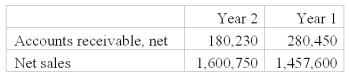
(78) The following data are taken from the comparative balance sheets of Gayle Company. Compute and interpret its accounts receivable turnover for Year 2. Competitors average a turnover of 7.5. How is the company doing in relation to its competitors?
(Essay)
4.8/5 (85)
(85) A dishonored note receivable is usually reclassified as an account receivable.
(True/False)
4.9/5 (83)
(83) The accounting principle that requires financial statements (including notes) to report all relevant information about the operations and financial condition of a company is called:
(Multiple Choice)
4.7/5 (84)
(84) The aging of accounts receivable involves classifying each account receivable by how long it is past its due date and estimating the percent of each uncollectible class.
(True/False)
4.8/5 (74)
(74) ____________________________ are amounts owed by customers from credit sales where payment is required in periodic amounts over an extended time period.
(Essay)
4.9/5 (79)
(79) Define a note receivable and explain how to calculate the interest due on a short-term note receivable.
(Essay)
4.8/5 (74)
(74) Griggs Company uses the direct write-off method of accounting for uncollectible accounts receivable. On December 6, Year 1, Griggs sold $6,300 of merchandise to the Hillman Company. On August 8, Year 2, after numerous attempts to collect the account, Griggs determined that the $6,300 account of the Hillman Company was uncollectible.
a. Prepare the journal entry required to record the transactions on August 8.
b. Assuming that the $6,300 is material, explain how the direct write-off method violates the matching principle in this case.
(Essay)
4.9/5 (88)
(88) Since pledged accounts receivables only serve as collateral for a loan and are not sold, it is not necessary to disclose the pledging.
(True/False)
4.8/5 (70)
(70) Explain the options a company has to convert its receivables to cash.
(Essay)
4.7/5 (68)
(68) On October 29 of the current year, a company concluded that a customer's $4,400 account receivable was uncollectible and that the account should be written off. What effect will this write-off have on this company's net income and total assets assuming the allowance method is used to account for bad debts?
(Multiple Choice)
4.7/5 (90)
(90) 
Filters
- Essay(0)
- Multiple Choice(0)
- Short Answer(0)
- True False(0)
- Matching(0)