



 Chat with AI
Exam 13: Accounting for Corporations

Exam 1: Accounting in Business245 Questions
Exam 2: Analyzing and Recording Transactions201 Questions
Exam 3: Adjusting Accounts and Preparing Financial Statements227 Questions
Exam 4: Completing the Accounting Cycle177 Questions
Exam 5: Accounting for Merchandising Operations189 Questions
Exam 6: Inventories and Cost of Sales194 Questions
Exam 7: Accounting Information Systems166 Questions
Exam 8: Cash and Internal Controls195 Questions
Exam 9: Accounting for Receivables162 Questions
Exam 10: Long-Term Assets208 Questions
Exam 11: Current Liabilities and Payroll Accounting178 Questions
Exam 12: Accounting for Partnerships141 Questions
Exam 13: Accounting for Corporations210 Questions
Exam 14: Long-Term Liabilities158 Questions
Exam 15: Investments and International Operations156 Questions
Exam 16: Statement of Cash Flows173 Questions
Exam 17: Analysis of Financial Statements182 Questions
Exam 18: Managerial Accounting Concepts and Principles199 Questions
Exam 19: Job Order Cost Accounting165 Questions
Exam 20: Process Cost Accounting172 Questions
Exam 21: Cost Allocation and Performance Measurement173 Questions
Exam 22: Cost-Volume-Profit Analysis190 Questions
Exam 23: Master Budgets and Planning166 Questions
Exam 24: Flexible Budgets and Standard Costs178 Questions
Exam 25: Capital Budgeting and Managerial Decisions153 Questions
Select questions type


The date of record is the date that directors vote to pay a cash dividend to shareholders.
(True/False)
4.9/5  (88)
(88) If the dividends account is not recorded as a reduction to Retained Earnings on the date of declaration, the dividends account is closed to Retained Earnings at the end of the accounting period.
(True/False)
4.8/5 (77)
(77) 
A corporation issued 5,000 $10 par value ordinary shares in exchange for some land with a market value of $60,000. The entry to record this exchange is:
(Multiple Choice)
5.0/5 (74)
(74) Shares that were reacquired and are still held by the issuing corporation are called:
(Multiple Choice)
4.8/5 (78)
(78) All of the following statements regarding share dividends are except:
(Multiple Choice)
4.8/5 (77)
(77) A company has earnings per share of $6.45. Its dividend per share is $0.20, and its market price per share is $80. Its price-earnings ratio equals 12.4.
(True/False)
4.7/5 (75)
(75) The term revenue reverse is sometimes used for retained earnings.
(True/False)
4.9/5 (84)
(84) The price-earnings ratio is computed by dividing earnings per share by the market price per share.
(True/False)
4.7/5 (69)
(69) A corporation had the following shares outstanding when the company's board of directors declared a $95,000 cash dividend during the current year:
Allocate the cash dividend between the preference and ordinary shareholders assuming the preference shares are cumulative and nonparticipating and dividends are one year in arrears.

(Essay)
4.9/5 (80)
(80) Shares that pay relatively large cash dividends on a regular basis are called:
(Multiple Choice)
5.0/5 (83)
(83) The main limitation in using book value per share for share valuation models is the potential difference between recorded value and market value for both assets and liabilities.
(True/False)
4.7/5 (75)
(75) The number of shares that a corporation's registration allows it to sell is referred to as:
(Multiple Choice)
4.8/5 (67)
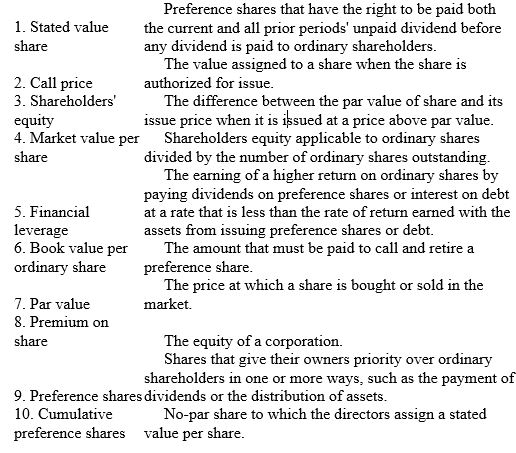
(67) is the shareholders' equity applicable to ordinary shares divided by the number of ordinary shares outstanding.
(Essay)
5.0/5 (74)
(74) Explain how to calculate the price-earnings ratio and describe how it is used in analysis of a company's financial condition and performance.
(Essay)
4.9/5 (75)
(75) Shares that pay large dividends on a regular basis are growth shares.
(True/False)
4.9/5 (83)
(83) Holders of have a right to be paid both current and all prior periods' unpaid dividends before any dividend is paid to ordinary shareholders.
(Essay)
4.8/5 (63)
(63) have special rights that give it priority or senior status over ordinary shares in one or more areas such as receiving dividends or for the distribution of assets if the corporation is liquidated.
(Essay)
4.9/5 (84)
(84) 
Filters
- Essay(0)
- Multiple Choice(0)
- Short Answer(0)
- True False(0)
- Matching(0)