



 Chat with AI
Exam 13: Accounting for Corporations

Exam 1: Accounting in Business245 Questions
Exam 2: Analyzing and Recording Transactions201 Questions
Exam 3: Adjusting Accounts and Preparing Financial Statements227 Questions
Exam 4: Completing the Accounting Cycle177 Questions
Exam 5: Accounting for Merchandising Operations189 Questions
Exam 6: Inventories and Cost of Sales194 Questions
Exam 7: Accounting Information Systems166 Questions
Exam 8: Cash and Internal Controls195 Questions
Exam 9: Accounting for Receivables162 Questions
Exam 10: Long-Term Assets208 Questions
Exam 11: Current Liabilities and Payroll Accounting178 Questions
Exam 12: Accounting for Partnerships141 Questions
Exam 13: Accounting for Corporations210 Questions
Exam 14: Long-Term Liabilities158 Questions
Exam 15: Investments and International Operations156 Questions
Exam 16: Statement of Cash Flows173 Questions
Exam 17: Analysis of Financial Statements182 Questions
Exam 18: Managerial Accounting Concepts and Principles199 Questions
Exam 19: Job Order Cost Accounting165 Questions
Exam 20: Process Cost Accounting172 Questions
Exam 21: Cost Allocation and Performance Measurement173 Questions
Exam 22: Cost-Volume-Profit Analysis190 Questions
Exam 23: Master Budgets and Planning166 Questions
Exam 24: Flexible Budgets and Standard Costs178 Questions
Exam 25: Capital Budgeting and Managerial Decisions153 Questions
Select questions type


What is a share split? How is it different from a bonus issue or a share dividend?
(Essay)
4.8/5  (80)
(80) Shares that have been issued and held by shareholders are _______________ shares.
(Essay)
4.8/5 (81)
(81) A corporation issued 300 $5 par value ordinary shares in payment of a $1,800 charge from its accountant for assistance in filing its registration. The entry to record this transaction will include:
(Multiple Choice)
4.7/5 (75)
(75) The date the directors vote to pay a dividend is called the:
(Multiple Choice)
4.7/5 (76)
(76) A corporation had the following shares outstanding when the company's board of directors declared a $95,000 cash dividend in the current year:
Allocate the cash dividend between the preference and ordinary shareholders assuming the preference shares are noncumulative and nonparticipating.

(Essay)
4.8/5 (75)
(75) The following data has been collected about a company's shareholders' equity accounts: Share Capital - Ordinary $10 par value 20,000 shares
Authorized and 10,000 shares issued, 1,000 shares in
Treasury……………………………………………………… $100,000
Share Premium - Ordinary………………………………………..... 50,000
Retained earnings…………………………………………………… 25,000
Treasury shares……………………………………………………… 11,500
The treasury shares were all purchased at the same price.
The cost per share of the treasury shares is:
(Multiple Choice)
4.8/5 (73)
(73) On September 1, a corporation had 50,000 $5 par value ordinary shares, and $1,000,000 of retained earnings. On that date, when the market price of the share is $15 per share, the corporation issues a 2-for-1 share split. The general journal entry to record this transaction is:
(Multiple Choice)
4.8/5 (78)
(78) A company has 1,000 $50 par value, 4.5% cumulative and nonparticipating preference shares and 10,000 $10 par value ordinary shares outstanding. The company paid total cash dividends of $1,000 in its first year of operation. The cash dividend that must be paid to preference shareholders in the second year before any dividend is paid to ordinary shareholders is:
(Multiple Choice)
5.0/5 (83)
(83) 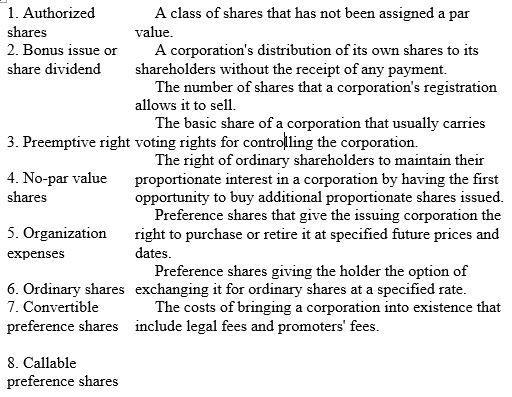
An ordinary share always carries a preference for receiving dividends over a preference share.
(True/False)
4.7/5 (82)
(82) If a corporation receives assets other than cash in exchange for shares, it records the assets received at their market value as of the date of the transaction.
(True/False)
4.8/5 (71)
(71) When all of the authorized shares have the same rights and characteristics, the share is called
(Multiple Choice)
4.8/5 (78)
(78) Marble Corporation had the following balances in its shareholders' equity accounts at December 31, 2010:
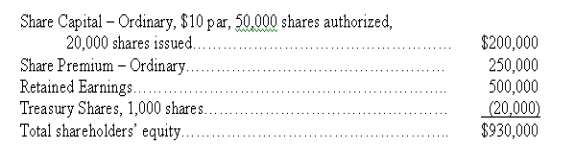 The following transactions occurred during 2011:
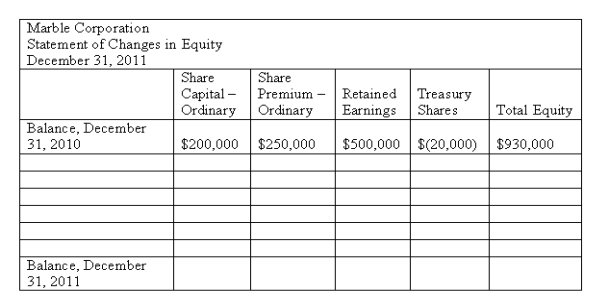
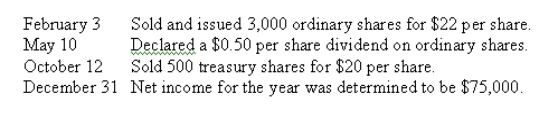 Based on the above information, prepare a statement of changes in equity for 2011. Use the form below.
The following transactions occurred during 2011:
Based on the above information, prepare a statement of changes in equity for 2011. Use the form below.
(Essay)
4.9/5 (60)
(60) A corporation's distribution of additional shares to its shareholders without the receipt of any payment in return is called a:
(Multiple Choice)
5.0/5 (74)
(74) A company paid $0.75 in cash dividends per share. Its earnings per share is $3.50, and its market price per share is $37.50. Its dividend yield equals:
(Multiple Choice)
4.9/5 (75)
(75) Retained earnings are not part of the shareholders' claims on the company's net assets.
(True/False)
4.9/5 (79)
(79) Book value per ordinary share is calculated by dividing shareholders' equity applicable to ordinary shares by the number of ordinary shares outstanding.
(True/False)
4.8/5 (72)
(72) Explain how to compute dividend yield and discuss how it is used in analysis of a company's financial condition.
(Essay)
4.8/5 (72)
(72) A participating preference share has a feature that allows it to share with ordinary shareholders in any dividends paid in excess of the percent or dollar amount stated on the preference share.
(True/False)
4.8/5 (70)
(70) 
Filters
- Essay(0)
- Multiple Choice(0)
- Short Answer(0)
- True False(0)
- Matching(0)