



 Chat with AI
Exam 21: Landscape Ecology

Exam 1: Introduction to Ecology Historical Foundations and Developing Frontiers23 Questions
Exam 2: Life on Land35 Questions
Exam 3: Life in Water35 Questions
Exam 4: Population Genetics and Natural Selection31 Questions
Exam 5: Temperature Relations35 Questions
Exam 6: Water Relations34 Questions
Exam 7: Energy and Nutrient Relations29 Questions
Exam 8: Socail Relations30 Questions
Exam 9: Population Distribution and Abundance29 Questions
Exam 10: Population Dynamics30 Questions
Exam 11: Population Growth29 Questions
Exam 12: Life Histories29 Questions
Exam 13: Competition30 Questions
Exam 14: Exploitative Interactions Predation, Herbivory, Parasitism, and Disease28 Questions
Exam 15: Mutualism29 Questions
Exam 16: Species Abundance and Diversity25 Questions
Exam 17: Species Interactions and Community Structure24 Questions
Exam 18: Primary Production and Energy Flow30 Questions
Exam 19: Nutrient Cycling and Retention36 Questions
Exam 20: Succession and Stability30 Questions
Exam 21: Landscape Ecology30 Questions
Exam 22: Geographic Ecology30 Questions
Exam 23: Global Ecology29 Questions
Select questions type


Mowing experiments in a Kansas prairie established that, for small mammals,
(Multiple Choice)
4.8/5  (82)
(82) Recent conversion of forests to beaver ponds and wet meadows
(Multiple Choice)
4.7/5 (65)
(65) Connections of similar habitat maintained between habitat fragments are known as ___________.
(Short Answer)
4.9/5 (75)
(75) Studies by Hanski, Kuussaari, and Nieminen determined that ______ and _____ of patches strongly influence the size and density of Glanville fritillary butterfly, Melitaea cinxia, populations.
(Multiple Choice)
4.9/5 (70)
(70) Expansion of forest in Veluwe, Netherlands at the expense of heathland has occurred primarily as a result of
(Multiple Choice)
4.8/5 (85)
(85) A large value of the patch shape index, S = P/(2A), indicates a
(Multiple Choice)
4.9/5 (75)
(75) Given the following data, calculate the Mann-Whitney statistic U for the stream draining the boreal forest. 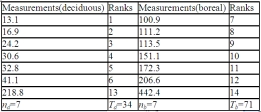
(Multiple Choice)
5.0/5 (81)
(81) A heterogeneous area consisting of a patchwork of distinctive ecosystems is called a ___________.
(Multiple Choice)
4.9/5 (82)
(82) 
Filters
- Essay(0)
- Multiple Choice(0)
- Short Answer(0)
- True False(0)
- Matching(0)