



 Chat with AI
Exam 21: The Influence of Monetary and Fiscal Policy on Aggregate Demand

Exam 1: Ten Principles of Economics438 Questions
Exam 2: Thinking Like an Economist620 Questions
Exam 3: Interdependence and the Gains From Trade527 Questions
Exam 4: The Market Forces of Supply and Demand700 Questions
Exam 5: Elasticity and Its Application598 Questions
Exam 6: Supply, Demand, and Government Policies648 Questions
Exam 7: Consumers, Producers, and the Efficiency of Markets547 Questions
Exam 8: Application: the Costs of Taxation514 Questions
Exam 9: Application: International Trade496 Questions
Exam 10: Measuring a Nations Income522 Questions
Exam 11: Measuring the Cost of Living545 Questions
Exam 12: Production and Growth507 Questions
Exam 13: Saving, Investment, and the Financial System567 Questions
Exam 14: The Basic Tools of Finance513 Questions
Exam 15: Unemployment699 Questions
Exam 16: The Monetary System517 Questions
Exam 17: Money Growth and Inflation487 Questions
Exam 18: Open-Economy Macroeconomics: Basic Concepts522 Questions
Exam 19: A Macroeconomic Theory of the Open Economy484 Questions
Exam 20: Aggregate Demand and Aggregate Supply563 Questions
Exam 21: The Influence of Monetary and Fiscal Policy on Aggregate Demand511 Questions
Exam 22: The Short-Run Trade-Off Between Inflation and Unemployment516 Questions
Exam 23: Six Debates Over Macroeconomic Policy372 Questions
Select questions type


Which of the following is likely more important for explaining the slope of the aggregate-demand curve of a small economy than it is for the United States?
(Multiple Choice)
4.8/5  (83)
(83) Figure 34-6. On the left-hand graph, MS represents the supply of money and MD represents the demand for money; on the right-hand graph, AD represents aggregate demand. The usual quantities are measured along the axes of both graphs.
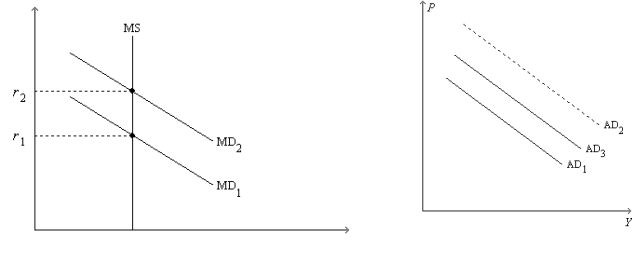 -Refer to Figure 34-6. Suppose the multiplier is 3 and the government increases its purchases by $25 billion. Also, suppose the AD curve would shift from AD1 to AD2 if there were no crowding out; the AD curve actually shifts from AD1 to AD3 with crowding out. Finally, assume the horizontal distance between the curves AD1 and AD3 is $40 billion. The extent of crowding out, for any particular level of the price level, is
 (Multiple Choice)
4.9/5 (86)
(86) Government expenditures on capital goods such as roads could increase aggregate supply. Such effects on aggregate supply are likely to matter more in the short run than in the long run.
(True/False)
4.9/5 (87)
(87) Changes in the interest rate bring the money market into equilibrium according to
(Multiple Choice)
4.8/5 (82)
(82) Suppose stock prices rise. To offset the resulting change in output the Federal Reserve could
(Multiple Choice)
4.8/5 (86)
(86) Who asserted that "the Federal Reserve's job is to take away the punch bowl just as the party gets going?"
(Multiple Choice)
5.0/5 (87)
(87) Figure 34-5. On the figure, MS represents money supply and MD represents money demand. 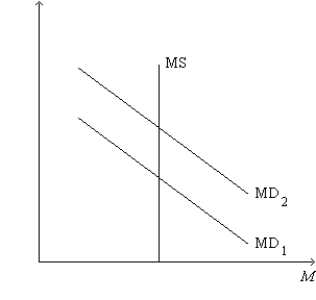 -Refer to Figure 34-5. A shift of the money-demand curve from MD2 to MD1 is consistent with which of the following sets of events?
 (Multiple Choice)
4.9/5 (79)
(79) If the MPC is 0.8 and there are no crowding-out or accelerator effects, then an initial increase in aggregate demand of $120 billion will eventually shift the aggregate demand curve to the right by
(Multiple Choice)
4.9/5 (61)
(61) If Congress increases taxes to balance the federal budget, then to prevent unemployment and a recession the Fed will
(Multiple Choice)
4.8/5 (75)
(75) Figure 34-1  -Refer to Figure 34-1. There is an excess demand for money at an interest rate of
 (Multiple Choice)
4.7/5 (83)
(83) Suppose the MPC is 0.60. Assume there are no crowding out or investment accelerator effects. If the government increases expenditures by $200 billion, then by how much does aggregate demand shift to the right? If the government decreases taxes by $200 billion, then by how much does aggregate demand shift to the right?
(Multiple Choice)
4.9/5 (76)
(76) Which of the following actions might we logically expect to result from rising stock prices?
(Multiple Choice)
4.7/5 (83)
(83) An increase in the price level shifts the money demand curve to the left, causing interest rates to increase.
(True/False)
4.9/5 (77)
(77) If the MPC = 0.75, then the government purchases multiplier is about
(Multiple Choice)
4.9/5 (71)
(71) When there is an excess demand for money, households will interest-bearing bonds, causing interest rates to _____.
(Essay)
4.8/5 (83)
(83) 
Filters
- Essay(0)
- Multiple Choice(0)
- Short Answer(0)
- True False(0)
- Matching(0)