



 Chat with AI
Exam 21: The Influence of Monetary and Fiscal Policy on Aggregate Demand

Exam 1: Ten Principles of Economics438 Questions
Exam 2: Thinking Like an Economist620 Questions
Exam 3: Interdependence and the Gains From Trade527 Questions
Exam 4: The Market Forces of Supply and Demand700 Questions
Exam 5: Elasticity and Its Application598 Questions
Exam 6: Supply, Demand, and Government Policies648 Questions
Exam 7: Consumers, Producers, and the Efficiency of Markets547 Questions
Exam 8: Application: the Costs of Taxation514 Questions
Exam 9: Application: International Trade496 Questions
Exam 10: Measuring a Nations Income522 Questions
Exam 11: Measuring the Cost of Living545 Questions
Exam 12: Production and Growth507 Questions
Exam 13: Saving, Investment, and the Financial System567 Questions
Exam 14: The Basic Tools of Finance513 Questions
Exam 15: Unemployment699 Questions
Exam 16: The Monetary System517 Questions
Exam 17: Money Growth and Inflation487 Questions
Exam 18: Open-Economy Macroeconomics: Basic Concepts522 Questions
Exam 19: A Macroeconomic Theory of the Open Economy484 Questions
Exam 20: Aggregate Demand and Aggregate Supply563 Questions
Exam 21: The Influence of Monetary and Fiscal Policy on Aggregate Demand511 Questions
Exam 22: The Short-Run Trade-Off Between Inflation and Unemployment516 Questions
Exam 23: Six Debates Over Macroeconomic Policy372 Questions
Select questions type


The price of imported oil rises. If the government wanted to stabilize output, which of the following could it do?
(Multiple Choice)
4.8/5  (61)
(61) Figure 34-5. On the figure, MS represents money supply and MD represents money demand. 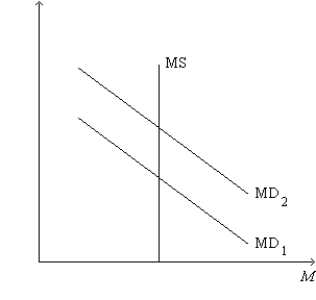 -Refer to Figure 34-5. A shift of the money-demand curve from MD1 to MD2 could be a result of
 (Multiple Choice)
4.7/5 (67)
(67) Suppose that the government increases expenditures by $150 billion while increasing taxes by $150 billion. Suppose that the MPC is .80 and that there are no crowding out or accelerator effects. What is the combined effect of these changes? Why is the combined change not equal to zero?
(Essay)
4.9/5 (92)
(92) Figure 34-3  -Refer to Figure 34-3. What quantity is represented by the downward-sloping line on the left-hand graph?
 (Multiple Choice)
4.8/5 (90)
(90) Which of the following shifts aggregate demand to the right?
(Multiple Choice)
4.9/5 (82)
(82) Suppose that the government spends more on a missile defense program. What does this do to aggregate demand? How is your answer affected by the presence of the multiplier, crowding-out, taxes, and investment-accelerator effects?
(Essay)
4.9/5 (62)
(62) Permanent tax changes have a effect on aggregate demand compared to temporary tax changes.
(Essay)
4.9/5 (78)
(78) Figure 34-4. On the figure, MS represents money supply and MD represents money demand.  -Refer to Figure 34-4. Suppose the current equilibrium interest rate is r1. Which of the following events would cause the equilibrium interest rate to increase?
 (Multiple Choice)
4.7/5 (82)
(82) If the Fed conducts open-market purchases, then which of the following quantities increases)?
(Multiple Choice)
4.8/5 (96)
(96) Explain why the interest rate is the opportunity cost of holding currency. What is the benefit of holding currency?
(Essay)
4.8/5 (72)
(72) If the spending multiplier is 8, then the marginal propensity to consume must be 7/8.
(True/False)
4.9/5 (81)
(81) A decrease in the domestic _____ causes domestic goods to become less expensive relative to foreign goods and increases net exports. The increase in net exports causes an) _____ in the quantity of domestic aggregate goods and services demanded and is known as the _____ effect.
(Essay)
4.7/5 (81)
(81) If expected inflation is constant and the nominal interest rate decreases by 2 percentage points, then the real interest rate
(Multiple Choice)
4.8/5 (75)
(75) In a certain economy, when income is $100, consumer spending is $60. The value of the multiplier for this economy is 4. It follows that, when income is $101, consumer spending is
(Multiple Choice)
4.8/5 (74)
(74) If the marginal propensity to consume is 4/5, then a decrease in government spending of $1 billion decreases the demand for goods and services by $5 billion.
(True/False)
4.8/5 (82)
(82) When the Fed announces a target for the federal funds rate, it essentially accommodates the day-to-day fluctuations in money demand by adjusting the money supply accordingly.
(True/False)
4.9/5 (78)
(78) Suppose that there are no crowding-out effects and the MPC is .9. By how much must the government increase expenditures to shift the aggregate demand curve right by $10 billion?
(Essay)
4.8/5 (74)
(74) Which of the following policies would Keynes's followers support when an increase in business optimism shifts the aggregate demand curve away from long-run equilibrium?
(Multiple Choice)
4.8/5 (78)
(78) Suppose a wave of optimism causes firms to increase investment. To stabilize output and employment, the Federal Reserve will .
(Essay)
4.9/5 (76)
(76) 
Filters
- Essay(0)
- Multiple Choice(0)
- Short Answer(0)
- True False(0)
- Matching(0)