



 Chat with AI
Exam 21: The Influence of Monetary and Fiscal Policy on Aggregate Demand

Exam 1: Ten Principles of Economics438 Questions
Exam 2: Thinking Like an Economist620 Questions
Exam 3: Interdependence and the Gains From Trade527 Questions
Exam 4: The Market Forces of Supply and Demand700 Questions
Exam 5: Elasticity and Its Application598 Questions
Exam 6: Supply, Demand, and Government Policies648 Questions
Exam 7: Consumers, Producers, and the Efficiency of Markets547 Questions
Exam 8: Application: the Costs of Taxation514 Questions
Exam 9: Application: International Trade496 Questions
Exam 10: Measuring a Nations Income522 Questions
Exam 11: Measuring the Cost of Living545 Questions
Exam 12: Production and Growth507 Questions
Exam 13: Saving, Investment, and the Financial System567 Questions
Exam 14: The Basic Tools of Finance513 Questions
Exam 15: Unemployment699 Questions
Exam 16: The Monetary System517 Questions
Exam 17: Money Growth and Inflation487 Questions
Exam 18: Open-Economy Macroeconomics: Basic Concepts522 Questions
Exam 19: A Macroeconomic Theory of the Open Economy484 Questions
Exam 20: Aggregate Demand and Aggregate Supply563 Questions
Exam 21: The Influence of Monetary and Fiscal Policy on Aggregate Demand511 Questions
Exam 22: The Short-Run Trade-Off Between Inflation and Unemployment516 Questions
Exam 23: Six Debates Over Macroeconomic Policy372 Questions
Select questions type


The multiplier for changes in government spending is calculated as
(Multiple Choice)
4.8/5  (64)
(64) Suppose there was a large increase in net exports. If the Fed wanted to stabilize output, it could
(Multiple Choice)
4.8/5 (77)
(77) Suppose households attempt to increase their money holdings. To stabilize output by countering this increase in money demand, the Federal Reserve would
(Multiple Choice)
4.9/5 (72)
(72) Both the multiplier effect and the investment accelerator tend to make the aggregate-demand curve shift further than it does due to an initial increase in government expenditures.
(True/False)
4.9/5 (77)
(77) An essential piece of the liquidity preference theory is the demand for money.
(True/False)
4.8/5 (85)
(85) In a certain economy, when income is $400, consumer spending is $325. The value of the multiplier for this economy is 3.33. It follows that, when income is $450, consumer spending is
(Multiple Choice)
4.9/5 (78)
(78) Economists who are skeptical about the relevance of "liquidity traps" argue that
(Multiple Choice)
4.9/5 (77)
(77) Figure 34-2. On the left-hand graph, MS represents the supply of money and MD represents the demand for money; on the right-hand graph, AD represents aggregate demand. The usual quantities are measured along the axes of both graphs.
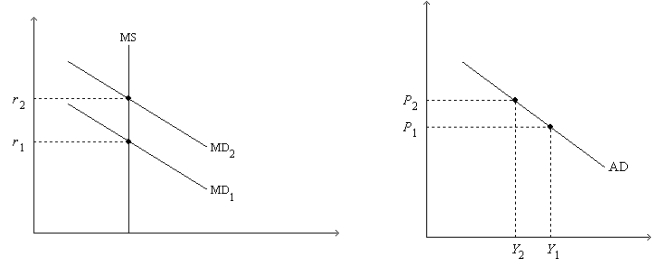 -Refer to Figure 34-2. Assume the money market is always in equilibrium, and suppose r1 = 0.08; r2 = 0.12; Y1 = 13,000; Y2 = 10,000; P1 = 1.0; and P2 = 1.2. Which of the following statements is correct? When P = P2,
 (Multiple Choice)
4.8/5 (79)
(79) The interest rate would fall and the quantity of money demanded would
(Multiple Choice)
4.8/5 (76)
(76) Figure 34-4. On the figure, MS represents money supply and MD represents money demand.  -Refer to Figure 34-4. Suppose the current equilibrium interest rate is r3. Which of the following events would cause the equilibrium interest rate to decrease?
 (Multiple Choice)
4.9/5 (89)
(89) Figure 34-3  -Refer to Figure 34-3. Which of the following sequences numbered arrows) shows the logic of the interest-rate effect?
 (Multiple Choice)
4.9/5 (75)
(75) Which of the following shifts aggregate demand to the left?
(Multiple Choice)
4.9/5 (75)
(75) Figure 34-1  -Refer to Figure 34-1. Which of the following is correct?
 (Multiple Choice)
5.0/5 (74)
(74) The Federal Reserve sets _____ policy, while the president and Congress set _____ policy. These two policies influence aggregate _____.
(Essay)
4.7/5 (62)
(62) The Kennedy tax cut of 1964 included an investment tax credit that was designed to
(Multiple Choice)
4.7/5 (72)
(72) The theory of liquidity preference is most helpful in understanding
(Multiple Choice)
4.9/5 (71)
(71) To offset increased pessimism by households, the government may _____ government spending and/or _____ taxes.
(Essay)
4.8/5 (74)
(74) An increase in government spending shifts aggregate demand
(Multiple Choice)
4.8/5 (78)
(78) 
Filters
- Essay(0)
- Multiple Choice(0)
- Short Answer(0)
- True False(0)
- Matching(0)