



 Chat with AI
Exam 14: The Basic Tools of Finance

Exam 1: Ten Principles of Economics438 Questions
Exam 2: Thinking Like an Economist620 Questions
Exam 3: Interdependence and the Gains From Trade527 Questions
Exam 4: The Market Forces of Supply and Demand700 Questions
Exam 5: Elasticity and Its Application598 Questions
Exam 6: Supply, Demand, and Government Policies648 Questions
Exam 7: Consumers, Producers, and the Efficiency of Markets547 Questions
Exam 8: Application: the Costs of Taxation514 Questions
Exam 9: Application: International Trade496 Questions
Exam 10: Measuring a Nations Income522 Questions
Exam 11: Measuring the Cost of Living545 Questions
Exam 12: Production and Growth507 Questions
Exam 13: Saving, Investment, and the Financial System567 Questions
Exam 14: The Basic Tools of Finance513 Questions
Exam 15: Unemployment699 Questions
Exam 16: The Monetary System517 Questions
Exam 17: Money Growth and Inflation487 Questions
Exam 18: Open-Economy Macroeconomics: Basic Concepts522 Questions
Exam 19: A Macroeconomic Theory of the Open Economy484 Questions
Exam 20: Aggregate Demand and Aggregate Supply563 Questions
Exam 21: The Influence of Monetary and Fiscal Policy on Aggregate Demand511 Questions
Exam 22: The Short-Run Trade-Off Between Inflation and Unemployment516 Questions
Exam 23: Six Debates Over Macroeconomic Policy372 Questions
Select questions type


Lucretia puts $400 into an account when the interest rate is 10 percent. Later she checks her balance and finds it's worth about $708.62. How many years did she wait to check her balance?
(Multiple Choice)
4.8/5  (75)
(75) Demonstrate that whether you would prefer to have $225 today or wait five years for $300 depends on the interest rate. Show your work.
(Essay)
4.8/5 (86)
(86) If the interest rate is 8 percent, then the present value of $1,000 to be received in 4 years is $735.03.
(True/False)
4.9/5 (68)
(68) Suppose that fundamental analysis indicates a particular company's stock is overvalued.
(Multiple Choice)
4.8/5 (74)
(74) You deposit $3,000 into an N-year certificate of deposit that pays 4.5 percent annual interest, and at the end of the N years you have $4,082.59. What is the number of years, N?
(Multiple Choice)
4.9/5 (96)
(96) What is the present value of a payment of $100 one year from today if the interest rate is 5 percent?
(Multiple Choice)
4.7/5 (80)
(80) Suppose the interest rate is 8 percent. Consider three payment options:Suppose the interest rate is 8 percent. Consider three payment options: 1. $200 today.
2) $220 one year from today.
3) $240 two years from today.
Which of the following is correct?
(Multiple Choice)
4.9/5 (81)
(81) Imagine that someone offers you $X today or $1,500 in 5 years. If the interest rate is 4 percent, then you would prefer to take the $X today if and only if
(Multiple Choice)
4.9/5 (91)
(91) Figure 27-1. The figure shows a utility function. 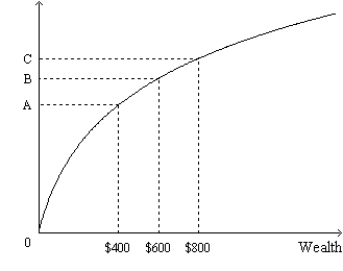 -Refer to Figure 27-1. Which distance along the vertical axis represents the marginal utility of an increase in wealth from $600 to $800?
 (Multiple Choice)
4.9/5 (89)
(89) Robert put $15,000 into an account with a fixed interest rate two years ago and now the account balance is $16,917.66. What rate of interest did Robert earn?
(Multiple Choice)
4.9/5 (73)
(73) An increase in the interest rate causes a decrease in the future value of $1,000 that you have in a bank account today.
(True/False)
4.9/5 (75)
(75) Hector puts $150 into an account when the interest rate is 4 percent. Later he checks his balance and finds he has about $168.73. How long did Hector wait to check his balance?
(Multiple Choice)
4.8/5 (80)
(80) Write the formula for finding the future value in n years of $x today.
(Essay)
4.9/5 (76)
(76) What is the present value of a payment of $200 to be made one year from today if the interest rate is 10 percent?
(Multiple Choice)
4.8/5 (78)
(78) According to the efficient markets hypothesis, which of the following would decrease the price of stock in Veblen's Leisure Company?
(Multiple Choice)
4.8/5 (90)
(90) Braden says that $400 saved for one year at 4 percent interest has a smaller future value than $400 saved for two years at 2 percent interest. Lefty says that the present value of $400 to be received one year from today if the interest rate is 4 percent exceeds the present value of $400 to be received two years from today if the interest rate is 2 percent.
(Multiple Choice)
4.8/5 (75)
(75) Which of the following actions best illustrates moral hazard?
(Multiple Choice)
4.9/5 (85)
(85) Using the rule of 70, about how much would $100 be worth after 50 years if the interest rate were 7 percent?
(Multiple Choice)
5.0/5 (84)
(84) Clint puts $200 into an account when the interest rate is 8 percent. Later he checks his balance and finds that he has a balance of about $272.10. How many years did Clint wait to check his balance?
(Multiple Choice)
4.9/5 (70)
(70) Which of the following changes would decrease the present value of a future payment?
(Multiple Choice)
4.8/5 (64)
(64) 
Filters
- Essay(0)
- Multiple Choice(0)
- Short Answer(0)
- True False(0)
- Matching(0)