



 Chat with AI
Exam 14: The Basic Tools of Finance

Exam 1: Ten Principles of Economics438 Questions
Exam 2: Thinking Like an Economist620 Questions
Exam 3: Interdependence and the Gains From Trade527 Questions
Exam 4: The Market Forces of Supply and Demand700 Questions
Exam 5: Elasticity and Its Application598 Questions
Exam 6: Supply, Demand, and Government Policies648 Questions
Exam 7: Consumers, Producers, and the Efficiency of Markets547 Questions
Exam 8: Application: the Costs of Taxation514 Questions
Exam 9: Application: International Trade496 Questions
Exam 10: Measuring a Nations Income522 Questions
Exam 11: Measuring the Cost of Living545 Questions
Exam 12: Production and Growth507 Questions
Exam 13: Saving, Investment, and the Financial System567 Questions
Exam 14: The Basic Tools of Finance513 Questions
Exam 15: Unemployment699 Questions
Exam 16: The Monetary System517 Questions
Exam 17: Money Growth and Inflation487 Questions
Exam 18: Open-Economy Macroeconomics: Basic Concepts522 Questions
Exam 19: A Macroeconomic Theory of the Open Economy484 Questions
Exam 20: Aggregate Demand and Aggregate Supply563 Questions
Exam 21: The Influence of Monetary and Fiscal Policy on Aggregate Demand511 Questions
Exam 22: The Short-Run Trade-Off Between Inflation and Unemployment516 Questions
Exam 23: Six Debates Over Macroeconomic Policy372 Questions
Select questions type


Available evidence indicates that stock prices, even if not exactly a random walk, are very close to a random walk.
(True/False)
4.9/5  (78)
(78) Figure 27-1. The figure shows a utility function. 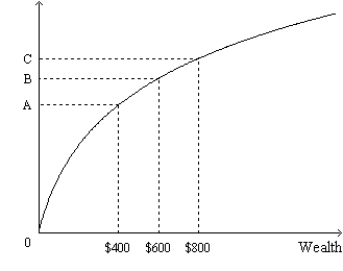 -Refer to Figure 27-1. The utility function that is shown exhibits the property of diminishing
 (Multiple Choice)
4.8/5 (88)
(88) Until recently, shares of stock accounted for 40 percent of Jimmy's savings. A few days ago, Jimmy sold some bonds and bought some additional shares of stock. Now shares of stock account for 70 percent of Jimmy's savings. How did this change affect Jimmy's expected retun on his savings? How did it affect the risks he faces?
(Essay)
4.9/5 (81)
(81) Whenever the price of an asset rises above what appears to be its fundamental value, the market is said to be experiencing a
(Multiple Choice)
4.8/5 (75)
(75) Cleo promises to pay Jacques $1,000 two years from today. If the interest rate is 4 percent, then how much is this future payment worth today?
(Multiple Choice)
4.8/5 (81)
(81) A scholarship gives you $1,000 today and promises to pay you $1,000 one year from today. What is the present value of these payments?
(Multiple Choice)
4.7/5 (85)
(85) At which interest rate is the present value of $168.54 two years from today equal to $150 today?
(Multiple Choice)
4.9/5 (79)
(79) If asset markets are driven by the "animal spirits" of investors, then
(Multiple Choice)
4.9/5 (91)
(91) As the interest rate increases, what happens to the present value of a future payment? Explain why changes in the interest rate will lead to changes in the quantity of loanable funds demanded and investment spending.
(Essay)
4.9/5 (88)
(88) Amelia knows that she has about $105 in her bank account. She knows she earned an interest rate of 4 percent, but she doesn't remember how much she opened the account with a year ago. How much did she put in?
(Multiple Choice)
4.9/5 (85)
(85) Adverse selection is illustrated by people who take greater risks after they purchase insurance.
(True/False)
4.8/5 (77)
(77) If unexpected news raised people's expectations of a corporation's future dividends and price, then before the price changes this corporation's stock would be
(Multiple Choice)
4.8/5 (73)
(73) Felix deposited $500 into an account two years ago. The first year he earned 3 percent interest and the second year he earned 5 percent interest. How much money does Felix have in his account now?
(Multiple Choice)
4.9/5 (82)
(82) A firm has three different investment options. Option A will give the firm $10 million at the end of one year, $10 million at the end of two years, and $10 million at the end of three years. Option B will give the firm $15 million at the end of one year, $10 million at the end of two years, and $5 million at the end of three years. Option C will give the firm $30 million at the end of one year, and nothing thereafter. Which of these options has the highest present value?
(Multiple Choice)
4.8/5 (81)
(81) The rule of 70 applies to a growing savings account but not to a growing economy.
(True/False)
4.7/5 (73)
(73) Happy Trails, a bicycle rental company, is considering purchasing three additional bicycles. Each bicycle would cost them $249.66. At the end of the first year the increase to their revenues would be $140 per bicycle. At the end of the second year the increase to their revenues again would be $140 per bicycle. Thereafter, there are no increases to their revenues. At which of the following interest rates is the sum of the present values of the additional revenues closest to the price of a bicycle?
(Multiple Choice)
4.9/5 (68)
(68) If a person had increasing marginal utility, then the decline in utility from losing $1,000 would be greater than the increase in utility from gaining $1,000.
(True/False)
4.9/5 (81)
(81) 
Filters
- Essay(0)
- Multiple Choice(0)
- Short Answer(0)
- True False(0)
- Matching(0)