



 Chat with AI
Exam 14: The Basic Tools of Finance

Exam 1: Ten Principles of Economics438 Questions
Exam 2: Thinking Like an Economist620 Questions
Exam 3: Interdependence and the Gains From Trade527 Questions
Exam 4: The Market Forces of Supply and Demand700 Questions
Exam 5: Elasticity and Its Application598 Questions
Exam 6: Supply, Demand, and Government Policies648 Questions
Exam 7: Consumers, Producers, and the Efficiency of Markets547 Questions
Exam 8: Application: the Costs of Taxation514 Questions
Exam 9: Application: International Trade496 Questions
Exam 10: Measuring a Nations Income522 Questions
Exam 11: Measuring the Cost of Living545 Questions
Exam 12: Production and Growth507 Questions
Exam 13: Saving, Investment, and the Financial System567 Questions
Exam 14: The Basic Tools of Finance513 Questions
Exam 15: Unemployment699 Questions
Exam 16: The Monetary System517 Questions
Exam 17: Money Growth and Inflation487 Questions
Exam 18: Open-Economy Macroeconomics: Basic Concepts522 Questions
Exam 19: A Macroeconomic Theory of the Open Economy484 Questions
Exam 20: Aggregate Demand and Aggregate Supply563 Questions
Exam 21: The Influence of Monetary and Fiscal Policy on Aggregate Demand511 Questions
Exam 22: The Short-Run Trade-Off Between Inflation and Unemployment516 Questions
Exam 23: Six Debates Over Macroeconomic Policy372 Questions
Select questions type


Matt's Utility Function 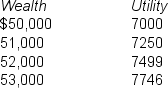 If Matt's current wealth is $51,000, then
 (Multiple Choice)
4.8/5  (80)
(80) Which of the following is not consistent with the efficient market hypothesis?
(Multiple Choice)
4.9/5 (78)
(78) The rule of 70 can be stated as follows: A variable with a growth rate of X percent per year
(Multiple Choice)
4.8/5 (86)
(86) Tonya put $250 into an account three years ago. The first year he earned 6 percent interest, the second year 7 percent, and the third year 8 percent. About how about much does Tonya have in her account now?
(Multiple Choice)
4.8/5 (73)
(73) Bill gets medical insurance and then exercises less. Lilly has health concerns and so applies for medical insurance. Identify each of these as moral hazard or adverse selection.
(Essay)
4.8/5 (83)
(83) Why might someone be willing to pay more than the fundamental value for a stock?
(Essay)
4.9/5 (87)
(87) Figure 27-1. The figure shows a utility function.  -Refer to Figure 27-1. Suppose the person to whom this utility function applies begins with $600 in wealth. Starting from there,
 (Multiple Choice)
4.8/5 (71)
(71) Discuss the statistical evidence concerning the efficient markets hypothesis.
(Essay)
4.9/5 (83)
(83) In general, as a person includes fewer stocks and more bonds in his portfolio,
(Multiple Choice)
5.0/5 (70)
(70) Which of the following concepts is most helpful in explaining why investment increases when the interest rate falls?
(Multiple Choice)
4.7/5 (82)
(82) Mixster Concrete Company is considering buying a new cement truck. The owners and their accountants decide that this is the profitable thing to do. Before they can buy the truck, the interest rate and price of trucks change. In which case do these changes both make them less likely to buy the truck?
(Multiple Choice)
4.9/5 (84)
(84) Suppose that interest rates unexpectedly rise and that FineLine Corporation announces that revenues from last quarter were down but not as much as the public had anticipated they would be down. According to the efficient markets hypothesis, which of the these things make the price of FineLine Corporation Stock fall?
(Multiple Choice)
4.8/5 (89)
(89) Assuming the interest rate is 6 percent, which of the following has the greatest present value?
(Multiple Choice)
4.7/5 (73)
(73) You have a choice among three options. Option 1: receive $900 immediately. Option 2: receive $1,200 one year from now. Option 3: receive $2,000 five years from now. The interest rate is 15 percent. Rank these three options from highest present value to lowest present value.
(Multiple Choice)
4.8/5 (58)
(58) If the interest rate is 2.49 percent, then what is the present value of $5,000 to be received in 4 years?
(Multiple Choice)
4.9/5 (82)
(82) Susan put $375 into an account and one year later had $405. What interest rate was paid on Susan's deposit?
(Multiple Choice)
4.7/5 (88)
(88) Figure 27-1. The figure shows a utility function.
-Refer to Figure 27-1. For the person to whom this utility function applies,
-Refer to Figure 27-1. For the person to whom this utility function applies, (Multiple Choice)
4.8/5 (79)
(79) 
Filters
- Essay(0)
- Multiple Choice(0)
- Short Answer(0)
- True False(0)
- Matching(0)