



 Chat with AI
Exam 13: Saving, Investment, and the Financial System

Exam 1: Ten Principles of Economics438 Questions
Exam 2: Thinking Like an Economist620 Questions
Exam 3: Interdependence and the Gains From Trade527 Questions
Exam 4: The Market Forces of Supply and Demand700 Questions
Exam 5: Elasticity and Its Application598 Questions
Exam 6: Supply, Demand, and Government Policies648 Questions
Exam 7: Consumers, Producers, and the Efficiency of Markets547 Questions
Exam 8: Application: the Costs of Taxation514 Questions
Exam 9: Application: International Trade496 Questions
Exam 10: Measuring a Nations Income522 Questions
Exam 11: Measuring the Cost of Living545 Questions
Exam 12: Production and Growth507 Questions
Exam 13: Saving, Investment, and the Financial System567 Questions
Exam 14: The Basic Tools of Finance513 Questions
Exam 15: Unemployment699 Questions
Exam 16: The Monetary System517 Questions
Exam 17: Money Growth and Inflation487 Questions
Exam 18: Open-Economy Macroeconomics: Basic Concepts522 Questions
Exam 19: A Macroeconomic Theory of the Open Economy484 Questions
Exam 20: Aggregate Demand and Aggregate Supply563 Questions
Exam 21: The Influence of Monetary and Fiscal Policy on Aggregate Demand511 Questions
Exam 22: The Short-Run Trade-Off Between Inflation and Unemployment516 Questions
Exam 23: Six Debates Over Macroeconomic Policy372 Questions
Select questions type


Consider the expressions T - G and Y - T - C. Which of the following statements is correct?
(Multiple Choice)
4.9/5  (59)
(59) Use the following table to answer the following questions.
Table 26-2
 -Refer to Table 26-2. For which stocks) isare) the P/E ratio less than what is historically typical?
 (Multiple Choice)
5.0/5 (79)
(79) Which of the following would a macroeconomist consider as investment?
(Multiple Choice)
4.8/5 (89)
(89) Suppose government expenditures on goods and services and net taxes both decrease, and expenditures fall by more than net taxes. The effects of these changes on the budget deficit cause
(Multiple Choice)
4.8/5 (86)
(86) Figure 26-5. Figure 26-5 shows the loanable funds market for a closed economy. 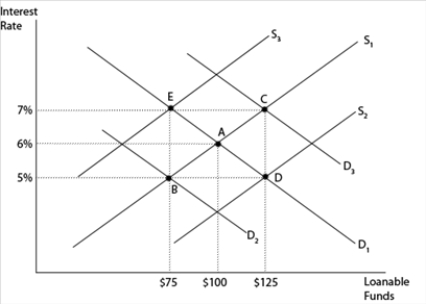 -Refer to Figure 26-5. Starting at point A, a reduction in government spending would cause
 (Multiple Choice)
4.9/5 (87)
(87) What would happen in the market for loanable funds if the government were to decrease the tax rate on interest income?
(Multiple Choice)
4.8/5 (89)
(89) 
Filters
- Essay(0)
- Multiple Choice(0)
- Short Answer(0)
- True False(0)
- Matching(0)