



 Chat with AI
Exam 13: Saving, Investment, and the Financial System

Exam 1: Ten Principles of Economics438 Questions
Exam 2: Thinking Like an Economist620 Questions
Exam 3: Interdependence and the Gains From Trade527 Questions
Exam 4: The Market Forces of Supply and Demand700 Questions
Exam 5: Elasticity and Its Application598 Questions
Exam 6: Supply, Demand, and Government Policies648 Questions
Exam 7: Consumers, Producers, and the Efficiency of Markets547 Questions
Exam 8: Application: the Costs of Taxation514 Questions
Exam 9: Application: International Trade496 Questions
Exam 10: Measuring a Nations Income522 Questions
Exam 11: Measuring the Cost of Living545 Questions
Exam 12: Production and Growth507 Questions
Exam 13: Saving, Investment, and the Financial System567 Questions
Exam 14: The Basic Tools of Finance513 Questions
Exam 15: Unemployment699 Questions
Exam 16: The Monetary System517 Questions
Exam 17: Money Growth and Inflation487 Questions
Exam 18: Open-Economy Macroeconomics: Basic Concepts522 Questions
Exam 19: A Macroeconomic Theory of the Open Economy484 Questions
Exam 20: Aggregate Demand and Aggregate Supply563 Questions
Exam 21: The Influence of Monetary and Fiscal Policy on Aggregate Demand511 Questions
Exam 22: The Short-Run Trade-Off Between Inflation and Unemployment516 Questions
Exam 23: Six Debates Over Macroeconomic Policy372 Questions
Select questions type


Which of the following counts as part of the supply of loanable funds?
(Multiple Choice)
5.0/5  (90)
(90) Figure 26-1. The figure depicts a demand-for-loanable-funds curve and two supply-of-loanable-funds curves. 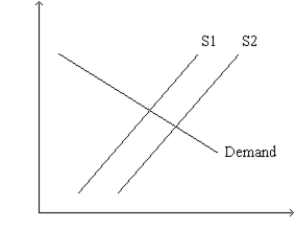 -Refer to Figure 26-1. Which of the following events would shift the supply curve from S1 to S2?
 (Multiple Choice)
4.8/5 (85)
(85) Which of the following equations represents GDP for a closed economy?
(Multiple Choice)
4.7/5 (72)
(72) You have some estimates of national accounts numbers for a closed economy for the coming year. Under one set of expectations, government purchases will be $30 billion, transfer payments will be $10 billion, and taxes will be $45 billion. Under another set of expectations, GDP will be $200 billion, taxes will be $50 billion, transfer payments will be $20 billion, consumption will be $120 million, and investment will be $40 billion. Based on these numbers in the first case there should be a
(Multiple Choice)
4.9/5 (79)
(79) What variable adjusts to balance demand and supply in the market for loanable funds?
(Essay)
4.8/5 (70)
(70) If consumers reduced their spending, what would happen to the interest rate and investment?
(Essay)
4.8/5 (77)
(77) Suppose the government deficit increases, but the interest rate remains the same. Which of the following things might have happened simultaneously to keep interest rates the same?
(Multiple Choice)
4.9/5 (86)
(86) When tax code changes reduce investment incentives, the _____ for loanable funds curve shifts to the _____. This results in an) _____ in the interest rate and an) _____ in investment.
(Essay)
4.8/5 (85)
(85) Morgan, a financial advisor, has told her clients the following things. Which of her statements is not correct?
(Multiple Choice)
5.0/5 (70)
(70) A government may use deficit financing to smooth tax rates over time.
(True/False)
4.8/5 (81)
(81) Scenario 26-1. Assume the following information for an imaginary, closed economy.
GDP = $100,000; taxes = $22,000; government purchases = $25,000; national saving = $15,000.
-Refer to Scenario 26-1. For this economy, investment amounts to
(Multiple Choice)
4.9/5 (68)
(68) Index funds are usually outperformed by mutual funds that are actively managed by professional money managers.
(True/False)
4.8/5 (76)
(76) Other things the same, which bond would you expect to pay the highest interest rate?
(Multiple Choice)
4.8/5 (73)
(73) Figure 26-3. The figure shows two demand-for-loanable-funds curves and two supply-of-loanable-funds curves.  -Refer to Figure 26-3. Which of the following movements shows the effects of households' decision to save more?
 (Multiple Choice)
4.9/5 (87)
(87) For a closed economy, GDP is $18 trillion, consumption is $13 trillion, taxes are $2 trillion and the government runs a deficit of $1 trillion. What are private saving and national saving?
(Multiple Choice)
4.8/5 (88)
(88) 
Filters
- Essay(0)
- Multiple Choice(0)
- Short Answer(0)
- True False(0)
- Matching(0)