



 Chat with AI
Exam 13: Saving, Investment, and the Financial System

Exam 1: Ten Principles of Economics438 Questions
Exam 2: Thinking Like an Economist620 Questions
Exam 3: Interdependence and the Gains From Trade527 Questions
Exam 4: The Market Forces of Supply and Demand700 Questions
Exam 5: Elasticity and Its Application598 Questions
Exam 6: Supply, Demand, and Government Policies648 Questions
Exam 7: Consumers, Producers, and the Efficiency of Markets547 Questions
Exam 8: Application: the Costs of Taxation514 Questions
Exam 9: Application: International Trade496 Questions
Exam 10: Measuring a Nations Income522 Questions
Exam 11: Measuring the Cost of Living545 Questions
Exam 12: Production and Growth507 Questions
Exam 13: Saving, Investment, and the Financial System567 Questions
Exam 14: The Basic Tools of Finance513 Questions
Exam 15: Unemployment699 Questions
Exam 16: The Monetary System517 Questions
Exam 17: Money Growth and Inflation487 Questions
Exam 18: Open-Economy Macroeconomics: Basic Concepts522 Questions
Exam 19: A Macroeconomic Theory of the Open Economy484 Questions
Exam 20: Aggregate Demand and Aggregate Supply563 Questions
Exam 21: The Influence of Monetary and Fiscal Policy on Aggregate Demand511 Questions
Exam 22: The Short-Run Trade-Off Between Inflation and Unemployment516 Questions
Exam 23: Six Debates Over Macroeconomic Policy372 Questions
Select questions type


Which of the two bonds in each example would you expect to generally pay the higher interest rate? Explain why.
a. a U.S. government bond or a Venezuelan government bond
b. a U.S. government bond or a municipal bond with the same term and issued by a creditworthy municipality.
c. a 6-month Treasury bill or a 20-year Treasury bond
d. a Microsoft bond or a bond issued by a new recording company
(Essay)
4.8/5  (86)
(86) Figure 26-5. Figure 26-5 shows the loanable funds market for a closed economy. 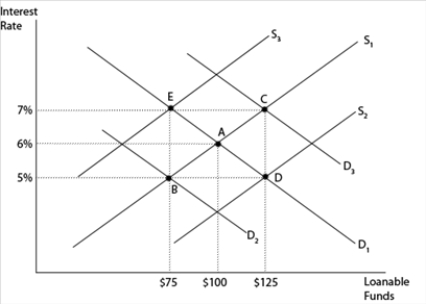 -Refer to Figure 26-5. Starting at point A, a change in tax laws that encouraged households to save more would likely cause
 (Multiple Choice)
4.8/5 (77)
(77) Late in the 2000-2009 decade, real estate prices in the U.S. fell by a greater percentage than they had fallen since the
(Multiple Choice)
4.8/5 (65)
(65) The income that households have left after paying their taxes and paying for their consumption is known as .
(Essay)
4.8/5 (74)
(74) Suppose the issuer of a bond fails to pay some of the interest or principal that was promised to the bondholders. This failure is referred to as a
(Multiple Choice)
4.9/5 (86)
(86) When the government goes from running a balanced budget to running a budget surplus,
(Multiple Choice)
5.0/5 (72)
(72) What would happen in the market for loanable funds if the government were to increase the tax on interest income?
(Multiple Choice)
4.9/5 (80)
(80) Because of differences in tax treatment, municipal bonds pay a higher interest rate than do corporate bonds.
(True/False)
4.9/5 (85)
(85) An increase in the budget deficit shifts the demand for loanable funds to the right.
(True/False)
4.8/5 (76)
(76) A certificate of indebtedness that specifies the obligations of the borrower to the holder is called a
(Multiple Choice)
4.9/5 (81)
(81) In the terminology of macroeconomics, what's the difference between a saver and an investor?
(Essay)
4.9/5 (67)
(67) Other things the same, as the maturity of a bond becomes longer, the bond will pay
(Multiple Choice)
4.8/5 (78)
(78) 
Filters
- Essay(0)
- Multiple Choice(0)
- Short Answer(0)
- True False(0)
- Matching(0)