



 Chat with AI
Exam 8: Application: the Costs of Taxation

Exam 1: Ten Principles of Economics438 Questions
Exam 2: Thinking Like an Economist620 Questions
Exam 3: Interdependence and the Gains From Trade527 Questions
Exam 4: The Market Forces of Supply and Demand700 Questions
Exam 5: Elasticity and Its Application598 Questions
Exam 6: Supply, Demand, and Government Policies648 Questions
Exam 7: Consumers, Producers, and the Efficiency of Markets547 Questions
Exam 8: Application: the Costs of Taxation514 Questions
Exam 9: Application: International Trade496 Questions
Exam 10: Measuring a Nations Income522 Questions
Exam 11: Measuring the Cost of Living545 Questions
Exam 12: Production and Growth507 Questions
Exam 13: Saving, Investment, and the Financial System567 Questions
Exam 14: The Basic Tools of Finance513 Questions
Exam 15: Unemployment699 Questions
Exam 16: The Monetary System517 Questions
Exam 17: Money Growth and Inflation487 Questions
Exam 18: Open-Economy Macroeconomics: Basic Concepts522 Questions
Exam 19: A Macroeconomic Theory of the Open Economy484 Questions
Exam 20: Aggregate Demand and Aggregate Supply563 Questions
Exam 21: The Influence of Monetary and Fiscal Policy on Aggregate Demand511 Questions
Exam 22: The Short-Run Trade-Off Between Inflation and Unemployment516 Questions
Exam 23: Six Debates Over Macroeconomic Policy372 Questions
Select questions type


When a good is taxed, the tax revenue collected by the government equals the decrease in the welfare of buyers and sellers caused by the tax.
(True/False)
4.8/5  (94)
(94) Figure 8-11  -Refer to Figure 8-11. The price labeled as P2 on the vertical axis represents the
 (Multiple Choice)
4.9/5 (79)
(79) Scenario 8-1
Erin would be willing to pay as much as $100 per week to have her house cleaned. Ernesto's opportunity cost of cleaning Erin's house is $70 per week.
-Refer to Scenario 8-1. If Erin pays Ernesto $90 to clean her house, Erin's consumer surplus is
(Multiple Choice)
4.8/5 (69)
(69) In which of the following instances would the deadweight loss of the tax on airline tickets increase by a factor of 9?
(Multiple Choice)
4.9/5 (68)
(68) Figure 8-3
The vertical distance between points A and C represents a tax in the market.  -Refer to Figure 8-3. The amount of deadweight loss associated with the tax is equal to
 (Multiple Choice)
4.9/5 (81)
(81) Figure 8-9
The vertical distance between points A and C represents a tax in the market.  -Refer to Figure 8-9. The imposition of the tax causes the price paid by buyers to
 (Multiple Choice)
4.7/5 (82)
(82) The larger the deadweight loss from taxation, the larger the cost of government programs.
(True/False)
4.8/5 (94)
(94) If the tax on a good is tripled, the deadweight loss of the tax
(Multiple Choice)
4.7/5 (77)
(77) Suppose that policymakers are considering placing a tax on either of two markets. In Market A, the tax will have a significant effect on the price consumers pay, but it will not affect equilibrium quantity very much. In Market B, the same tax will have only a small effect on the price consumers pay, but it will have a large effect on the equilibrium quantity. Other factors are held constant. In which market will the tax have a larger deadweight loss?
(Multiple Choice)
4.9/5 (69)
(69) Figure 8-8
Suppose the government imposes a $10 per unit tax on a good.  -Refer to Figure 8-8. The government collects tax revenue that is the area
 (Multiple Choice)
4.8/5 (81)
(81) The benefit to sellers of participating in a market is measured by the
(Multiple Choice)
4.9/5 (63)
(63) Figure 8-13  -Refer to Figure 8-13. Suppose the government places a $5 per-unit tax on this good. The per-unit burden of the tax on sellers is
 (Multiple Choice)
4.8/5 (85)
(85) Figure 8-9
The vertical distance between points A and C represents a tax in the market.
-Refer to Figure 8-9. The imposition of the tax causes the price paid by buyers to increase by
-Refer to Figure 8-9. The imposition of the tax causes the price paid by buyers to increase by (Multiple Choice)
4.9/5 (73)
(73) Which of the following statements is correct regarding a tax on a good and the resulting deadweight loss?
(Multiple Choice)
4.9/5 (72)
(72) When a tax is imposed on buyers, consumer surplus decreases but producer surplus increases.
(True/False)
4.8/5 (76)
(76) Figure 8-2
The vertical distance between points A and B represents a tax in the market.  -Refer to Figure 8-2. The imposition of the tax causes the price received by sellers to
 (Multiple Choice)
4.9/5 (89)
(89) Figure 8-28 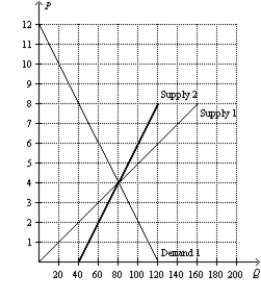 -Refer to Figure 8-28. Suppose that Market A is characterized by Demand 1 and Supply 1, and Market B is characterized by Demand 1 and Supply 2. If an identical tax is imposed on each market, the tax will create a larger deadweight loss in which market? Explain.
 (Essay)
4.9/5 (72)
(72) Taxes on labor tend to encourage second earners to stay at home rather than work in the labor force.
(True/False)
4.9/5 (75)
(75) As the size of a tax increases, the government's tax revenue rises, then falls.
(True/False)
4.8/5 (70)
(70) 
Filters
- Essay(0)
- Multiple Choice(0)
- Short Answer(0)
- True False(0)
- Matching(0)