



 Chat with AI
Exam 8: Application: the Costs of Taxation

Exam 1: Ten Principles of Economics438 Questions
Exam 2: Thinking Like an Economist620 Questions
Exam 3: Interdependence and the Gains From Trade527 Questions
Exam 4: The Market Forces of Supply and Demand700 Questions
Exam 5: Elasticity and Its Application598 Questions
Exam 6: Supply, Demand, and Government Policies648 Questions
Exam 7: Consumers, Producers, and the Efficiency of Markets547 Questions
Exam 8: Application: the Costs of Taxation514 Questions
Exam 9: Application: International Trade496 Questions
Exam 10: Measuring a Nations Income522 Questions
Exam 11: Measuring the Cost of Living545 Questions
Exam 12: Production and Growth507 Questions
Exam 13: Saving, Investment, and the Financial System567 Questions
Exam 14: The Basic Tools of Finance513 Questions
Exam 15: Unemployment699 Questions
Exam 16: The Monetary System517 Questions
Exam 17: Money Growth and Inflation487 Questions
Exam 18: Open-Economy Macroeconomics: Basic Concepts522 Questions
Exam 19: A Macroeconomic Theory of the Open Economy484 Questions
Exam 20: Aggregate Demand and Aggregate Supply563 Questions
Exam 21: The Influence of Monetary and Fiscal Policy on Aggregate Demand511 Questions
Exam 22: The Short-Run Trade-Off Between Inflation and Unemployment516 Questions
Exam 23: Six Debates Over Macroeconomic Policy372 Questions
Select questions type


Figure 8-21  -Refer to Figure 8-21. Suppose the market is represented by Demand 1 and Supply 1. At first the government places a $3 per-unit tax on this good. Then the government decides to raise the tax to $6 per unit. How would you characterize the decision to raise the tax rate from $3 to $6 per unit? The decision is
 (Multiple Choice)
4.8/5  (89)
(89) Which of the following scenarios is consistent with the Laffer curve?
(Multiple Choice)
4.8/5 (59)
(59) In 1776, the American Revolution was sparked by anger over
(Multiple Choice)
5.0/5 (68)
(68) Tom walks Bethany's dog once a day for $50 per week. Bethany values this service at $60 per week, while the opportunity cost of Tom's time is $30 per week. The government places a tax of $35 per week on dog walkers. After the tax, what is the total surplus?
(Multiple Choice)
4.7/5 (84)
(84) Assume that for good X the supply curve for a good is a typical, upward-sloping straight line, and the demand curve is a typical downward-sloping straight line. If the good is taxed, and the tax is doubled, the
(Multiple Choice)
4.7/5 (80)
(80) When a tax is placed on a product, the price paid by buyers
(Multiple Choice)
4.8/5 (91)
(91) Figure 8-2
The vertical distance between points A and B represents a tax in the market.  -Refer to Figure 8-2. The amount of the tax on each unit of the good is
 (Multiple Choice)
4.9/5 (86)
(86) Suppose the demand curve and the supply curve in a market are both linear, and suppose the price elasticity of supply is 0.5. Will the deadweight loss from a $3 tax per unit be larger if the price elasticity of demand is 0.3 or if the price elasticity of demand is 0.7?
(Essay)
4.8/5 (79)
(79) Assume the price of gasoline is $2.40 per gallon, and the equilibrium quantity of gasoline is 12 million gallons per day with no tax on gasoline. Starting from this initial situation, which of the following scenarios would result in the largest deadweight loss?
(Multiple Choice)
4.9/5 (77)
(77) Scenario 8-2
Roland mows Karla's lawn for $25. Roland's opportunity cost of mowing Karla's lawn is $20, and Karla's willingness to pay Roland to mow her lawn is $28.
-Refer to Scenario 8-2. If Karla hires Roland to mow her lawn, Karla's consumer surplus is
(Multiple Choice)
4.9/5 (80)
(80) Figure 8-9
The vertical distance between points A and C represents a tax in the market.  -Refer to Figure 8-9. The per-unit burden of the tax on sellers is
 (Multiple Choice)
4.9/5 (94)
(94) Figure 8-1  -Refer to Figure 8-1. Suppose the government imposes a tax of P' - P'''. Total surplus after the tax is measured by the area
 (Multiple Choice)
5.0/5 (84)
(84) Tax revenue equals the size of the tax multiplied by the quantity sold in the market after the tax is levied.
(True/False)
4.9/5 (77)
(77) Suppose a tax is imposed on baseball bats. In which of the following cases will the tax cause the equilibrium quantity of baseball bats to shrink by the smallest amount?
(Multiple Choice)
4.9/5 (75)
(75) Figure 8-29 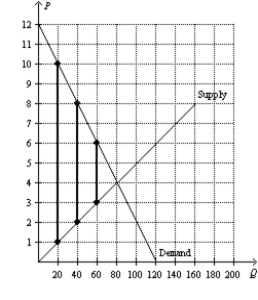 -Refer to Figure 8-29. As the size of the tax increases from $3 to $6 to $9, what happens to tax revenues?
 (Essay)
5.0/5 (80)
(80) Figure 8-25  -Refer to Figure 8-25. Suppose the government places a $4 tax per unit on this good. How much is the deadweight loss from this tax?
 (Essay)
4.8/5 (84)
(84) Figure 8-7
The vertical distance between points A and B represents a tax in the market.  -Refer to Figure 8-7. The deadweight loss associated with this tax amounts to
 (Multiple Choice)
4.9/5 (79)
(79) 
Filters
- Essay(0)
- Multiple Choice(0)
- Short Answer(0)
- True False(0)
- Matching(0)