



 Chat with AI
Exam 8: Application: the Costs of Taxation

Exam 1: Ten Principles of Economics438 Questions
Exam 2: Thinking Like an Economist620 Questions
Exam 3: Interdependence and the Gains From Trade527 Questions
Exam 4: The Market Forces of Supply and Demand700 Questions
Exam 5: Elasticity and Its Application598 Questions
Exam 6: Supply, Demand, and Government Policies648 Questions
Exam 7: Consumers, Producers, and the Efficiency of Markets547 Questions
Exam 8: Application: the Costs of Taxation514 Questions
Exam 9: Application: International Trade496 Questions
Exam 10: Measuring a Nations Income522 Questions
Exam 11: Measuring the Cost of Living545 Questions
Exam 12: Production and Growth507 Questions
Exam 13: Saving, Investment, and the Financial System567 Questions
Exam 14: The Basic Tools of Finance513 Questions
Exam 15: Unemployment699 Questions
Exam 16: The Monetary System517 Questions
Exam 17: Money Growth and Inflation487 Questions
Exam 18: Open-Economy Macroeconomics: Basic Concepts522 Questions
Exam 19: A Macroeconomic Theory of the Open Economy484 Questions
Exam 20: Aggregate Demand and Aggregate Supply563 Questions
Exam 21: The Influence of Monetary and Fiscal Policy on Aggregate Demand511 Questions
Exam 22: The Short-Run Trade-Off Between Inflation and Unemployment516 Questions
Exam 23: Six Debates Over Macroeconomic Policy372 Questions
Select questions type


Figure 8-9
The vertical distance between points A and C represents a tax in the market.  -Refer to Figure 8-9. The producer surplus without the tax is
 (Multiple Choice)
4.9/5  (67)
(67) Figure 8-4
The vertical distance between points A and B represents a tax in the market.  -Refer to Figure 8-4. The per-unit burden of the tax on buyers is
 (Multiple Choice)
4.9/5 (79)
(79) When a good is taxed, the deadweight loss is larger the more elastic are demand and supply.
(True/False)
4.9/5 (75)
(75) Figure 8-1  -Refer to Figure 8-1. Suppose the government imposes a tax of P' - P'''. Total surplus before the tax is measured by the area
 (Multiple Choice)
4.9/5 (66)
(66) Scenario 8-3
Suppose the market demand and market supply curves are given by the equations:  -Refer to Scenario 8-3. Suppose that a tax of T is placed on buyers so that the demand curve becomes:
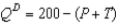 If T = 40, what price will buyers pay and what price will sellers receive?
-Refer to Scenario 8-3. Suppose that a tax of T is placed on buyers so that the demand curve becomes: If T = 40, what price will buyers pay and what price will sellers receive? (Essay)
4.8/5 (87)
(87) Figure 8-8
Suppose the government imposes a $10 per unit tax on a good.  -Refer to Figure 8-8. After the tax goes into effect, consumer surplus is the area
 (Multiple Choice)
4.9/5 (73)
(73) Figure 8-3
The vertical distance between points A and C represents a tax in the market.  -Refer to Figure 8-3. Which of the following equations is valid for the tax revenue that the tax provides to the government?
 (Multiple Choice)
4.8/5 (78)
(78) The elasticities of the supply and demand curves in the market for cigarettes affect how much a tax distorts that market.
(True/False)
4.8/5 (78)
(78) The benefit that government receives from a tax is measured by
(Multiple Choice)
4.8/5 (68)
(68) Diana is a personal trainer whose client Charles pays $80 per hour-long session. Charles values this service at $100 per hour, while the opportunity cost of Diana's time is $75 per hour. The government places a tax of $10 per hour on personal trainers. Before the tax, what is the total surplus?
(Multiple Choice)
4.8/5 (78)
(78) Figure 8-4
The vertical distance between points A and B represents a tax in the market.
-Refer to Figure 8-4. The equilibrium price before the tax is imposed is
-Refer to Figure 8-4. The equilibrium price before the tax is imposed is (Multiple Choice)
4.9/5 (62)
(62) Figure 8-25  -Refer to Figure 8-25. Suppose the government places a $4 tax per unit on this good. How many units of this good will be bought and sold after the tax is imposed?
 (Essay)
4.8/5 (84)
(84) The deadweight loss from a $3 tax will be largest in a market with
(Multiple Choice)
4.8/5 (74)
(74) Figure 8-4
The vertical distance between points A and B represents a tax in the market.
-Refer to Figure 8-4. The price that sellers effectively receive after the tax is imposed is
-Refer to Figure 8-4. The price that sellers effectively receive after the tax is imposed is (Multiple Choice)
4.9/5 (80)
(80) Suppose that instead of a supply-demand diagram, you are given the following information:
Qs = 100 + 3P Qd = 400 - 2P
From this information compute equilibrium price and quantity. Now suppose that a tax is placed on buyers so that
Qd = 400 - 2P + T).
If T = 15, solve for the new equilibrium price and quantity. Note: P is the price received by sellers and P + T is the price paid by buyers.) Compare these answers for equilibrium price and quantity with your first answers. What does this show you?
(Essay)
4.8/5 (78)
(78) Figure 8-14  -Refer to Figure 8-14. Which of the following statements is not correct?
 (Multiple Choice)
4.8/5 (76)
(76) Figure 8-7
The vertical distance between points A and B represents a tax in the market.  -Refer to Figure 8-7. As a result of the tax, consumer surplus decreases by
 (Multiple Choice)
4.9/5 (76)
(76) When a tax is imposed on a good for which the demand is relatively elastic and the supply is relatively inelastic,
(Multiple Choice)
4.8/5 (67)
(67) 
Filters
- Essay(0)
- Multiple Choice(0)
- Short Answer(0)
- True False(0)
- Matching(0)