



 Chat with AI
Exam 23: Aggregate Demand and Aggregate Supply

Exam 1: Ten Principles of Economics438 Questions
Exam 2: Thinking Like an Economist620 Questions
Exam 3: Interdependence and the Gains From Trade527 Questions
Exam 4: The Market Forces of Supply and Demand700 Questions
Exam 5: Elasticity and Its Application598 Questions
Exam 6: Supply, Demand, and Government Policies648 Questions
Exam 7: Consumers, Producers, and the Efficiency of Markets550 Questions
Exam 8: Application: The Costs of Taxation514 Questions
Exam 9: Application: International Trade496 Questions
Exam 10: Externalities522 Questions
Exam 11: Public Goods and Common Resources434 Questions
Exam 12: The Costs of Production420 Questions
Exam 13: Firms in Competitive Markets543 Questions
Exam 14: Monopoly637 Questions
Exam 15: Measuring a Nations Income522 Questions
Exam 16: Measuring the Cost of Living545 Questions
Exam 17: Production and Growth507 Questions
Exam 18: Saving, Investment, and the Financial System567 Questions
Exam 19: The Basic Tools of Finance513 Questions
Exam 20: Unemployment699 Questions
Exam 21: The Monetary System518 Questions
Exam 22: Money Growth and Inflation487 Questions
Exam 23: Aggregate Demand and Aggregate Supply563 Questions
Exam 24: The Influence of Monetary and Fiscal Policy on Aggregate Demand512 Questions
Select questions type


Part of the explanation for why the aggregate-demand curve slopes downward is that a decrease in the price level
(Multiple Choice)
4.9/5  (80)
(80) In response to a decrease in output, the economy would revert to its original level of prices and output whether the decrease in output was caused by a decrease in aggregate demand or a decrease in short-run aggregate supply.
(True/False)
4.8/5 (91)
(91) When the price level increases, the real value of people's money holdings
(Multiple Choice)
4.8/5 (86)
(86) Financial Crisis
Suppose that banks are less able to raise funds and so lend less. Consequently, because people and households are less able to borrow, they spend less at any given price level than they would otherwise. The crisis is persistent so lending should remain depressed for some time.
-Refer to Financial Crisis. Suppose the economy reaches long-run equilibrium without the Fed responding. Now suppose the financial crisis ends and the ability of banks to lend returns to normal. In which case is the price level lower compared to its value prior to the crisis?
(Multiple Choice)
4.8/5 (71)
(71) Figure 33-17. 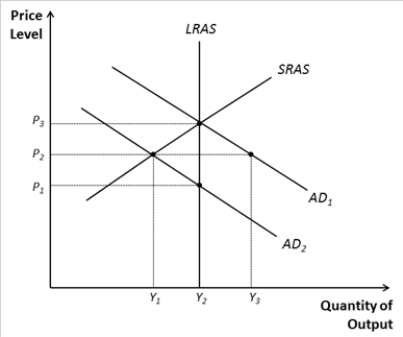 -Refer to Figure 33-17. Suppose the economy starts at P3 and Y2. Explain how government purchases would need to change to move the economy to P2 and Y1. What about taxes?
 (Short Answer)
4.8/5 (64)
(64) The aggregate demand and aggregate supply model implies monetary neutrality
(Multiple Choice)
4.9/5 (82)
(82) The misperceptions theory of the short-run aggregate supply curve says that if the price level is higher than people expected, then some firms believe that the relative price of what they produce has
(Multiple Choice)
4.7/5 (92)
(92) In which case can we be sure aggregate demand shifts left overall?
(Multiple Choice)
4.9/5 (77)
(77) At the end of World War II many European countries were rebuilding and so were eager to buy capital goods and had rising incomes. We would expect that the rebuilding increased aggregate demand in
(Multiple Choice)
4.8/5 (75)
(75) The wealth effect, interest-rate effect, and exchange-rate effect are all explanations for
(Multiple Choice)
4.9/5 (78)
(78) Suppose that a decrease in the demand for goods and services pushes the economy into recession. What happens to the price level? If the government does nothing, what ensures that the economy still eventually gets back to the natural rate of output?
(Essay)
4.8/5 (76)
(76) When the price level changes, which of the following variables will change and thereby cause a change in the aggregate quantity of goods and services demanded?
(Multiple Choice)
4.9/5 (74)
(74) Which of the following shifts aggregate demand to the left?
(Multiple Choice)
5.0/5 (69)
(69) Other things the same, the aggregate quantity of goods demanded decreases if
(Multiple Choice)
4.8/5 (91)
(91) Other things the same, as the price level falls, the exchange rate rises. A rise in the exchange rate leads to a decrease in net exports.
(True/False)
4.8/5 (88)
(88) Figure 33-6. 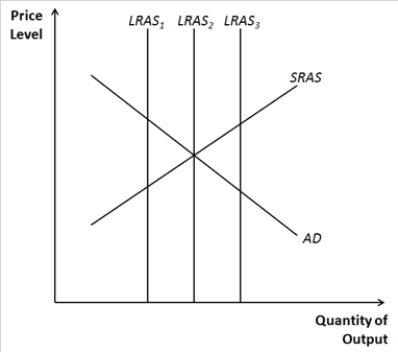 -Refer to Figure 33-6. Which of the long-run aggregate-supply curves is consistent with a short-run economic expansion?
 (Multiple Choice)
4.9/5 (88)
(88) Other things the same, as the price level rises, exchange rates
(Multiple Choice)
4.7/5 (80)
(80) 
Filters
- Essay(0)
- Multiple Choice(0)
- Short Answer(0)
- True False(0)
- Matching(0)